Benefits under the Civil Service Retirement System (CSRS) 2026

Get Form
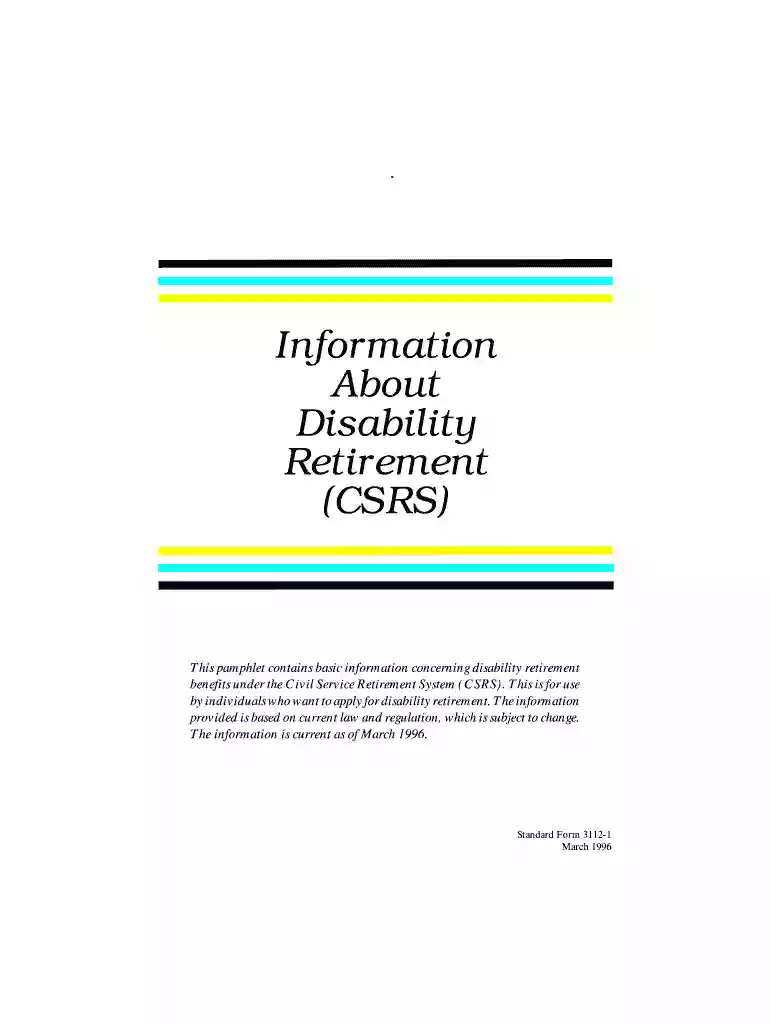
benefits under the Civil Service Retirement System (CSRS) Preview on Page 1

Here's how it works

01. Edit your form online
Type text, add images, blackout confidential details, add comments, highlights and more.

02. Sign it in a few clicks
Draw your signature, type it, upload its image, or use your mobile device as a signature pad.

03. Share your form with others
Send it via email, link, or fax. You can also download it, export it or print it out.

Overview of the Civil Service Retirement System (CSRS)

The Civil Service Retirement System (CSRS) is a defined benefit retirement plan for federal employees, providing a range of retirement, disability, and survivor benefits. Established before the Federal Employees Retirement System (FERS), CSRS caters to those who entered federal service before 1984. Understanding the nuanced benefits under CSRS is essential for eligible federal employees nearing retirement or managing retirement planning.

Eligibility Criteria for CSRS Benefits

To qualify for benefits under CSRS, employees must meet specific eligibility requirements. Generally, only federal employees who began service before January 1, 1984, and have not opted into FERS are eligible for CSRS. Eligibility is contingent on years of service, and retirement age varies by category:


  • Optional Retirement: Employees with at least 30 years of service can retire at age 55.
  • Early Retirement: Those with a minimum of 20 years of service may retire at age 60.
  • Deferred Retirement: Employees who leave federal service before retiring can receive benefits at age 62 if they have at least five years of creditable service.
decoration image ratings of Dochub

Understanding CSRS Benefits

CSRS offers a robust set of benefits, including retirement annuities based on a formula considering the employee's years of service and highest salary:

  • Annuity Computation: The annuity is calculated using the employee’s years of service and average salary during the highest three consecutive earning years.
  • Cost-of-Living Adjustments (COLAs): Annuities are adjusted annually to keep pace with inflation.

Additionally, CSRS participants do not pay Social Security taxes on their earnings as federal employees under CSRS, but may qualify for Social Security benefits based on other employment history.

Application Process and Approval Time

Applying for CSRS benefits requires careful preparation and submission of various forms and documents. The process includes:

  1. Submission of Standard Form 2801: This is the primary application for retirement under CSRS.
  2. Filing Supporting Documents: Include proof of federal service, birth date, and any applicable military service records.
  3. Processing Timeline: Generally takes six to eight weeks, but can vary based on workload and completeness of the application.

Required Documents for CSRS Retirement

Applicants must provide comprehensive documentation to ensure a smooth processing of their CSRS benefits. Required documents often include:

  • Standard Form 2801: Main application for immediate retirement.
  • Proof of Age: Such as a birth certificate or passport.
  • Marriage Certificate: If applying for survivor benefits or spousal annuity.

State-Specific Aspects of CSRS

While CSRS is a federal program, retirement benefits can be influenced by state laws in terms of taxation and eligibility for additional state-provided benefits. For instance:

  • Some states offer additional tax benefits or exemptions for CSRS pensions.
  • Laws related to property division in divorce can variably affect CSRS benefits.

Digital vs. Paper Submissions

Employees have the choice to file their CSRS retirement applications digitally or via paper. While traditional paper applications remain available, digital submissions offer certain advantages:

  • Efficiency: Reducing postal delays and potential for lost documents.
  • Tracking: Easier monitoring of application status through government portals.

Common Use Cases of CSRS Benefits

CSRS benefits serve various scenarios, catering mainly to retired federal employees and their survivors, such as:

  • Retirement Income: Providing a stable pension to retirees.
  • Disability Benefits: Offering financial support to federal employees unable to continue working due to disability.
  • Survivor Benefits: Ensuring financial security for the surviving spouses and children of deceased federal employees.

Important Filing Deadlines for CSRS

To optimize benefits and ensure uninterrupted coverage, consider these essential deadlines:

  • Filing for Retirement: Must be submitted to the Office of Personnel Management (OPM) no later than 60 days before the planned retirement date.
  • Changes in Benefits: Any adjustments or elections, such as choosing a survivor annuity, must be made before the start of retirement benefits.

By diligently following these processes and understanding the detailed requirements, employees can maximize their benefits under the CSRS and ensure a seamless transition into retirement.

be ready to get more

Complete this form in 5 minutes or less

Get form

Got questions?

We have answers to the most popular questions from our customers. If you can't find an answer to your question, please contact us.
Contact us
Ideally, you want to retire on the final day of the pay period to get credit for all accrued annual leave. Retiring too early in a pay period could result in forfeiting the 8 hours of annual leave earned in that final pay period. Saturdays matter here, even though they are not a business day.
However, FERS benefits are often less generous than CSRS retirement benefits. For instance, CSRS allows all retirees to receive the same retirement annuity as long as they retire at 55 or later. On the other hand, FERS reduces your retirement annuity for anyone retiring below the age of 62.
Your monthly checks from CSRS wont start until you turn 62. Your monthly annuity amount is based on your pay when you leave. With inflation, those dollars wont buy as much by the time you receive them at age 62. You cant continue your health or life insurance as a retiree, either.
Upcoming CSRS Webinar CSRS is known as a defined benefit plan, which is when an employer provides a guaranteed income stream for life to eligible employees, when they retire.
Under CSRS rules, the maximum allowable yearly annuity cannot exceed 80 percent of an annuitants high-three average. This limit is docHubed when an annuitants years of service amount to 41 years and 11 months.

Security and compliance

At DocHub, your data security is our priority. We follow HIPAA, SOC2, GDPR, and other standards, so you can work on your documents with confidence.
Learn more
ccpa2
pci-dss
gdpr-compliance
hipaa
soc-compliance

People also ask

If you retire under the Civil Service Retirement System (CSRS), the maximum survivor benefit payable is 55 percent of your unreduced annual benefit. If you retire under the Federal Employees Retirement System (FERS), the maximum survivor benefit payable is 50 percent of your unreduced annual benefit.

Related links