




01. Edit your sf 2805 online
Type text, add images, blackout confidential details, add comments, highlights and more.

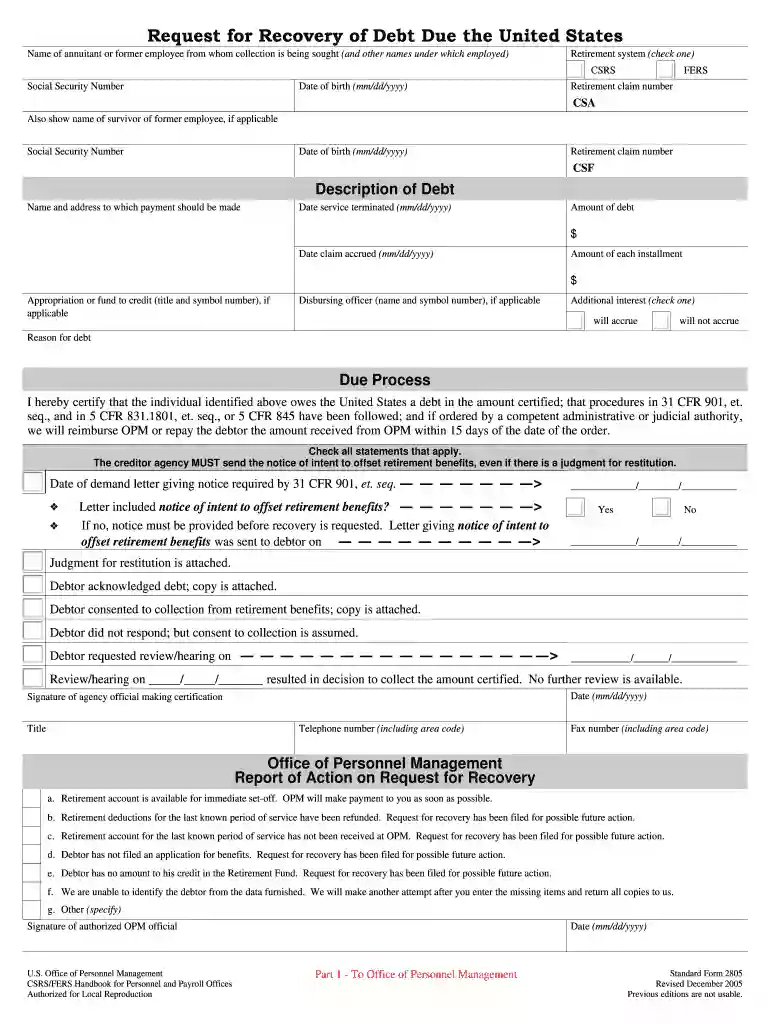
Type text, add images, blackout confidential details, add comments, highlights and more.

Draw your signature, type it, upload its image, or use your mobile device as a signature pad.

Send it via email, link, or fax. You can also download it, export it or print it out.
The "retirement - Federal Register" refers to a formal document published in the Federal Register concerning retirement-related regulations, policies, or announcements specific to the United States federal system. It provides comprehensive details about the rules and processes for federal retirement systems, focusing on updates and clarifications relevant to federal employees, retirees, and annuitants. Understanding the definitions and the context of these documents is vital for anyone navigating federal retirement processes.
Federal Register publications offer transparency and communicate changes in regulations or policies to the public. As such, these documents play a crucial role in ensuring that federal annuitants, employees, and other stakeholders are informed about their rights, responsibilities, and the procedures they must follow.
Using the retirement-related documents from the Federal Register requires familiarity with navigating formal government publications. Here are the primary steps to effectively utilize these documents:
Research Specific Sections: Start by identifying the specific sections or entries that pertain to your interest or current situation. The Federal Register includes a table of contents that can guide you to relevant areas.
Interpret Regulations: Carefully examine the regulatory text to understand how it applies to your retirement situation. Pay close attention to subheadings, legal references, and contextual notes.
Apply Information Practically: Use the insights to make informed decisions about federal retirement benefits, updating existing plans as necessary to remain compliant with changing regulations.
Real-world applications might include ensuring your retirement application aligns with new provisions or updating your beneficiaries according to recent amendments.
Ensuring completeness and accuracy while filling out any retirement-related form announced in the Federal Register is crucial. Follow these sequential steps:
Gather Necessary Information: Collect all personal data, employment history, and relevant identification numbers.
Understand Instructions: Thoroughly read the form instructions provided in the Federal Register to grasp common terminologies and required fields.
Complete Each Section Carefully: Fill in the required information with precision. Pay attention to sections requiring detailed explanations to avoid discrepancies.
Review and Verify: Double-check all entered information for accuracy. Mistakes can delay processing or lead to incorrect benefit calculations.
Submit According to Guidelines: Refer to submission protocols for online or mail-in forms, ensuring adherence to deadlines and required supporting documents.
The "retirement - Federal Register" encompasses several critical components:
Personal Identification: This includes your full name, social security number, and federal employee identification.
Employment and Retirement Details: Document your federal service history, retirement system, and type of benefits applied for.
Debt Recovery Information: If applicable, include information related to any outstanding debts or current offsets against retirement benefits.
Signatures and Declarations: Ensure that all declarations are signed. These signatures confirm the accuracy and authenticity of provided information.
Understanding key terms is vital when engaging with the Federal Register concerning retirement:
Annuity: A series of payments made regularly to a retiree or annuitant, often from a pension or retirement savings.
Annuitant: A person who receives these regular payments after retirement from federal service.
Offset: A deduction from retirement benefits due to debts or overpayments incurred during service.
These terms are crucial in communicating effectively and comprehending policies within retirement-related federal documents.
The legal implications of using documents referred to in the "retirement - Federal Register" primarily encompass compliance with federal law:
Adherence to Federal Guidelines: Ensure all actions and applications align with the legal standards set forth in the Federal Register.
Due Process: Understand your rights concerning appeals or disputes, particularly in debt recovery scenarios.
Confidentiality and Security: Safeguard personal information while sharing or submitting any related forms or applications.
Different states may have specific nuances regarding the application of federal retirement policies:
State Tax Implications: Consider how state taxation affects federal retirement benefits or if unique provisions apply.
Local Legal Aid and Guidance: Certain states offer additional resources or advocacy services to assist retirees.
Practical examples of using the Federal Register for retirement purposes include:
Amending Retirement Plans: A federal employee revisiting their pension distribution method following updates in the Federal Register.
Resolving Benefits Discrepancies: A retiree addressing inconsistencies in benefits calculation after new federal guidelines are published.
Successful navigation of these documents requires a keen eye for detail and clarity in understanding legal language and procedural expectations.
We've got more versions of the sf 2805 form. Select the right sf 2805 version from the list and start editing it straight away!
| Versions | Form popularity | Fillable & printable |
|---|---|---|
| 2005 | 4.8 Satisfied (87 Votes) |
At DocHub, your data security is our priority. We follow HIPAA, SOC2, GDPR, and other standards, so you can work on your documents with confidence.

Jun 23, 2026 In this edition of the Federal Register , OPM also publishes a notice to revise the normal cost percentage under the Federal EmployeesRead more
Retirement Governments and tax-exempt bonds virtual currency is treated as property for federal income tax purposes


