Definition and Meaning of Incident Replacement Requisition - GSA
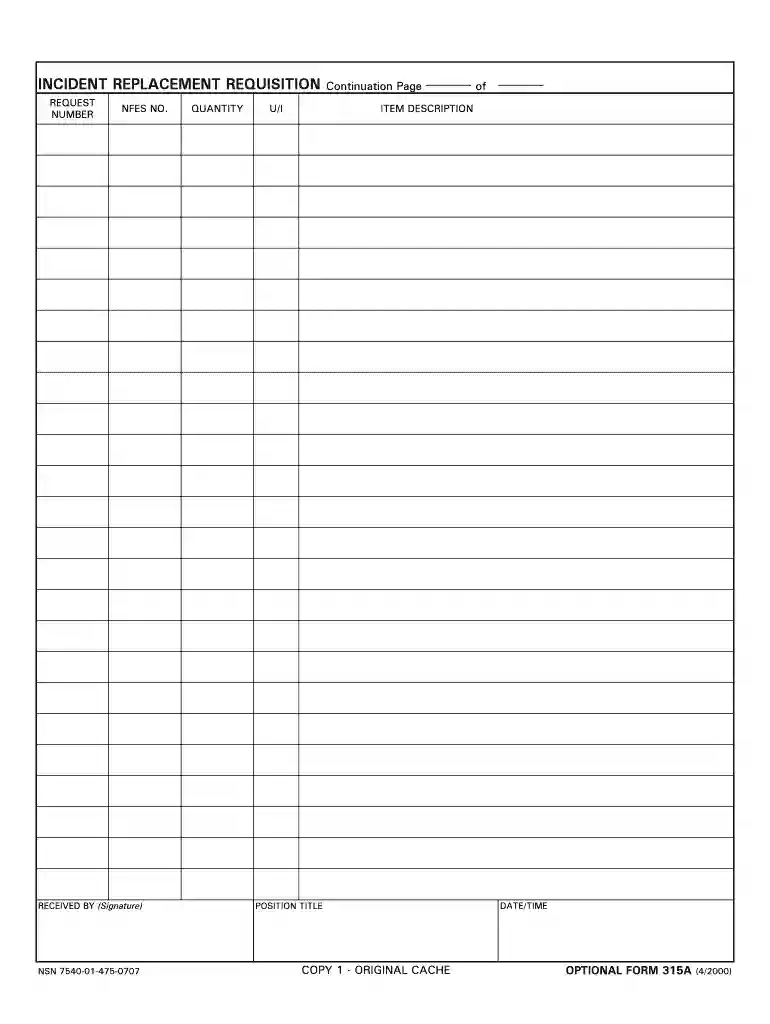
The "Incident Replacement Requisition - GSA" form is an essential tool used primarily by government agencies to request supplies that have been consumed or replaced during an incident response. This form ensures that all necessary items, such as equipment or materials, are accounted for and restocked efficiently after an emergency or planned operation. It serves to document the exact nature and number of items required, providing a clear and standardized method for inventory replenishment.
Key Components of the Form
- Request Number: A unique identifier assigned to each requisition to track requests and ensure accurate processing.
- NFES and NSN Numbers: These standardized identification codes represent specific items within the National Fire Equipment System and National Stock Number system.
- Quantity and Item Description: Detailed records of the amount and nature of supplies needed, ensuring clarity in communication and orders.
- Position Title and Date/Time: Captures when and by whom the form is filled out, providing accountability and traceability.
Steps to Complete the Incident Replacement Requisition - GSA
Follow the step-by-step process to accurately fill out the requisition form.
- Filling Out Request Details: Start by inputting the unique request number, ensuring correct tracking.
- Entering NFES/NSN Numbers: Utilize the catalogue or database to find and record the correct National Fire Equipment System (NFES) or National Stock Number (NSN).
- Specifying Quantities and Descriptions: List the precise quantity of each item and provide comprehensive descriptions to avoid miscommunication.
- Documenting Submission Information: Include the position title of the person completing the form and note the exact date and time of submission.
- Verification and Submission: Double-check all details for accuracy before submitting via the prescribed method, whether electronically or in hard copy.
Common Mistakes to Avoid
- Inaccurate NFES/NSN Entries: Ensure all codes correspond to the correct items to avoid delays.
- Incomplete Item Descriptions: Always provide detailed item descriptions to prevent any mix-ups in orders.
- Missing or Incorrect Dates: Double-check to ensure accurate date and time entries to maintain the integrity of records.
How to Obtain the Incident Replacement Requisition - GSA
To access the form, you should reach out to the relevant department within a federal or state agency responsible for supply management or incident response logistics.
Methods of Distribution
- Digital Access: The form might be available for download from official email communications or dedicated government websites.
- Physical Copies: Some agencies might provide printed copies during training sessions or in logistical centers.
Who Typically Uses the Incident Replacement Requisition - GSA
The primary users of this form include federal and state agency personnel involved in incident management and logistics.

Specific User Groups
- Emergency Response Teams: Personnel from emergency services who need to replace consumed equipment quickly.
- Logistic Coordinators: Specialists responsible for managing supply counts and ensuring the availability of resources.
- Government Supply Officers: Individuals who monitor stock levels and facilitate the replenishment process.
Important Terms Related to the Incident Replacement Requisition - GSA
Understanding crucial terms related to this form enhances effective use and communication.
- Requisition: A formal request for the procurement of items or services.
- Incident Command System: A standardized approach to command, control, and coordination of emergency response.
- Inventory Management: The process of ordering, storing, and using a company's inventory—includes supplies and equipment.
Legal Use of the Incident Replacement Requisition - GSA
The proper and legal use of this form is imperative to ensure accountability and control over public resources.
Compliance Guidelines
- Authorization: Only authorized staff should complete and approve requisitions.
- Documentation: Retain copies of completed forms as part of the official record, ensuring compliance with agency guidelines.
- Audit Trails: Maintain clear records for audit purposes, showcasing transparency and proper resource management.
Key Elements of the Incident Replacement Requisition - GSA
Several critical components must be accurately completed to ensure the requisition is processed correctly.
Essential Elements
- Complete and Accurate Data: Ensure all fields are filled out with precise information.
- Clear Justification: Provide thorough reasoning for each item’s necessity, supporting the legitimacy of the request.
- Approval Signatures: Obtain required approvals to validate and proceed with the requisition process.
Examples of Using the Incident Replacement Requisition - GSA
Examining real-world scenarios enhances understanding and application of the form.
Practical Application Scenarios
- Wildfire Response: After a wildfire operation, teams use the form to requisition replacement hoses and safety gear.
- Natural Disaster Relief: Disaster response teams require new shelter supplies and medical kits, processed through this form.
- Training Exercises: Regular drills may necessitate replacement of training materials, managed efficiently with the form.
By understanding and utilizing the Incident Replacement Requisition - GSA effectively, government agencies can ensure the prompt restocking of critical resources, thereby maintaining efficient and effective incident response operations.