




01. Edit your form online
Type text, add images, blackout confidential details, add comments, highlights and more.

Type text, add images, blackout confidential details, add comments, highlights and more.

Draw your signature, type it, upload its image, or use your mobile device as a signature pad.

Send it via email, link, or fax. You can also download it, export it or print it out.
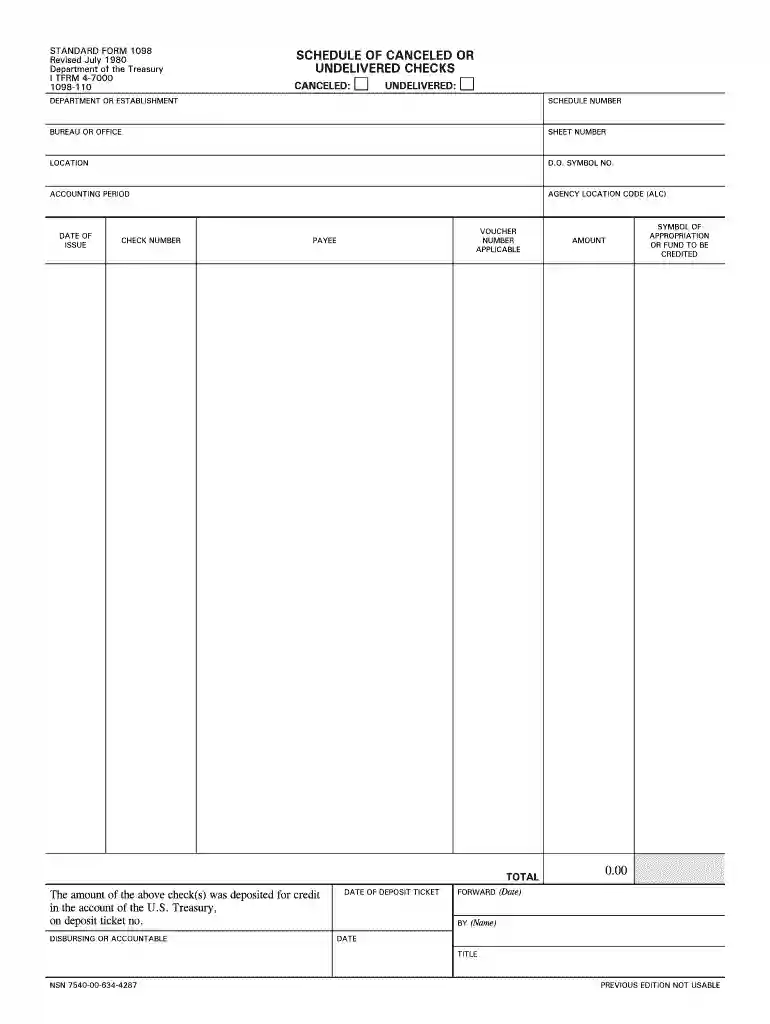
The Standard Form 1098, Schedule of Canceled or Undelivered Checks, July 1980, serves a critical function within financial and governmental institutions. It is primarily utilized by the Department of the Treasury to document checks that remain unresolved within a given timeframe, specifically focusing on canceled or undelivered payments. This form not only maintains the accuracy of financial records but also ensures the proper allocation of funds into the U.S. Treasury account. Accounting personnel and administrative staff typically handle the preparation and submission of this form, helping to maintain transparency and compliance with federal regulations.
Using Standard Form 1098 involves a series of detailed steps that ensure the meticulous recording of canceled or undelivered checks. Users should first gather all relevant documentation related to the check transactions, such as the schedule number, payee information, check numbers, and amounts. Then, they must accurately input these details onto the form, following the specified fields for department information and accounting periods. It is crucial that all input data is checked for accuracy to avoid discrepancies in official records.
Obtaining the Standard Form 1098 can be accomplished through several official channels.
Completing the Standard Form 1098 involves precise adherence to outlined steps, ensuring each section is filled with accurate information:
Utilizing the Standard Form 1098 is essential for ensuring the integrity of financial records and maintaining compliance with Treasury procedures. By systematically documenting undelivered or canceled checks, organizations prevent financial mismanagement and contribute to accurate governmental accounting. This form is especially critical for departments managing large volumes of transactions, providing a formalized method for recording financial discrepancies and facilitating audits.
The primary users of Standard Form 1098 are governmental financial departments responsible for overseeing public funds. Within the Treasury, accounting officers and financial auditors employ this form as part of their routine processes to ensure checks are accurately tracked and reported. It is also significant for individuals in leadership roles managing departmental budgets, ensuring all monetary transactions are transparent and accountable.


Standard Form 1098 is composed of several pivotal components, each essential for comprehensive documentation:
Legal compliance is a foundational aspect of employing the Standard Form 1098. This form helps organizations maintain adherence to federal financial management policies. The documentation of canceled or undelivered checks is a critical element in legal audits and reviews, as it establishes a transparent financial trail. Non-compliance in accurately completing and submitting this form can result in significant financial and legal repercussions, emphasizing its importance in governmental transactions.
To successfully complete and file the Standard Form 1098, several supplementary documents are necessary. These typically include transaction records and supporting documentation indicating why checks were canceled or undelivered. Financial statements, reconciliation records, and previous fiscal reports may also be needed to provide comprehensive context and substantiate the details recorded on the form.
We've got more versions of the Standard Form 1098, Schedule of Canceled or Undelivered Checks, July 1980 form. Select the right Standard Form 1098, Schedule of Canceled or Undelivered Checks, July 1980 version from the list and start editing it straight away!
| Versions | Form popularity | Fillable & printable |
|---|---|---|
| 1980 | 4.8 Satisfied (30 Votes) |
At DocHub, your data security is our priority. We follow HIPAA, SOC2, GDPR, and other standards, so you can work on your documents with confidence.
Standard Form 1098, Schedule of Canceled or Undelivered Checks, July 1980. SCHEDULE OF CANCELED OR UNDELIVERED CHECKS. DATE OF ISSUE CHECK NUMBER PAYEE VOUCHER
Enter your itemized deductions from Schedule A, line 28, or standard deduction shown on the left. But see page 31 to find your standard deduction if you
English Module:UT文本/en t keep maintaining this form./, A form beyond my wildest fantasies./, OUR SHOW RUNS ON A STRICT SCHEDULE./,


