General Terms of Lease - GSA 2026

Get Form
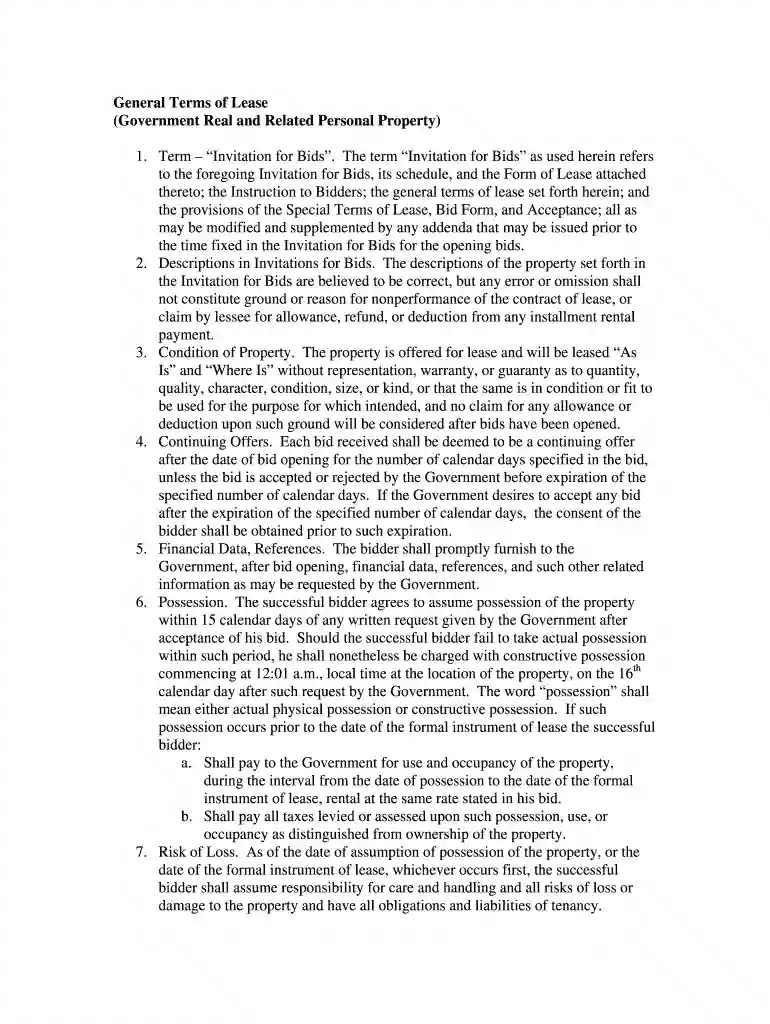
General Terms of Lease - GSA Preview on Page 1

Here's how it works

01. Edit your form online
Type text, add images, blackout confidential details, add comments, highlights and more.

02. Sign it in a few clicks
Draw your signature, type it, upload its image, or use your mobile device as a signature pad.

03. Share your form with others
Send it via email, link, or fax. You can also download it, export it or print it out.

Definition & Meaning

The "General Terms of Lease - GSA" refers to the specific guidelines and conditions set forth by the General Services Administration (GSA) that govern the leasing of government-owned real and related personal property. These terms lay down the framework for how leases are managed, specifying details such as bidding procedures, property conditions, and the legal responsibilities of involved parties. By establishing these guidelines, the GSA ensures that leases are executed with transparency and compliance with federal regulations.

How to Use the General Terms of Lease - GSA

Utilizing the General Terms of Lease effectively involves understanding the lease’s clauses and complying with its stipulations. Begin by thoroughly reviewing the terms, paying close attention to sections on property use, maintenance responsibilities, and risk management. Users should:

  • Identify key clauses relevant to their operations.
  • Review obligations concerning payments and insurance.
  • Familiarize themselves with the process for proposing modifications to the lease.

These steps will streamline lease management and ensure compliance throughout the lease term.

Steps to Complete the General Terms of Lease - GSA

Completing the General Terms of Lease involves several essential steps:

  1. Review the Full Lease Document: Carefully read through the entire lease to understand its provisions and requirements.
  2. Identify Required Signatories: Determine who needs to sign the lease within your organization and ensure they are available for review.
  3. Fill Out Required Sections: Complete all necessary fields, ensuring accuracy and compliance with GSA specifications.
  4. Gather Supplemental Documentation: Prepare any additional documents that need to accompany the lease, such as insurance certificates.
  5. Submit for Review and Approval: Pass the completed lease and supporting documents through the appropriate channels for approval.

Key Elements of the General Terms of Lease - GSA

Several key elements define the structure and enforceability of the General Terms of Lease:

  • Possession and Use: Specifies when and how possession of the property is transferred and stipulates approved uses of the property.
  • Risk of Loss: Details who bears responsibility for property damage under various circumstances.
  • Insurance Requirements: Outlines the types and amounts of insurance that must be maintained over the lease term.

These elements ensure clear expectations between the government and lessees and provide a basis for accountability.

Legal Use of the General Terms of Lease - GSA

The General Terms of Lease must be adhered to in accordance with federal laws and regulations. Lessees are expected to:

  • Abide by antitrust laws and prohibitions against contingent fees.
  • Ensure that no undue benefits are provided to government officials.
  • Comply with all applicable regulations as outlined in the acceptance of the bid.

Failure to adhere to these legal obligations can result in penalties or termination of the lease.

Important Terms Related to General Terms of Lease - GSA

Understanding specific terms within the lease is crucial:

  • Bid Acceptance: Confirmation that a submitted bid has been accepted, formalizing the lease agreement.
  • Contingent Fees: Fees conditional on certain events, which are generally prohibited under government leasing agreements.
  • Modification Clauses: Provisions detailing how and when changes to the lease can occur.

Familiarity with these terms aids in navigating the lease process efficiently.

State-Specific Rules for the General Terms of Lease - GSA

While the General Terms of Lease provide a federal framework, some nuances may vary by state:

  • Zoning and Land Use Laws: States may have additional restrictions on property use.
  • State-imposed Fees or Taxes: Variances in state requirements may affect lease costs.

These differences necessitate consultation with legal experts familiar with state-specific leasing regulations to ensure full compliance.

Examples of Using the General Terms of Lease - GSA

Various scenarios illustrate how the General Terms of Lease are applied in real-world situations:

  • A company leasing office space in a GSA-owned building must adhere to guidelines related to property maintenance and usage.
  • Public events held on leased government land require insurance and adherence to risk management protocols as stipulated in the lease.

These examples demonstrate practical applications of the lease terms in everyday operations and the importance of compliance in diverse situations.

be ready to get more

Complete this form in 5 minutes or less

Get form

Got questions?

We have answers to the most popular questions from our customers. If you can't find an answer to your question, please contact us.
Contact us
Lease term: This section specifies the duration of the lease, whether it is for a fixed term (e.g., 11 months, 1 year) or month-to-month. Rent amount and payment terms: The agreement must state the rent amount, due date, payment method, and any penalties for late payments.
Choose a 24-month lease if you value flexibility and expect potential changes in your life. Opt for a 36-month lease if you prioritize cost savings and stability. Ultimately, consider your personal situation, financial goals, and long-term plans when making your decision.
The proper real estate terminology depends on the state and local laws, but generally: Rental agreements are usually short-term or month-to-month. A standard lease is for more extended periods (six months or one year)
In a typical lease option, the prospective buyer-tenant would pay an additional 3% to 5% of the house price per year ($15,000 to $25,000) as an option fee, as well as an additional premium to their monthly rent. In exchange, they would have the option to buy the house in two years, at todays price.
The most common terms for a car lease are 2-3 years. A major benefit to 2-3 year leases is that the vehicle warranty is normally for 36k miles or 3 years, meaning that there is little risk for out-of-pocket repair during the lease.

Security and compliance

At DocHub, your data security is our priority. We follow HIPAA, SOC2, GDPR, and other standards, so you can work on your documents with confidence.

Learn more
ccpa2
pci-dss
gdpr-compliance
hipaa
soc-compliance
be ready to get more

Complete this form in 5 minutes or less

Get form

People also ask

The lease term lays out the period of time that the lessee has the right to use the underlying asset. The lease term is in the lease agreement, along with the lease state date, payment amount, and other special conditions.
GSA leases are structured as gross leases, which simply means that the landlord is responsible for all operating expenses associated with the property.
A lessor may be called a landlord. A lessor is a person or legal entity that owns a property and rents it out to a lessee, who in term pays the lessor to live in their property.

Related links