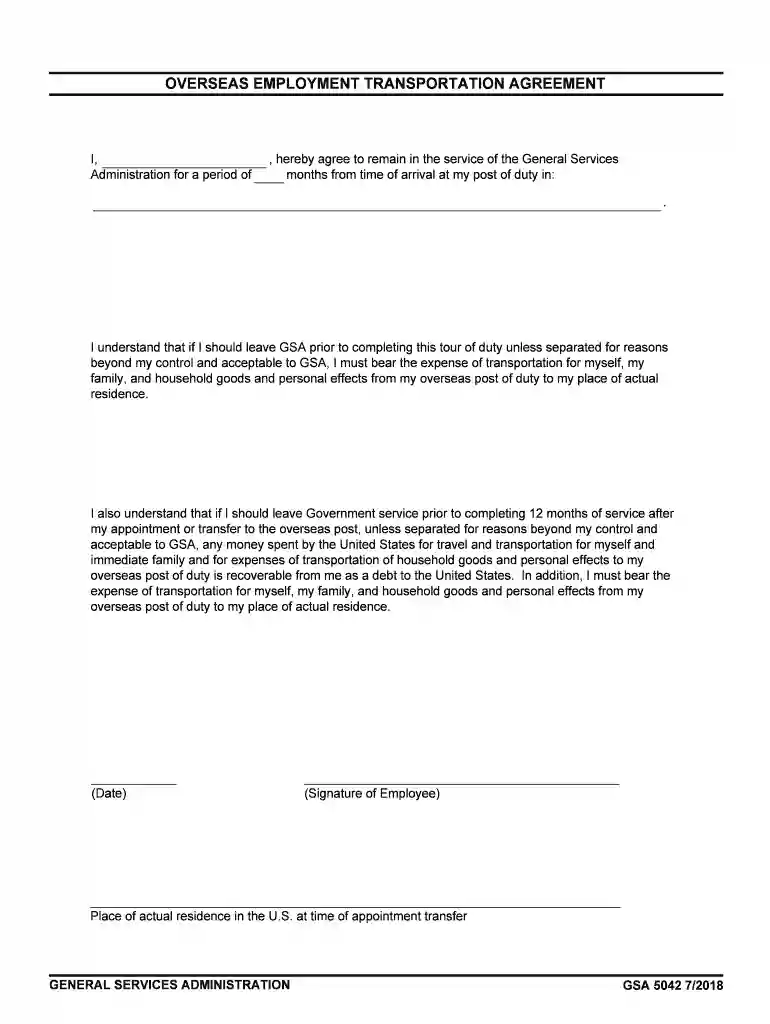
301-1: Overseas EmploymentHHS 2026

Get Form
301-1: Overseas EmploymentHHS Preview on Page 1

Here's how it works

01. Edit your form online
Type text, add images, blackout confidential details, add comments, highlights and more.

02. Sign it in a few clicks
Draw your signature, type it, upload its image, or use your mobile device as a signature pad.

03. Share your form with others
Send it via email, link, or fax. You can also download it, export it or print it out.

Definition & Meaning

The "301-1: Overseas EmploymentHHS" form is a crucial document used in the context of employment agreements, particularly concerning transportation obligations related to overseas assignments. This form outlines the transportation responsibilities that employees have when participating in international roles under the General Services Administration (GSA). Its primary function is to ensure that employees who do not complete their specified service period are aware of their obligation to cover certain transportation costs. This includes any costs incurred for themselves and their families that would otherwise be covered by the U.S. government. It is especially important when addressing scenarios involving early termination of overseas employment contracts.

How to Use the 301-1: Overseas EmploymentHHS

To use the 301-1: Overseas EmploymentHHS form effectively, understanding each section is critical. The form should be reviewed thoroughly to comprehend the employee's responsibilities if the overseas employment is terminated prematurely. Typically, the form will detail the conditions under which transportation expenses need to be reimbursed to the government. This includes understanding scenarios where exemptions may apply, such as separations due to uncontrollable circumstances. Employees are advised to evaluate the financial implications and consider the service duration when entering into such agreements.

Steps to Complete the 301-1: Overseas EmploymentHHS

Completing the 301-1 form involves several well-defined steps:

  1. Read the Guidelines: Begin by reviewing any provided instructions or guidelines associated with the form to ensure all requirements are understood.
  2. Fill Personal Information: Enter accurate personal and employment details, specifying the nature of the overseas assignment.
  3. Specify Duration: Clearly state the agreed service period that the transportation agreement will cover.
  4. Acknowledge Financial Conditions: Review and initial sections that specify financial responsibilities, particularly focusing on conditions that trigger reimbursement of transportation costs.
  5. Sign and Date: Ensure that the document is signed and dated appropriately, confirming acceptance of the terms detailed in the form.

Important Terms Related to 301-1: Overseas EmploymentHHS

Understanding specific terminology used in the 301-1 form can facilitate better comprehension:

  • GSA (General Services Administration): A central management agency that contributes to the effective and efficient functioning of the federal government.
  • Transportation Expenses: Costs associated with the movement of individuals and their families which might be initially covered by the government but can become the employee's responsibility upon early contract termination.
  • Service Requirement: The predetermined period of time an employee must serve in the overseas position to avoid financial penalties.

Key Elements of the 301-1: Overseas EmploymentHHS

The 301-1 form includes several critical components:

  • Employee Obligations: Details the responsibilities of employees in the event of early job termination.
  • Reimbursement Conditions: Specifies scenarios wherein transportation reimbursement to the government is required.
  • Exemption Clauses: Lists uncontrollable circumstances where penalties may be waived.

Legal Use of the 301-1: Overseas EmploymentHHS

The legal implications of the 301-1 form revolve around the employee's commitment to adhere to the specified terms of service. Employees must acknowledge their financial obligations should they resign prematurely. It's crucial for the terms to be legally binding, which ensures the form can be enforced in situations of non-compliance. The form also provides a legal framework within which disputes related to transportation reimbursements can be resolved.

Examples of Using the 301-1: Overseas EmploymentHHS

Consider a scenario where an employee accepts an overseas posting with a 12-month service commitment. If the employee leaves after six months without valid uncontrollable circumstances, they would typically be required to reimburse the government for any incurred transportation expenses. This form is used to clearly outline such obligations, ensuring employees are aware of financial liabilities tied to early termination.

Penalties for Non-Compliance

Failing to adhere to the conditions outlined in the 301-1 form can lead to significant financial repercussions. Employees who do not meet their agreed service period without a valid reason may be required to reimburse the full amount of transportation costs upfront. Ignoring these obligations may also impact an employee's ability to seek future positions within agencies governed by the GSA.

Required Documents

When preparing to submit the 301-1 form, employees should gather pertinent documentation:

  • Employment Contract: Outlining the service period and role.
  • Identification Proof: Typically a government-issued ID.
  • Supporting Documents for Waivers: Any documentation justifying uncontrollable circumstances leading to early termination.

These documents ensure that all aspects of the transportation agreement are properly addressed and substantiated during form submission.

be ready to get more

Complete this form in 5 minutes or less

Get form

Got questions?

We have answers to the most popular questions from our customers. If you can't find an answer to your question, please contact us.
Contact us
The policy, she said, states that, If an employee takes an assignment to an overseas post, then they have a job to return to in the states, but that the typical rotation period shouldnt exceed five years.
Foreign service positions located overseas: The federal government maintains a substantial presence overseas and the positions available cover the entire spectrum of employment. The government needs the skills of engineers, chemists, economists, scientists, security professionals, and more.
Yes, working remotely from another country is possible. In fact, theres never been a time when more people have been working remotely. But youll need to pay attention to visa, tax and other labor laws when working remotely from another country.
How to Check Dual Employment and Employee Moonlighting? Employee Declaration. Reference Checks. Document Verification. Social Media Screening. Third-Party Verification. Regular Audits: Conflict Resolution: Ensuring Undivided Allegiance. Quality Assurance: Consistent Delivery of High-Quality Work.
Federal employees assigned to domestic positions have no authority to telework (even on a short-term basis) from a foreign location without an approved DETO Agreement. All DETO arrangements require Chief of Mission (COM) approval because all DETOs fall under COM authority and security responsibility.

Security and compliance

At DocHub, your data security is our priority. We follow HIPAA, SOC2, GDPR, and other standards, so you can work on your documents with confidence.

Learn more
ccpa2
pci-dss
gdpr-compliance
hipaa
soc-compliance

People also ask

The instruction also states an employee must spend two years in a stateside job after completing an overseas posting before being eligible for another five-year overseas assignment.
A Domestic Employee Teleworking Overseas (DETO) is a United States Government (USG) employee assigned to a domestic position with an alternative work arrangement permitting work to be performed at an approved worksite in an overseas location for a limited period of time.
The FLSA applies to employment within any state of the United States, the District of Columbia or any territory or possession of the United States. An employee working in a foreign country is not protected by the FLSA even though the employer has its main office in the United States.

Related links