







Definition and Meaning
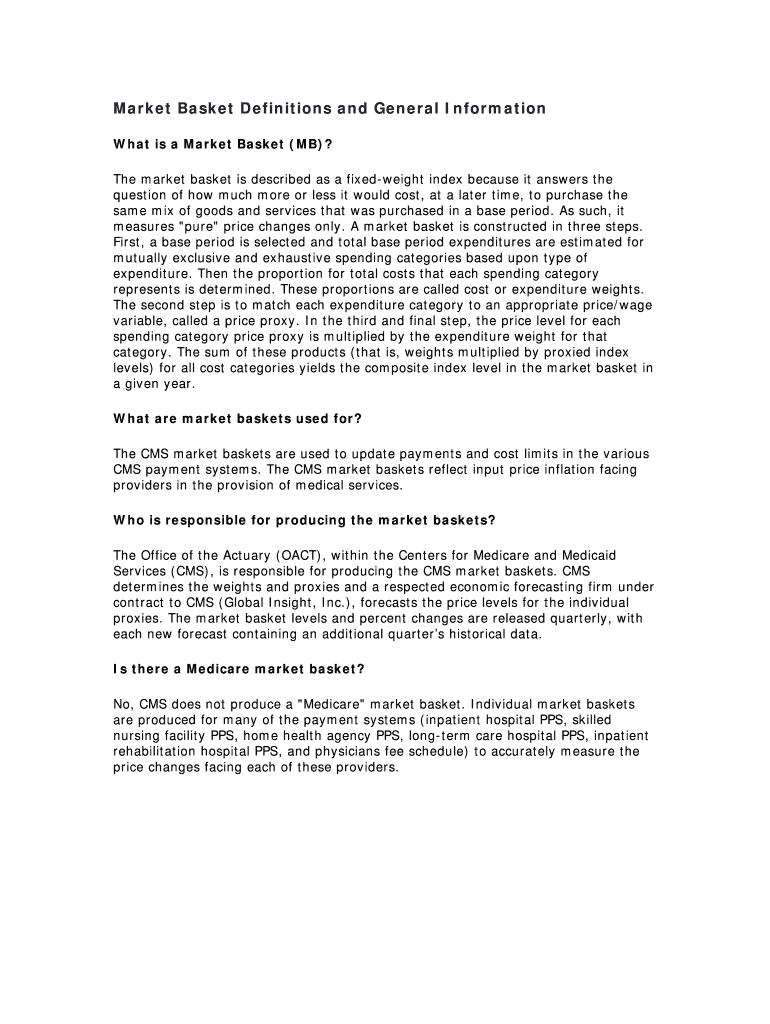
Market baskets are analytical tools used primarily in healthcare payment systems to measure price changes for a fixed mix of goods and services over time. They are vital for ensuring accurate and fair compensation within healthcare systems, specifically through the Centers for Medicare and Medicaid Services (CMS). These tools analyze price fluctuations of goods and services, playing a critical role in adjusting reimbursement rates accurately.
Purpose and Construction
Market baskets serve the purpose of capturing price variations by monitoring a set selection of goods and services. The construction of a market basket involves selecting a representative mix of items, whose prices are tracked over time. This systematic approach aids in understanding inflationary trends within healthcare, allowing for the calibration of payment systems to reflect economic realities.
Steps to Use Market Basket Definitions
- Understand the Basics: Familiarize yourself with the fundamental components, purposes, and mechanisms of market baskets.
- Access Data: Obtain data from tracked goods and services to have a foundational dataset.
- Calculate Changes: Use methodologies for calculating moving averages and forecast errors to understand trends.
- Analyze Trends: Evaluate how changes impact the healthcare economic landscape and financing.
- Implement Adjustments: Adjust healthcare financing models as per the understanding derived from market baskets.
Key Elements of Market Basket Definitions
- Goods and Services Selection: A standardized selection of healthcare goods and services is tracked.
- Data Sources: Utilization of robust data sources, such as federal health data and industry statistics, supporting accurate cost weights and price proxies.
- Rebasing Intervals: Regular updates to the baseline year for tracking changes ensure that market baskets reflect current economic conditions accurately.
Important Components
- Forecast Development: The Office of the Actuary and Global Insight, Inc., collaborate on forecasting updates that occur quarterly.
- Cost Weights and Price Proxies: Essential for understanding how each item contributes to overall healthcare costs.
Legal Use of Market Basket Definitions
Adhering to legal standards is crucial when utilizing market basket information, especially in a U.S. context where specific legislation governs healthcare financing. The market baskets align with federal guidelines and legal requirements for economic assessments within healthcare systems. This ensures transparency and compliance with federal fiscal policies.
Important Terms Related to Market Basket Definitions
- Price Proxies: Utilize alternative data to estimate prices where direct pricing is not available.
- Constant Quantity and Intensity Effects: Methods to measure the pure price effect, isolating any effect due to quantity or service intensity changes.
Who Typically Uses Market Basket Definitions
Market basket information is typically employed by:
- Healthcare Economists: Analyze financial trends related to healthcare services.
- Policy Makers: Formulate healthcare policies that reflect economic conditions.
- Financial Analysts: Ensure that compensation frameworks are fair and reflective of current economic conditions.
- Healthcare Administrators: Adjust budgetary and financial frameworks within healthcare institutions.
Examples of Using Market Basket Definitions
Case Study 1: A healthcare institution uses a market basket to determine if rising costs of medical supplies have led them to adjust patient treatment costs, ensuring they stay within budgetary limits.
Case Study 2: Policymakers adjust Medicare reimbursement rates based on shifts in the market basket index, aligning compensation with current market conditions.
Who Issues the Form
The Centers for Medicare and Medicaid Services (CMS) are primarily responsible for defining and issuing market basket forms. These definitions form part of broader economic assessments to ensure fair and adequate compensation across healthcare services.
State-Specific Rules for Market Basket Definitions
Different states may have specific regulations or policies regarding the application of market baskets in healthcare payment systems. While core principles remain consistent, adjustments may be required based on local economic and regulatory landscapes.
Example
- California: Incorporates state-level economic indicators into its market basket calculations, aligning with both federal and state policy requirements.
This detailed exploration of market basket definitions offers critical insights into their construction, usage, and legal framework, providing comprehensive understanding essential for stakeholders in the healthcare financial domain.




