
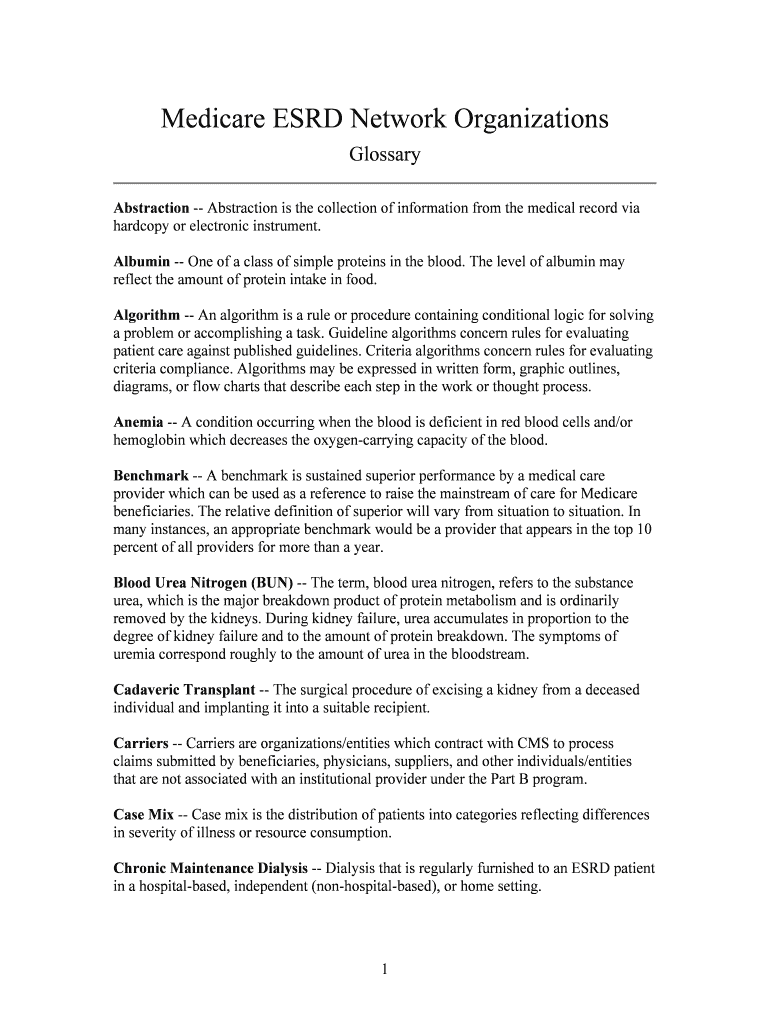







Definition and Meaning of Medicare ESRD Network Organizations
Medicare End Stage Renal Disease (ESRD) Network Organizations are integral to the regulatory and support framework for patients undergoing dialysis or having a kidney transplant funded by Medicare. Established by the Centers for Medicare & Medicaid Services (CMS), these organizations ensure that ESRD patients receive high-quality care. They are tasked with promoting improvements in the quality of dialysis services and patient education, while also facilitating communication between patients, providers, and CMS. These network organizations oversee dialysis clinics in designated geographic areas, addressing local needs and implementing CMS initiatives. By monitoring care standards and fostering collaboration among stakeholders, they play a crucial role in enhancing patient outcomes across the United States.
How to Use the Medicare ESRD Network Organizations
Using Medicare ESRD Network Organizations involves understanding their role in patient care and leveraging their resources for better health management. Patients should contact their respective network organization to gain information about local dialysis centers, and quality of care data, and to voice any concerns about their treatment. Healthcare providers can utilize the organization as a channel for performance benchmarking against set quality metrics, and for sharing best practices to improve patient care. The organizations offer educational materials and workshops for both patients and providers, helping ensure that everyone can access the necessary knowledge to manage ESRD effectively.
How to Obtain Information from Medicare ESRD Network Organizations
Information from Medicare ESRD Network Organizations can be accessed through multiple channels. Patients and healthcare providers can visit the official website of their regional ESRD network to find contact information, reports on dialysis facility performance, and educational resources. Organizations often host public meetings and webinars where stakeholders can engage with representatives and ask questions. Additionally, consumers can directly reach out via email or phone to request specific data or support. For personalized assistance, network offices provide direct consultations to address individual concerns and improve care delivery.
Steps to Engage with Medicare ESRD Network Organizations
Engaging with Medicare ESRD Network Organizations follows a streamlined process.
- Identify the appropriate network: Determine your geographic region’s network organization by visiting CMS's website or consulting your dialysis provider.
- Establish contact: Use the provided contact details, such as phone numbers or email addresses, to communicate your needs to the network representatives.
- Present your inquiry or issue: Clearly describe your questions regarding services, or any specific concerns about the quality of care.
- Participate in educational sessions: Enroll in workshops or webinars conducted by the network to stay informed.
- Provide feedback: Share your experiences and suggestions to help the network improve the quality of care for all patients.
Eligibility Criteria for Medicare ESRD Network Organizations
Eligibility for services from Medicare ESRD Network Organizations typically extends to individuals and healthcare providers directly involved in the treatment of ESRD. Patients receiving dialysis or kidney transplant services under Medicare automatically qualify for network oversight and assistance. Healthcare facilities providing such services are also under the purview of the network organizations. Moreover, these networks offer services designed to aid in the education and training of healthcare providers and the general public, with a focus on improving overall care standards.


Important Terms Related to Medicare ESRD Network Organizations
Understanding the key terminology is crucial for navigating Medicare ESRD Network Organizations.
- Dialysis Types: Methods of filtering and purifying the blood when kidneys can no longer function adequately, primarily including hemodialysis and peritoneal dialysis.
- Performance Measures: Metrics used to evaluate the quality of care provided by dialysis centers.
- Patient Care Guidelines: Protocols established to ensure consistent and high-quality treatment for ESRD patients.
- Quality Improvement: Continuous efforts undertaken by network organizations to enhance care delivery and patient outcomes.
Key Elements of the Medicare ESRD Network Organizations
Medicare ESRD Network Organizations are composed of elements designed to streamline ESRD patient care. These include:
- Quality Assurance Programs: Initiatives aimed at monitoring and improving care standards across participating facilities.
- Outreach and Education: Efforts to educate patients and providers about best practices in ESRD management.
- Conflict Resolution: Mechanisms for addressing grievances between patients and care providers.
- Performance Calculations: Analytical processes that measure the effectiveness of facilities in delivering high-quality care.
Examples of Using the Medicare ESRD Network Organizations
Examples of the utility of Medicare ESRD Network Organizations can be found in real-world scenarios, such as:
- Case Study 1: A dialysis center that participated in a network’s quality improvement program reports a significant reduction in infection rates, showcasing the positive impact of network intervention.
- Case Study 2: A patient uses resources provided by their regional network to better understand their treatment options, leading to improved satisfaction and healthier outcomes.
- Case Study 3: A healthcare provider implements patient education tools acquired through a network organization, resulting in enhanced compliance with treatment regimes among their patients.
State-Specific Rules for Medicare ESRD Network Organizations
Different states might have specific rules and operational nuances related to the Medicare ESRD Network Organizations, mainly as a result of varying healthcare regulations and infrastructure. These organizations adapt to comply with local laws while still meeting federal standards. Providers and patients should stay informed of state-specific regulations by attending network informational sessions or consulting network experts to ensure compliance and optimal care delivery. State differences can impact program implementation and patient engagement strategies, necessitating tailored approaches to achieve desired health outcomes.




