







Understanding the National Vital Statistics Report, Vol 53, No 17 (3 7 2005)
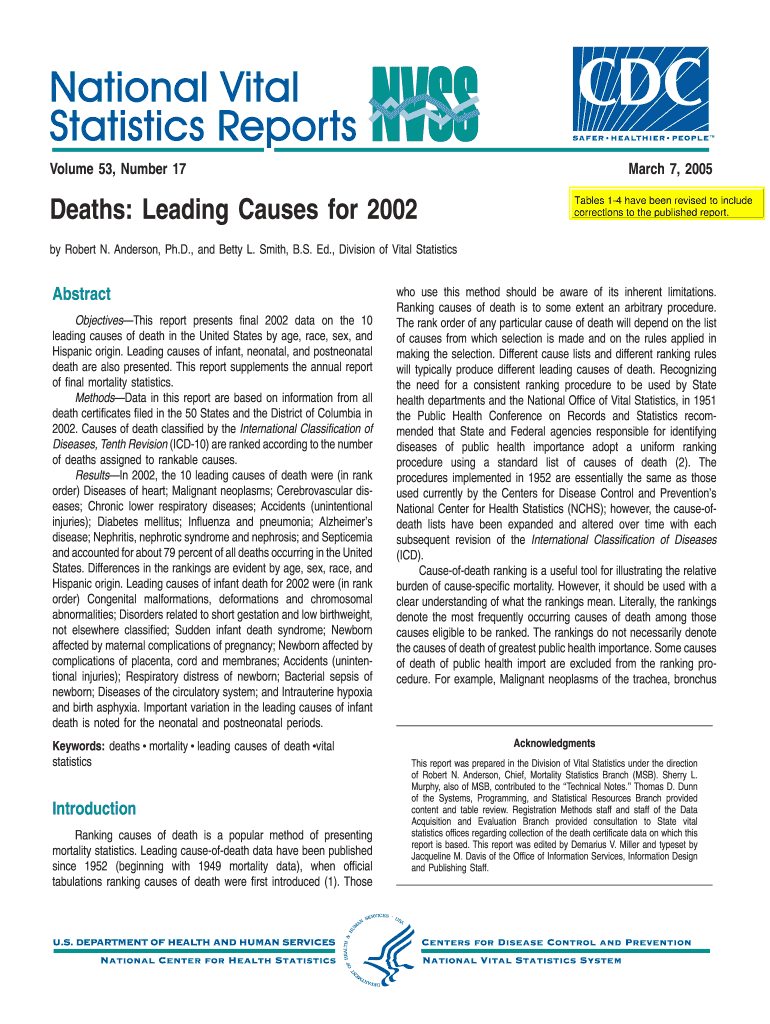
The National Vital Statistics Report, Vol 53, No 17 (3 7 2005), titled "Deaths: Leading Causes for 2002," offers a comprehensive overview of mortality data in the United States for the year 2002. Authored by Robert N. Anderson, Ph.D., and Betty L. Smith, B.S., this report has been revised to correct previously published tables, making it an essential reference for researchers, public health officials, and policymakers. It provides insight into the primary causes of death, categorized by demographics and geography, contributing to informed decision-making and policy development.
How to Use the Report Effectively
Researchers and policymakers can utilize the report to understand trends in mortality and identify major health concerns affecting different population segments. Data from the report assists in formulating public health initiatives, allocating resources, and setting priority areas for health interventions. It also serves as a reliable source for academic studies and health policy analyses. Evidence from the report is crucial in drafting legislation and enhancing healthcare strategies to mitigate prevalent health issues.
Obtaining and Accessing the Report
The National Vital Statistics Report is typically available through the CDC's official website and may be accessible in physical libraries that house government publications. For researchers needing historical data, library archives and digital databases often maintain copies. It is also possible to access the report through platforms like DocHub for enhanced digital interaction, enabling users to annotate and highlight key data points for further academic work.
Detailed Steps for Completing Database Analysis
-
Gather Required Tools: Ensure access to statistical software for data analysis and relevant healthcare databases to support findings with external resources.
-
Import Data: Use platforms like DocHub to easily import sections of the report into your preferred formats (e.g., Excel or CSV) for compatibility with analysis tools.
-
Understand Key Variables: Familiarize yourself with the categories and classifications used in the report to accurately identify relevant data points.
-
Analyze Data: Use statistical techniques to derive meaningful insights, focusing on trends and disparities in the leading causes of death across different demographics.
-
Draw Conclusions: Interpret results to guide public health strategies or academic research, supporting arguments with data-driven evidence.
Importance of the Report
The report holds significant value for public health by identifying leading causes of death and their demographic distributions. This information underpins health policy and aids in understanding the effectiveness of past interventions, providing a benchmark for future improvements. It supports educational outreach and awareness campaigns tailored to specific health concerns highlighted within various communities.
Typical Users of the Report
Healthcare professionals, epidemiologists, and policy analysts use the report to guide and justify public health actions. It is also utilized by academic researchers for statistical investigations and by governmental agencies in the planning and evaluation of national health programs. Furthermore, non-profits and advocacy groups leverage the data to advocate for changes in health policy or resource allocation.
Key Concepts and Terminology
- Mortality Rate: Measurement of the number of deaths in a particular population during a specific timeframe.
- Epidemiology: The study of the distribution and determinants of health-related events in specified populations.
- Demographics: The statistical data relating to the population, including age, race, and sex, critical for targeted health interventions.
Legal and Ethical Considerations
The report must be used ethically, ensuring data is interpreted and presented accurately without misrepresentation to avoid misinformation in the public domain. Legal guidelines prohibit the misuse of data in ways that may harm, discriminate or mislead the public. Users must always adhere to regulations governing public data usage and privacy.
Examples and Scenarios
Consider a public health department using the report to deploy targeted flu vaccination campaigns in communities with historically high respiratory-related mortalities. A researcher might analyze socioeconomic disparities in leading causes of death, providing insights for improved educational efforts on lifestyle changes and healthcare access.
Quick Facts and Insights
- Heart disease and cancer frequently dominate the list of leading causes of death.
- The report breaks down data into categories including age, sex, and race to highlight at-risk groups.
- Early childhood and elderly populations are often the focus of specific sections due to the unique health challenges they face.
This structured analysis of the National Vital Statistics Report, Vol 53, No 17 (3 7 2005), aims to deliver valuable insights and relevant instructions for stakeholders across health sectors, ensuring informed utilization of the data provided.




