Type text, add images, blackout confidential details, add comments, highlights and more.
02. Sign it in a few clicks
Draw your signature, type it, upload its image, or use your mobile device as a signature pad.
03. Share your form with others
Send it via email, link, or fax. You can also download it, export it or print it out.
How to use or fill out Feral Swine with our platform
Ease of Setup
DocHub User Ratings on G2
Ease of Use
DocHub User Ratings on G2
Click ‘Get Form’ to open the Feral Swine document in the editor.
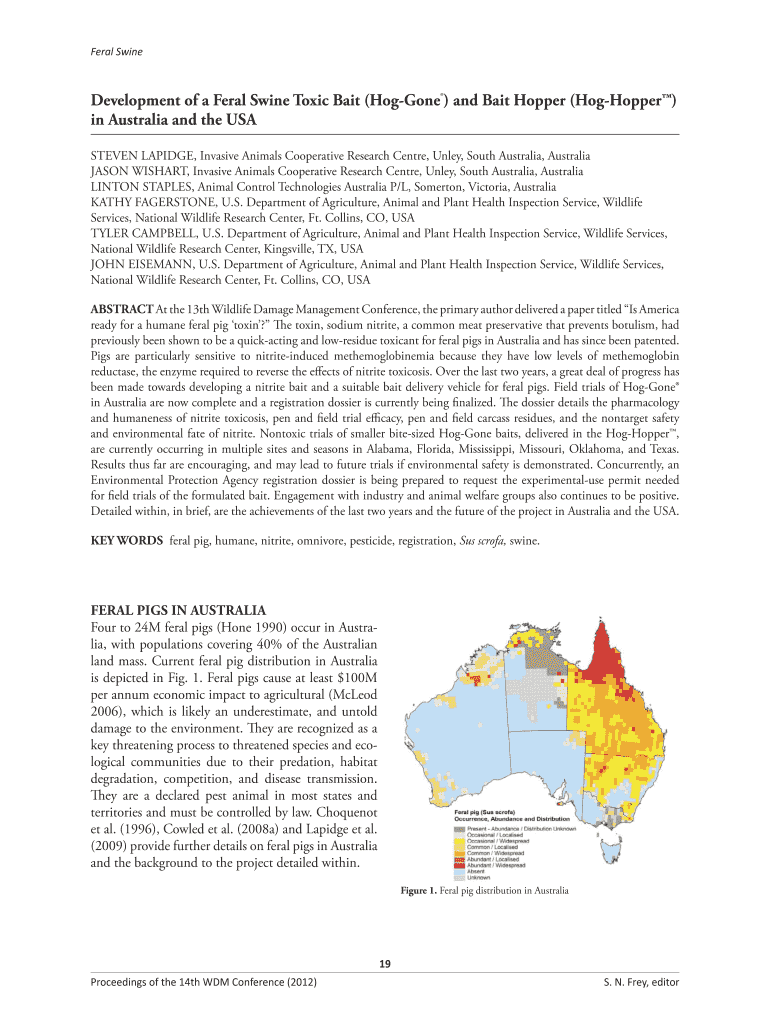
Begin by reviewing the abstract section, which provides an overview of the project and its significance. This will help you understand the context of the form.
Move on to fill out any required fields regarding your involvement or interest in feral swine management. Ensure that all information is accurate and up-to-date.
In the sections discussing control options, provide insights or data relevant to your experience with feral swine. Use bullet points for clarity if necessary.
Review the nontarget concerns section carefully. If applicable, add any additional comments or observations based on your fieldwork or research.
Once all sections are completed, utilize our platform's features to save your progress and share it with collaborators for feedback before final submission.
Engage with our platform today to streamline your document editing and enhance your workflow!
They are a dangerous and destructive invasive species, and their populations have expanded across the country. Help us manage their damage.
What is wrong with feral hogs?
Feral swine can carry at least 30 diseases and nearly 40 types of parasites that may affect people, pets, livestock, and wildlife. Some diseases, such as pseudorabies, are fatal to cats and dogs that may be exposed from direct contact with a feral swine carcass.
What are the problems with feral pigs?
Feral pigs can consume crops, damage fences, and compete with livestock for resources. Spread of Disease: Feral pigs can carry diseases that can affect both livestock and humans, such as leptospirosis and brucellosis. Their presence can increase the risk of disease transmission.
What is the problem with feral swine?
Life Cycle Although some piglets die within their first three months, feral hogs generally live to age four or five and sometimes to age eight. Feral hogs are mostly nocturnal. Sows and pigs often travel in groups called sounders. Feral Hog (Feral Swine) - Missouri Department of Conservation mo.gov discover-nature field-guide fer mo.gov discover-nature field-guide fer
Why are feral pigs bad for the environment?
Feral swine are ecosystem engineers, which means they can change their environment by altering water quality and runoff in wetlands, shifting plant composition and distribution in grasslands, and decreasing tree diversity in forests.
Related Searches
Feral swine sizeWhere are feral pigs invasiveWhere did feral hogs come fromAre feral hogs dangerousFeral pig vs wild boarFeral swine scientific NameWhy are feral pigs a problemFeral swine invasive species
Related links
Feral Hog Ecology
Feral hogs are very adaptable animals that are able to thrive in a variety of ecosystems. They are considered habitat generalists.
Wild boars provide archaeologists with clues to early domestication
Scientists have shown that a life spent in captivity has an identifiable effect on the shape of a tarsal bone that plays a propulsive role in locomotion.
Feral swinealso known as wild pigs, wild boars, wild hogs, and razorbacksare descendants of escaped or released pigs first brought to the United States by
Cookie consent notice
This site uses cookies to enhance site navigation and personalize your experience.
By using this site you agree to our use of cookies as described in our Privacy Notice.
You can modify your selections by visiting our Cookie and Advertising Notice.