01. Edit your form online
Type text, add images, blackout confidential details, add comments, highlights and more.

Type text, add images, blackout confidential details, add comments, highlights and more.

Draw your signature, type it, upload its image, or use your mobile device as a signature pad.

Send it via email, link, or fax. You can also download it, export it or print it out.
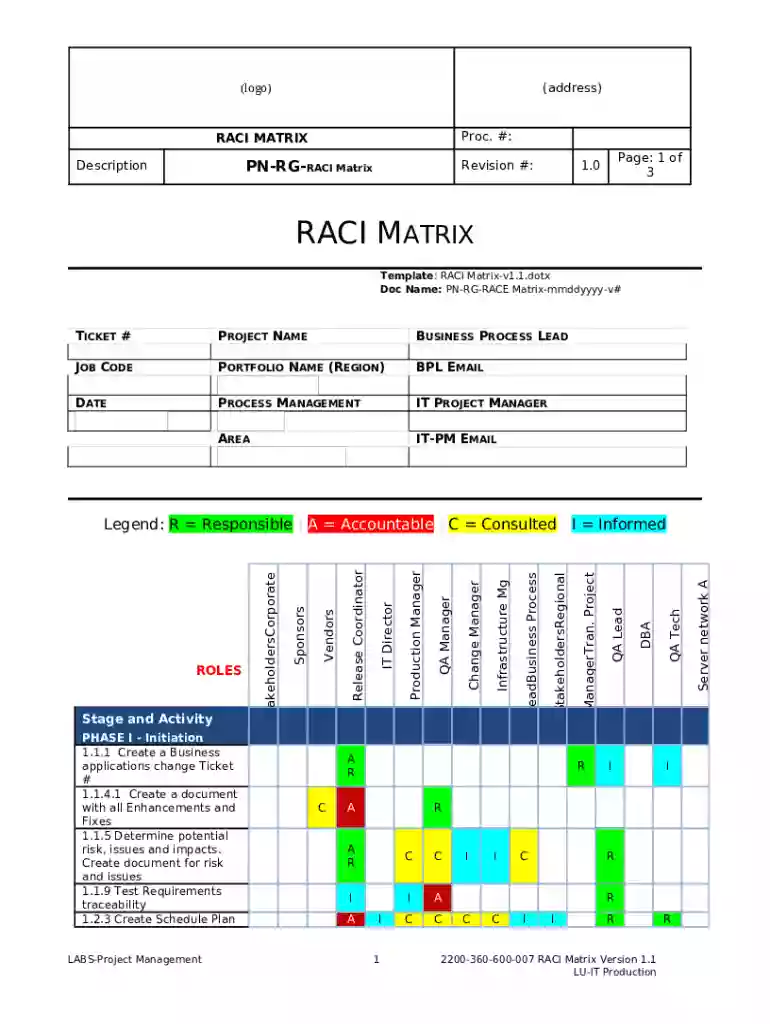
RACI chart templates are vital tools in project management designed to clarify roles and responsibilities across various project phases. These templates use a straightforward framework where each task is designated as Responsible, Accountable, Consulted, or Informed. Using RACI charts, teams can effectively manage project workflows from initiation through to closeout, providing clear guidance on team member involvement. By streamlining responsibilities, RACI charts help prevent overlaps and ensure efficient task management.
To make the most of the 10 free RACI chart templates in Excel, Google Sheets, and other formats, teams can follow a clear, structured approach. Start by listing all tasks involved in your project. Next, identify the key people associated with each task, and assign them roles according to the RACI framework. By using the templates available in both Excel and Google Sheets, teams can leverage drag-and-drop functionality, which makes the process quicker and more intuitive. This adaptability allows for smooth integration into existing workflows.
Completing a RACI chart template involves several precise steps. First, download the desired template format (Excel, Google Sheets, etc.). Begin by populating the tasks and stakeholders for your specific project. Use the RACI mapping to allocate each person to one of the four categories: Responsible, Accountable, Consulted, or Informed. Finally, review the chart for clarity and ensure all stakeholders understand their roles. This process provides a clear roadmap for collaboration and accountability.
RACI charts incorporate several key elements to ensure comprehensive coverage of projects. Each task is paired with roles such as:
The inclusion of these elements clarifies the participation expectations for each team member.
The RACI chart templates are compatible with widely-used applications like Excel and Google Sheets. This software flexibility makes it easier for teams that use a variety of digital platforms. These formats support both Windows and macOS environments, and due to their cloud-based nature, Google Sheets allows for real-time collaboration—a crucial feature for teams working remotely or in different geographical locations.
In a U.S. context, using RACI charts in compliance with local regulations ensures an organized and transparent project management environment. While RACI charts are not legally binding documents, they serve as important informal agreements within project teams. Having clear documentation assists in reducing potential conflicts and misunderstandings by establishing clear responsibility lines as per occupational guidelines.
In project management, RACI charts are often used by project managers, team leaders, and stakeholders across industries. They are particularly beneficial for sectors with complex projects involving multiple teams, such as construction, marketing, and IT. By providing clarity on roles and tasks, these templates help organizations maintain productivity and keep projects on track.
Implementing RACI charts in your workflow can greatly enhance team efficiency by preventing role confusion. They aid in managing expectations, improving communication, and setting up a single, unified point of accountability for each task. By clearly outlining duties, teams can avoid duplication of effort and ensure that all necessary parties are engaged at the right stages.
For instance, in a software development project, a RACI chart might list tasks such as code development, testing, and deployment. The lead developer could be responsible, while the project manager is accountable. A QA specialist is consulted for input on testing processes, and stakeholders are informed of milestone completions. These examples showcase the adaptability of RACI charts to various project scenarios.
While RACI charts can be created in both digital and paper formats, digital versions offer distinct advantages. Digital charts are easier to edit, share, and store than paper counterparts. They can be updated in real-time and shared with distributed teams instantly, making them a preferred choice for modern project management practices.
Organizations might encounter or develop variations of the RACI chart to better fit their needs. Alternatives such as RASCI (where an additional 'support' role is defined) or DACI (Driver, Approver, Contributor, Informed) charts are sometimes used for more intricate projects with nuanced roles. These variations provide flexibility to adapt standard RACI templates to unique project requirements.
Various business types, including startups, nonprofit organizations, and educational institutions, benefit from using RACI charts. Startups can quickly scale operations without role duplication, nonprofits ensure clear communication among volunteers, and educational institutions manage collaborative research projects efficiently. Each type of business sees enhanced coordination and accountability through structured role assignment.
At DocHub, your data security is our priority. We follow HIPAA, SOC2, GDPR, and other standards, so you can work on your documents with confidence.