
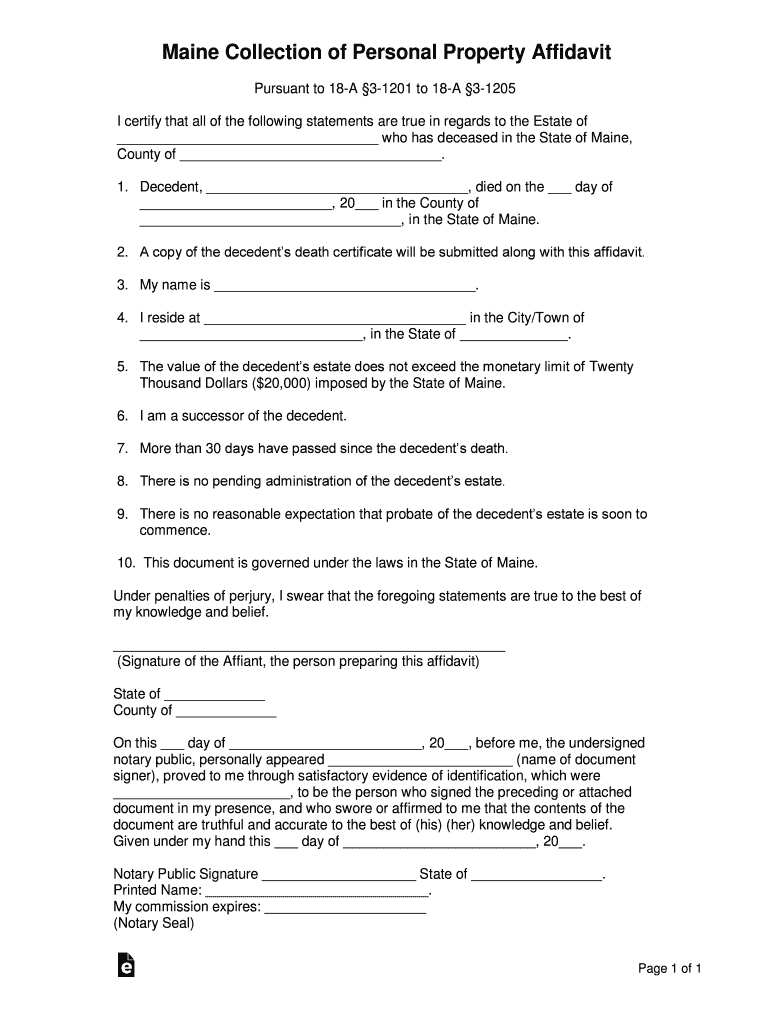







Definition and Meaning of the Maine Small Estate Affidavit
The Maine Small Estate Affidavit is a legal document used to simplify the transfer of a deceased individual's personal property without the need for formal probate proceedings. This affidavit is applicable when the value of the estate does not exceed $20,000 and there is no pending probate administration. It serves to certify the deceased's passing, affirm the affiant's identity and residency, and detail the estate's value and distribution according to legal guidelines.
Key Components of the Maine Small Estate Affidavit
- Decedent's Information: Includes the full name, date of death, and last known address of the deceased.
- Affiant's Details: The person completing the affidavit, their relationship to the decedent, and contact information.
- Estate Valuation: Confirmation that the estate's total value is under the limit set by state law, which is currently $20,000.
- Non-probate Statement: A declaration that there is no current probate or estate administration pending for the deceased.
- Notarization Requirement: The affidavit must be signed by the affiant and notarized to be legally binding. This step verifies the authenticity of the document and the identity of the affiant.
How to Use the Maine Small Estate Affidavit
The Maine Small Estate Affidavit is typically used to transfer ownership of the deceased's personal assets, such as bank accounts, vehicles, and other personal property. It is not applicable for real estate transfers.
Step-by-Step Usage
- Determine Eligibility: Verify that the estate qualifies as a small estate under Maine law (valued at $20,000 or less).
- Collect Required Information: Gather relevant details about the decedent, the affiant, and the list of assets to be transferred.
- Complete the Affidavit: Fill out the Maine Small Estate Affidavit with accurate information. Ensure all sections are completed truthfully.
- Notarization: Take the completed affidavit to a notary public for official signing and notarization.
- Present Affidavit to Asset Holders: Submit the notarized affidavit to banks, financial institutions, or other entities holding the deceased's assets to facilitate the transfer.
Practical Example
If a deceased family member had a bank account and car, the affidavit allows the designated heir to collect these assets without a lengthy probate process.
Steps to Complete the Maine Small Estate Affidavit
Completing the Maine Small Estate Affidavit involves several precise actions to ensure legal compliance and smooth asset transfer.
- Gather Personal Information: Collect the decedent's full legal name, date of death, and last residence.
- Document Estate Assets: List all personal property that needs to be transferred, ensuring the total valuation does not exceed $20,000.
- Provide Affiant Information: Include the full name, address, and contact information of the person completing the affidavit. Specify the relationship to the deceased.
- Legal Declarations: State that no probate proceedings are underway or anticipated.
- Review and Notarize: Double-check all information for accuracy. Have the affidavit signed and notarized, which may require a valid ID.
Eligibility Criteria for the Maine Small Estate Affidavit
Not all situations qualify for using the Maine Small Estate Affidavit. Meeting specific criteria is necessary for legal eligibility.


Basic Eligibility
- Estate Value: The total estate should not exceed $20,000 in value.
- Probate Proceedings: No ongoing or anticipated probate administration for the estate.
- Type of Property: Limited to personal property such as bank accounts, vehicles, or other movable assets.
Who Can File
- Immediate Family Members: Spouse, children, or other close relatives are typically eligible to file the affidavit.
- Executor/Personal Representative: If previously designated by the deceased in a will or trust.
Important Terms Related to the Maine Small Estate Affidavit
Understanding certain legal terms is crucial when dealing with the Maine Small Estate Affidavit. These terms help clarify processes and legal requirements.
- Affiant: The person who completes and signs the affidavit, asserting the truthfulness of the information provided.
- Decedent: The individual who has passed away and whose estate is being managed.
- Notarization: A formal step where a notary public verifies the affiant's identity and signature, adding legal credibility to the document.
- Estate Valuation: The assessment of the total value of the decedent's personal property, ensuring it does not exceed legal limits for the affidavit's use.
Legal Use of the Maine Small Estate Affidavit
The legality of using the Maine Small Estate Affidavit hinges on adherence to state regulations and accurate completion of the document.
Asset Transfers
The affidavit legally empowers an affiant to claim and redistribute assets purely through the document without court intervention. This method is faster and more cost-effective than traditional probate.
Legal Binding and Consequences
The affidavit carries the weight of a sworn statement. False declarations or misuse may result in legal penalties, including fines or perjury charges.
Key Elements of the Maine Small Estate Affidavit
For the affidavit to be valid and effective, specific elements must be included.
- Comprehensive Decedent Information: Ensures the correct identification of the estate being managed.
- Affiant's Assertions: Must explicitly state their right to claim and manage the estate assets.
- Asset Overview: Detailed listing of all personal property under the affidavit's jurisdiction, confirming the low-value criteria.
- Completion Verification: Must bear the affiant's signature under oath, notarized to solidify its status as a legal document.
By adhering to these guidelines, the Maine Small Estate Affidavit serves as a powerful tool for simplifying estate management, ensuring quick and efficient resolution without the complexity of formal probate.




