Conscious Discipline - Arizona Department of Education 2026

Get Form
Conscious Discipline - Arizona Department of Education Preview on Page 1

Here's how it works

01. Edit your form online
Type text, add images, blackout confidential details, add comments, highlights and more.

02. Sign it in a few clicks
Draw your signature, type it, upload its image, or use your mobile device as a signature pad.

03. Share your form with others
Send it via email, link, or fax. You can also download it, export it or print it out.

Definition and Meaning of Conscious Discipline - Arizona Department of Education

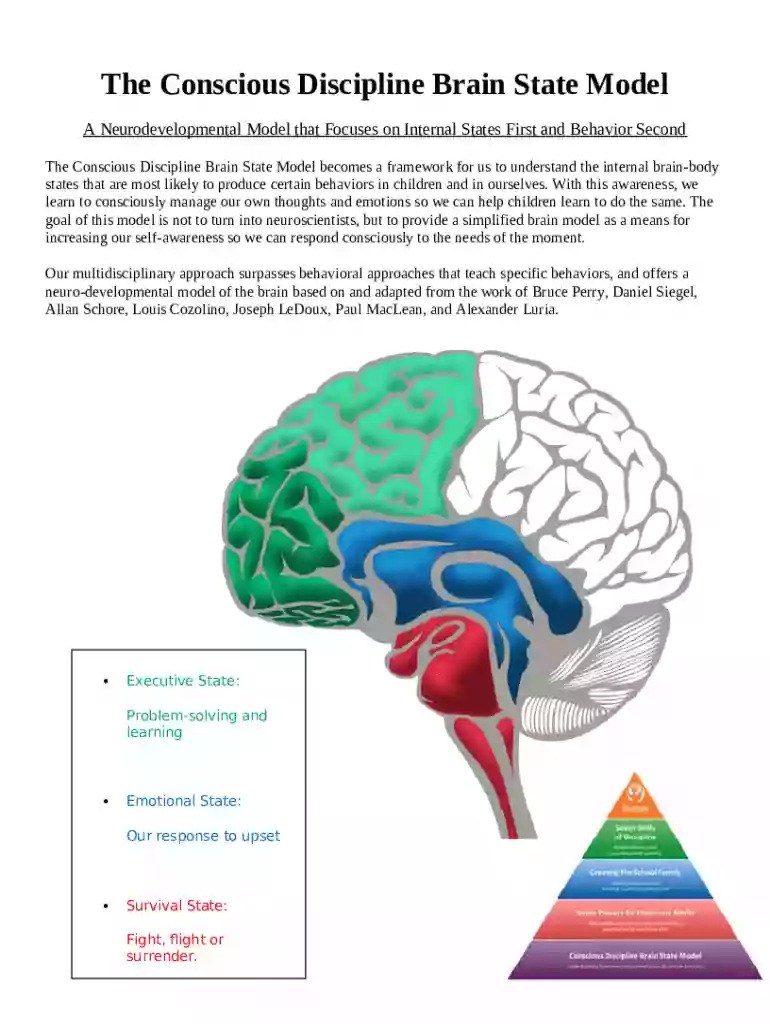
Conscious Discipline is a comprehensive, trauma-informed, and evidence-based program that integrates social-emotional learning, discipline, and self-regulation. The model is structured around the Conscious Discipline Brain State Model, which focuses on understanding and managing the brain-body states that affect behavior. Initiated by the Arizona Department of Education, the program aims to promote a healthier educational environment by fostering emotional intelligence and positive relationships among students, teachers, and parents.

  • Executive State: The primary focus here is problem-solving and decision-making, encouraging thoughtful and deliberate responses to challenges.
  • Emotional State: This involves addressing feelings of upset or distress, teaching individuals to manage emotions constructively.
  • Survival State: This centers on instinctive reactions, like fight or flight, and how they can be redirected.

The intentional design of Conscious Discipline helps schools address behavioral issues while supporting social-emotional development.

How to Use the Conscious Discipline Framework

Implementing the Conscious Discipline framework requires dedication to fostering an emotionally supportive environment. It's essential for educators, caregivers, and administrators to embody its principles.

  • Seven Powers for Conscious Adults: Focus on adults developing self-control and self-awareness to model these behaviors for children.
  • Seven Skills of Discipline: These skills transform discipline moments into opportunities for teaching social-emotional and problem-solving skills.
  • Routine Integration: Daily routines, such as morning meetings or conflict resolution sessions, can incorporate strategies from Conscious Discipline to reinforce learning.

Through consistent application, the program can redefine the disciplinary and educational climate, encouraging a supportive community that prioritizes emotional growth and understanding.

Steps to Complete the Conscious Discipline Program

To fully integrate the Conscious Discipline program, a structured implementation approach is crucial.

  1. Initial Training: Engage in thorough training sessions provided by certified Conscious Discipline trainers.
  2. Assessment: Evaluate current disciplinary practices and identify areas for improvement aligning with Conscious Discipline principles.
  3. Implementation Plan: Develop a clear implementation roadmap, outlining how Conscious Discipline will be integrated across classroom activities and school policies.
  4. Continuous Evaluation: Regularly assess the effectiveness of the implementation, gathering feedback from students, educators, and parents to refine approaches.
  5. Sustainability Measures: Establish a support system within the institution to ensure long-term adherence and effectiveness of the program.

Regular workshops and collaborative sessions enhance skill development and effectiveness.

Key Elements of the Conscious Discipline - Arizona Department of Education

The Conscious Discipline program includes several core components designed to enhance its efficacy.

  • Safe Place Creation: A designated area in the classroom where students can self-regulate, reflect, and manage their emotions.
  • School Family Concept: Encourages community building and nurturing relationships within the school, promoting a sense of belonging.
  • Rituals and Routines: Implement shared procedures, such as greeting rituals, to establish a predictable and secure environment conducive to learning.
  • Conflict Resolution: Utilize behaviors and language that promote cooperative problem-solving amongst students.

These elements combine to produce a holistic approach to discipline, linking education with deeper social and emotional learning goals.

Important Terms Related to Conscious Discipline

Understanding specific terms is crucial for effectively engaging with the Conscious Discipline framework.

  • Brain State Model: A structure defining how internal states influence behavior.
  • Social-Emotional Learning (SEL): The development of self-awareness, self-control, and interpersonal skills that are vital for school, work, and life success.
  • Self-Regulation: The ability to manage one's emotions, thoughts, and behaviors in different situations.
  • Trauma-Informed: An approach that acknowledges the presence of trauma symptoms and acknowledges the role trauma may play in an individual's life.

Familiarity with these terms supports the effective use of Conscious Discipline strategies.

Examples of Using Conscious Discipline in Schools

Practical application of Conscious Discipline can vary but generally falls under integrated classroom activities.

  • Morning Meetings: Implementing daily check-ins with students to build community and prepare for the day ahead.
  • Peace Tables: Designated areas where students can resolve conflicts through structured dialogue.
  • Personal Reflection Stations: Spaces for students to calm down using breathing exercises or reflection prompts.
  • Behavior Charters: Co-created rules and expectations to promote ownership and communal responsibility.

Such examples illustrate how Conscious Discipline can be woven into everyday activities to facilitate a supportive learning environment.

State-Specific Rules and Adaptations

While the fundamental structure of Conscious Discipline is nationally consistent, adaptations based on state-specific educational policies and cultural nuances are common.

  • Arizona Specifics: Aligning the Conscious Discipline program with Arizona's educational benchmarks and standards.
  • Cultural Sensitivity Training: Ensures practices are inclusive and culturally relevant to diverse student populations.
  • Policy Compliance: Ensuring the program meets all state and federal educational policies and regulations.

Such customizations ensure that the program is both legally compliant and effectively addresses local educational needs.

Legal Use and Compliance

Conscious Discipline adheres to educational and psychological standards, ensuring its strategies are both effective and compliant.

  • FERPA Considerations: Conscious Discipline practices align with confidentiality requirements under the Family Educational Rights and Privacy Act.
  • Title I Schools: Adaptations to meet the resource demands and specific needs of economically disadvantaged schools.
  • Special Education: Tailored approaches to support students with special needs, aligning with IDEA legislation.

Compliance with these legal frameworks ensures that the program is implemented responsibly and optimally.

be ready to get more

Complete this form in 5 minutes or less

Get form

Got questions?

We have answers to the most popular questions from our customers. If you can't find an answer to your question, please contact us.
Contact us
Conscious Discipline is a social-emotional learning classroom management program that uses classroom activities and routines to teach children problem-solving skills and to foster a sense of safety in the classroom. Teacher fidelity to Conscious Discipline and childrens executive ScienceDirect.com article abs pii ScienceDirect.com article abs pii
What are the 3 core components of Conscious Discipline? 1) Safety. Creating physically and psychologically safe classrooms and schools is an important driver in Conscious Discipline. 2) Connection. 3) Problem-solving. The core components of conscious discipline - Marlee Marlee blog conscious-discipline Marlee blog conscious-discipline
The seven skills are Composure, Encouragement, Assertiveness, Choices, Empathy, Positive Intent and Consequences. The seven skills emerge from the foundation of the Seven Powers for Conscious Adults. As we become more conscious of our reactions to conflict, we can choose a different response. Seven Skills - Conscious Discipline Conscious Discipline methodology seven-s Conscious Discipline methodology seven-s
What is the practice? Conscious Discipline is a trauma-informed, evidence-based social emotional behavioral methodology for all ages. Based on 4 key components (1) Conscious Discipline Brain State Model, (2) Seven Powers for Conscious Adults, (3) Creating the School Family, and (4) Seven Skills of Discipline.
Seven skills of Conscious Discipline Composure: Anger management, delay of gratification. Encouragement: Pro-social skills, kindness, helpfulness. Assertiveness: Bully prevention, setting healthy boundaries. Choices: Impulse control, goal achievement. Empathy: Emotional regulation, perspective-taking.

Security and compliance

At DocHub, your data security is our priority. We follow HIPAA, SOC2, GDPR, and other standards, so you can work on your documents with confidence.
Learn more
ccpa2
pci-dss
gdpr-compliance
hipaa
soc-compliance
be ready to get more

Complete this form in 5 minutes or less

Get form

People also ask

Conscious Discipline is a social-emotional learning program. Designed by Dr. Becky Bailey, the program supports first teaching ourselves about self-control and self-regulation, and then teaching children. What is Conscious Discipline? - Brown University Health Brown University Health be-well what-conscious Brown University Health be-well what-conscious
Practice choices, active calming and the four main breathing exercises in Conscious Discipline (S.T.A.R., Drain, Pretzel and Balloon) with this cute, colorful choice board and create new breathing choices of your own.

Related links