
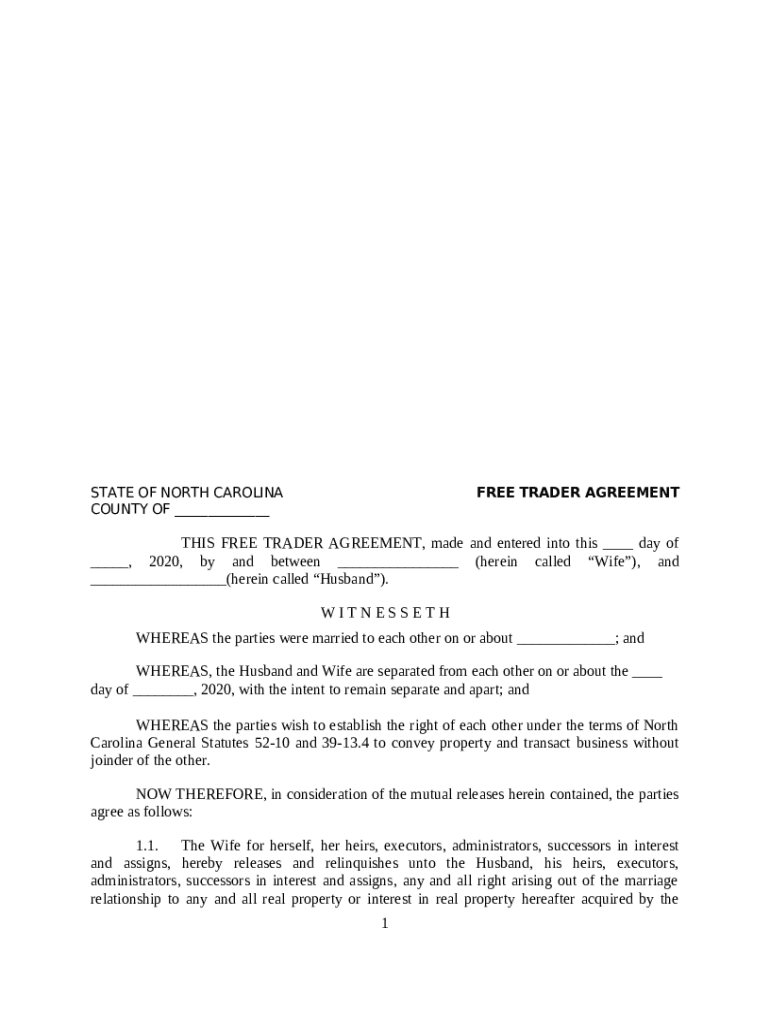







Definition & Meaning
The "State of North Carolina Free Trader Agreement County Of" is a legal document primarily used in the state of North Carolina. It allows a husband and wife to mutually release property rights upon separation. This agreement empowers each spouse to manage, acquire, and convey property independently without requiring the consent of the other party. The agreement becomes beneficial when parties wish to ensure clear boundaries concerning property rights and obligations following their decision to separate. Such an agreement is typically executed to conform with North Carolina state law.
Key Elements of the Free Trader Agreement
A comprehensive Free Trader Agreement in North Carolina consists of several critical components:
- Parties Involved: Clearly identifies the spouses involved in the agreement.
- Effective Date: Mentions the specific date the agreement was executed.
- Purpose: Explains the mutual release of property rights between the spouses.
- Independent Management: Grants each party the ability to independently manage their respective properties.
- Consent Waiver: Specifies that neither party needs the other's consent to manage or sell property acquired post-separation.
- State Compliance: Ensures the agreement aligns with North Carolina law.
How to Obtain the Free Trader Agreement
To obtain a Free Trader Agreement in North Carolina, follow these steps:
- Consultation: Engage a qualified attorney who specializes in family law to draft or review the agreement.
- Preparation: Gather necessary personal and property information regarding assets owned jointly or individually.
- Drafting: Work with your attorney to draft the agreement, ensuring all legal provisions and requirements are met.
- Review: Both parties should thoroughly review the draft to ensure mutual understanding and agreement on all points.
- Execution: Sign the agreement in the presence of a notary public to make it legally binding and enforceable.
Legal Use of the Free Trader Agreement
In North Carolina, the legal use of a Free Trader Agreement includes:
- Property Transactions: Facilitates the sale, transfer, or management of properties post-separation without requiring further consent from the spouse.
- Independent Financial Management: Enables separated spouses to independently handle financial transactions related to property.
- Legal Protection: Offers legal assurance that property transactions will not be challenged by the other party.
State-Specific Rules
North Carolina law imposes specific rules governing Free Trader Agreements:
- Validity: The agreement must be notarized to be deemed valid and enforceable.
- Jurisdiction: Only applicable within North Carolina, adhering to local property and family laws.
- Post-Separation Agreements: It should only cover property acquired or managed after the separation date.
Steps to Complete the Agreement
Completing a Free Trader Agreement involves the following process:
- Identification of Assets: List all significant assets that will be subject to independent control.
- Agreement Drafting: Draft a document detailing each party's rights and obligations concerning these assets.
- Mutual Consent: Ensure both parties understand and agree to the terms.
- Signing: Execute the agreement in front of a notary public for proper authentication.
- Filing: File the agreement with the local county records where the property is located, especially if linked to real estate transactions.
Who Typically Uses the Free Trader Agreement
This agreement is most commonly used by:
- Married Couples: Specifically those considering separation or divorce.
- Real Estate Holders: Spouses with joint or individual real estate interests.
- Asset Holders: Couples who want to ensure clarity and independence in managing and executing transactions related to personal or joint assets.


Important Terms Related to the Agreement
Understanding key terms is essential when dealing with a Free Trader Agreement:
- Mutual Release: Refers to both parties agreeing to relinquish any property rights or claims against the other's property.
- Notarization: The process of signing the document in the presence of a notary, making it legally binding.
- Property Rights: The legal rights to acquire, manage, and sell property without intervention from the other spouse.
- Separation: An explicit state of living apart that may precede or coincide with the drafting of the agreement.




