Application form for childminders and providers of childcare on domestic premises to seek approval t 2026

Get Form
Application form for childminders and providers of childcare on domestic premises to seek approval t Preview on Page 1

Here's how it works

01. Edit your form online
Type text, add images, blackout confidential details, add comments, highlights and more.

02. Sign it in a few clicks
Draw your signature, type it, upload its image, or use your mobile device as a signature pad.

03. Share your form with others
Send it via email, link, or fax. You can also download it, export it or print it out.

Definition and Purpose of the Form

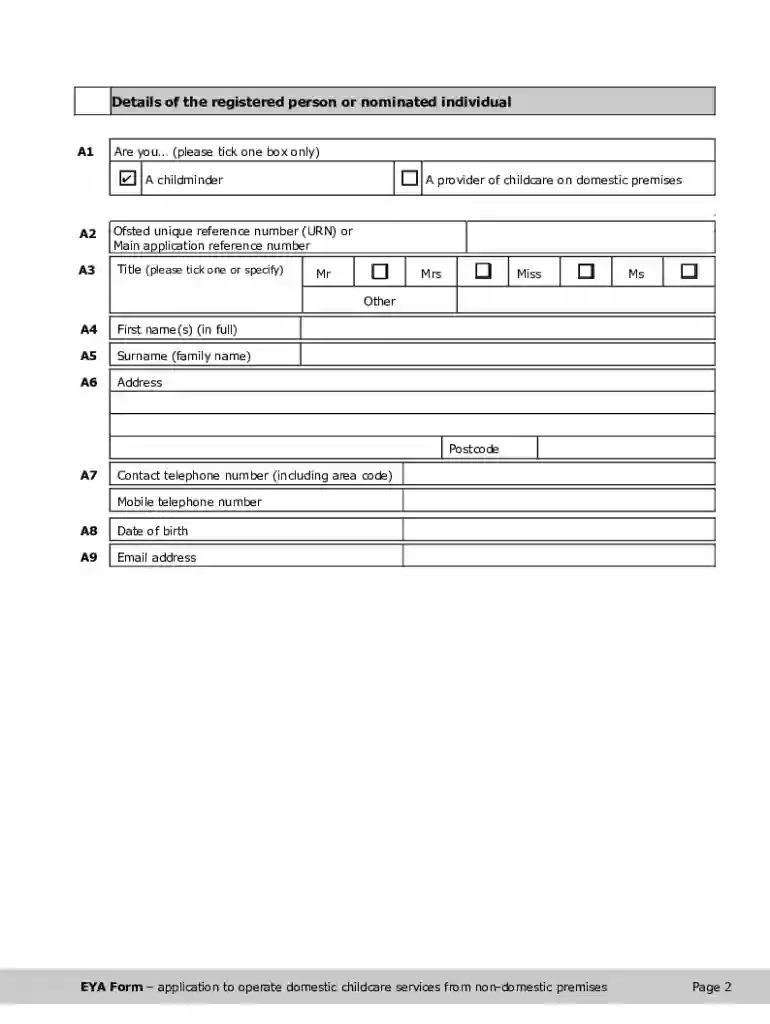
The application form for childminders and providers of childcare on domestic premises serves as a formal request for approval to operate childcare services from non-domestic premises up to 50% of the time. This form is essential for ensuring compliance with local regulations and maintaining high standards of child care. Completing this application not only formalizes your intention to operate legally but also helps in documenting necessary details about the childcare environment, which ensures the safety and well-being of the children.

How to Use the Form Effectively

Using the application form effectively involves understanding its structure and knowing how to complete it accurately. The form requires detailed information about the applicant and the non-domestic premises where childcare services will be offered. Start by gathering all necessary documents, such as identification, property details, and consent declarations. When filling out the form, ensure all sections are completed with accurate information to avoid delays in approval.

Steps to Complete the Form

  1. Gather Required Documentation: Collect personal identification, details about the childcare premises, and any previous approvals or certifications.
  2. Complete Personal Details Section: Enter personal information accurately, including contact details and any relevant qualifications.
  3. Provide Premises Information: Describe the non-domestic premises, including its location, size, and safety features.
  4. Fill Out Consent Declarations: Ensure all declarations are acknowledged and signed by the appropriate parties.
  5. Review and Double-Check: Verify that all sections are completed correctly, and no fields are left blank.
  6. Submit the Form: Submit the completed form to the designated authority, typically Ofsted, through the specified method.

Eligibility Criteria

To be eligible to use this application form, applicants must meet certain criteria. They should be recognized childminders or childcare providers, with a commitment to operating in compliance with regulations. The premises intended for childcare must meet safety and health standards. Additionally, applicants should have no history of violations against childcare regulations and possess relevant certifications or credentials.


decoration image ratings of Dochub

Key Elements of the Form

  • Personal Information: Full name, contact information, and relevant qualifications of the applicant.
  • Premises Details: Comprehensive information about the location and setup of the non-domestic premises.
  • Consent and Declarations: Sections for acknowledgment and consent from the applicant and any involved parties.
  • Supporting Documentation: Fields for attaching necessary documents, such as previous certifications or approvals.

Legal Use and Implications

The legal use of this application form involves securing approval from relevant authorities like Ofsted. By using this form, applicants agree to comply with childcare regulations and standards. Failure to obtain approval may result in penalties or legal consequences. The approval process ensures that childcare services are provided in a safe and regulated environment, safeguarding the interests of both the children and the providers.

Submission Methods

Online Submission

  • Requirements: Digital copies of all necessary documents.
  • Process: Fill out the application form online and upload supporting documents.
  • Benefits: Faster processing time and immediate acknowledgment of receipt.

Mail Submission

  • Requirements: Printed application form and physical copies of supporting documents.
  • Process: Mail the completed form and documents to the designated address.
  • Considerations: Longer processing time due to postal delivery.

In-Person Submission

  • Requirements: Fill out the form and gather documents.
  • Process: Submit the application directly to the relevant office.
  • Advantages: Opportunity to ask questions or clarify issues directly with officials.

Common Issues and Edge Cases

Childcare providers may face several challenges during the application process, such as unclear instructions or missing information. It's crucial to read all instructions carefully and seek clarification if needed. Common issues include incomplete forms or misfiled documents leading to delays. For those operating in two different states, it's important to ensure compliance with both states' regulations.

Approval Process and Timeframes

Upon submission, the approval process typically involves a review of the application, which may include checks for compliance with safety and health standards. The time frame for approval can vary based on the workload of the reviewing authority but generally takes several weeks. Applicants should allow sufficient time for processing before planning to commence childcare operations.

be ready to get more

Complete this form in 5 minutes or less

Get form

Got questions?

We have answers to the most popular questions from our customers. If you can't find an answer to your question, please contact us.
Contact us
If you become an assistant, you will need to take first aid training, have a DBS check, and learn about child development, safeguarding and the EYFS. The childminder will be able to support you and point you in the right direction for what you need to do.
A childminder may care for a maximum of six children under the age of 8. Of these six children, a maximum of three may be young children and there should only be one child under the age of one (a child is a young child until 1st September following their 5th birthday).
To become a registered childminder you will need to hold a Level 3 or above in Childcare Education and have worked with children under the age of 5 years in the past 2 years.
A childminder can have 6 children under 8; An assistant can have 6 children under 8; A co-childminder can have 6 children under 8. To comply with requirement 3.9 - Providers must ensure that people looking after children are suitable to fulfil the requirements of their roles. A CRB check or DBS disclosure.
Childcare workers education requirements vary. Some states require these workers to have a high school diploma or equivalent, but others do not have any education requirements for entry-level positions. Employers often prefer to hire workers who have at least a high school diploma.

Security and compliance

At DocHub, your data security is our priority. We follow HIPAA, SOC2, GDPR, and other standards, so you can work on your documents with confidence.
Learn more
ccpa2
pci-dss
gdpr-compliance
hipaa
soc-compliance

People also ask

Working under the supervision of, and in partnership with the registered childminder, a childminding assistant will support them in providing high quality care to the children, appropriate learning experiences, and help to ensure their safety and wellbeing.
Registering as a childminder with Ofsted You will need: an enhanced check with barred lists for home based workers from the Disclosure and Barring Service ( DBS ) first aid training for the age group you will look after. a health declaration booklet.
Registering as a childminder You will need to register with Ofsted or a Childminder Agency before you can look after children under the age of eight years of age for more than two hours a day. Registration can take up to 12 weeks.

Related links