Minnesota cr h 2026

Get Form
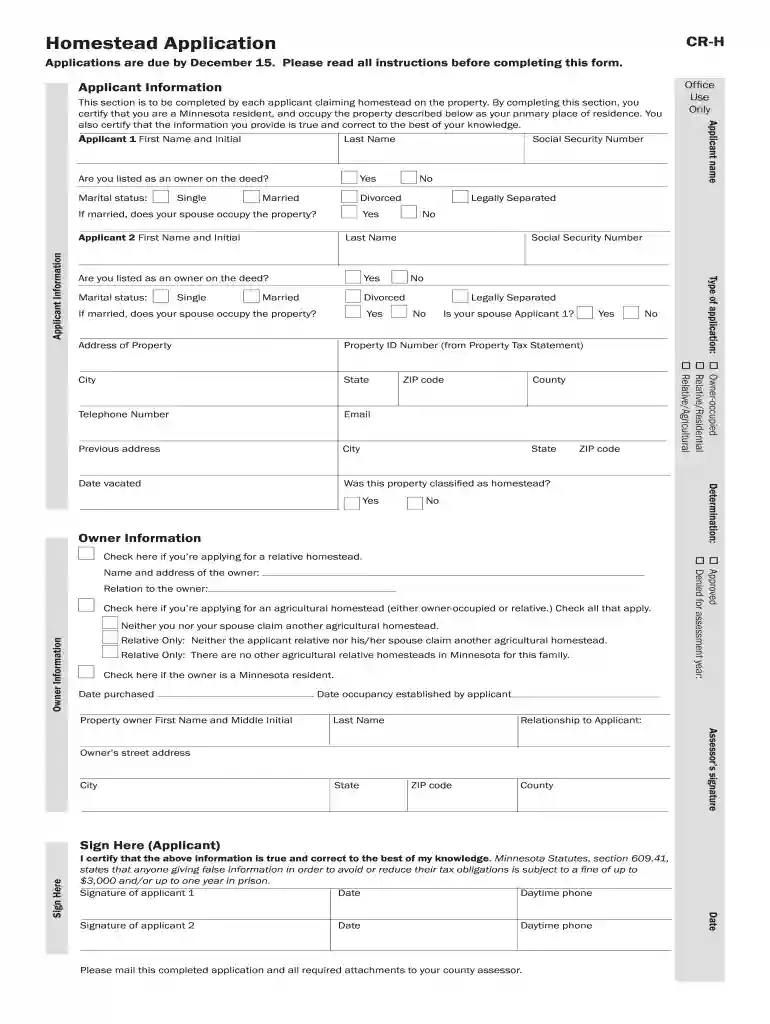
homestead application state of mn cr h Preview on Page 1

Here's how it works

01. Edit your homestead application state of mn cr h online
Type text, add images, blackout confidential details, add comments, highlights and more.

02. Sign it in a few clicks
Draw your signature, type it, upload its image, or use your mobile device as a signature pad.

03. Share your form with others
Send cr h homestead application via email, link, or fax. You can also download it, export it or print it out.

Definition and Meaning

The Minnesota CR-H form is a Homestead Application for property owners within the state of Minnesota. It's designed to help homeowners apply for homestead classification, which may reduce property taxes. The homestead classification acknowledges an individual’s property as their principal residence, potentially resulting in significant tax benefits. This document specifies eligibility requirements, the application process, and responsibilities, serving as a critical tool for Minnesota residents seeking financial advantages through tax relief.

How to Obtain the Minnesota CR-H

To acquire the Minnesota CR-H form, potential applicants can visit the website of the respective county's property tax office, as the document is generally available for download. Additionally, individuals can request a physical form by contacting their local assessor's office directly. Some counties might offer an online submission portal, simplifying the document acquisition process. It’s important to check whether there are any county-specific nuances or requirements associated with obtaining the form.

Steps to Complete the Minnesota CR-H

  1. Gather Required Information: Before starting the form, collect all necessary details, including personal information, property details, and proof of ownership.

  2. Complete Personal Information: Fill in personal details such as name, address, and contact information accurately to avoid processing delays.

  3. Verify Property Information: Ensure that the property’s legal description and parcel number are correct. This information can usually be found on your property tax statement.

  4. Certify Residency and Ownership: Confirm that the property is your primary residence and that you hold ownership rights. This might require additional documentation such as a utility bill or deed.

  5. Review and Sign: Double-check all entered details for accuracy before signing the form. The signature attests to the correctness of the information provided and acknowledges potential penalties for false statements.

  6. Submit the Application: Depending on your county, submit the form either online or via mail by the deadline, typically December 15. Confirm receipt with the assessor’s office to ensure processing.

Eligibility Criteria

Eligibility for the Minnesota CR-H hinges on several key factors:

  • Principal Residency: The property must be your primary home, meaning you live there most of the time.
  • Ownership: Applicants must legally own the residence. This includes full ownership or co-ownership scenarios.
  • Timing: The property must have been occupied and owned by December 1 of the assessment year.
  • Additional Considerations: Particular applicants, such as those with trusts or certain co-op memberships, may have additional eligibility considerations.
decoration image ratings of Dochub

Required Documents

Completing the Minnesota CR-H form requires specific documentation:

  • Proof of Ownership: Provide deeds, mortgage statements, or closing papers to establish ownership.
  • Evidence of Residency: Utility bills, driver's license with current address, or voter registration.
  • Identification: Include a valid form of ID that matches the property’s address.
  • Legal Documents: If applicable, submit documents related to trusts or other relevant legal arrangements.

Important Terms Related to the Minnesota CR-H

Understanding key terminology is vital:

  • Homestead: A state recognizing a dwelling as a primary residence, potentially qualifying it for tax benefits.
  • Primary Residence: The home where a person lives for the majority of the year.
  • Assessor’s Office: The county office responsible for assessing property values and managing property tax records.
  • Parcel Number: A unique identifier for properties, often found on a tax bill or property deed.

Penalties for Non-Compliance

Failure to comply with the Minnesota CR-H requirements can lead to:

  • Taxation Adjustments: Loss of homestead classification may result in increased property taxes.
  • Back Taxes: Applicants may need to pay back taxes for periods in which homestead classification was incorrectly claimed.
  • Legal Consequences: Falsifying information can lead to legal ramifications, including fines or other penalties.
  • Revocation of Benefits: Loss of any tax benefits previously granted under the false claims.

Filing Deadlines and Important Dates

Submitting the Minnesota CR-H is time-sensitive:

  • Annual Deadline: The completed form should be submitted by December 15 to apply for the next tax year.
  • Critical Review Dates: Review notifications from the assessor's office to ensure continuous qualification and update information as required annually.
  • Re-assessment Notifications: Pay close attention to any reassessment notes or requests for additional documents from the county to maintain the classification.

State-Specific Rules for the Minnesota CR-H

Minnesota imposes distinct rules for the homestead classification application:

  • County Variations: Some counties might have additional requirements or variations in form submission processes.
  • Special Circumstances: Minnesota offers exceptions for certain groups, like disabled veterans or senior citizens, which could impact eligibility or extend benefits.
  • Appeal Rights: Property owners can appeal decisions if they believe their application was wrongfully denied, allowing for a review and reassessment by the county.
be ready to get more

Complete this form in 5 minutes or less

Get form

Got questions?

We have answers to the most popular questions from our customers. If you can't find an answer to your question, please contact us.
Contact us
About the Rebate Program Your 2021 adjusted gross income (line 1 of Form M1 or Form M1PR) was: $150,000 or less for married joint filers. $75,000 or less for all other filers.
To qualify for homestead: You must own the property, or be a relative or in-law of the owner (son, daughter, parent, grandchild, grandparent, brother, sister, aunt, uncle, niece or nephew). You or your relative must occupy the property as the primary place of residence. You must be a Minnesota resident.
The CRP provides a record of the rent paid in the previous year. What are the maximums? For tax year 2024 credit claims paid in 2025 (based on rent paid in 2024), the maximum refund is $2,640. Renters whose income exceeds $75,389 are not eligible for refunds.
The Senior Citizens Property Tax Deferral Program allows property taxpayers who are 65 years or older, and whose total household income is $96,000 or less, to defer a portion of their homestead property taxes until some later time.
Eligibility requirements for a homestead exemption vary by state. One of the key requirements is occupancy status homestead exemptions are typically only available for primary residences. Some other factors that may impact eligibility include your age and income, as well as your marital, veteran or disability status.

Security and compliance

At DocHub, your data security is our priority. We follow HIPAA, SOC2, GDPR, and other standards, so you can work on your documents with confidence.
Learn more
ccpa2
pci-dss
gdpr-compliance
hipaa
soc-compliance
be ready to get more

Complete this form in 5 minutes or less

Get form

People also ask

Homestead Market Value Exclusion Increased During its 2023 session, the Minnesota State legislature authorized a modification was authorized to increase the homestead market value exclusion for homesteads to $517,200. The purpose of this revision was to keep pace with increases in home values since 2012.
Apply by November 1 to defer your property taxes the following year. You may apply in the year you turn 65. Once accepted, you do not need to reapply yearly.
You must issue CRPs no later than January 31 of each year. You can give CRPs to renters as an electronic or hard copy. If a renter moves before December 31, you may give them their CRP when they move or by January 31 of the following year.

minnesota homestead application cr h 2017