
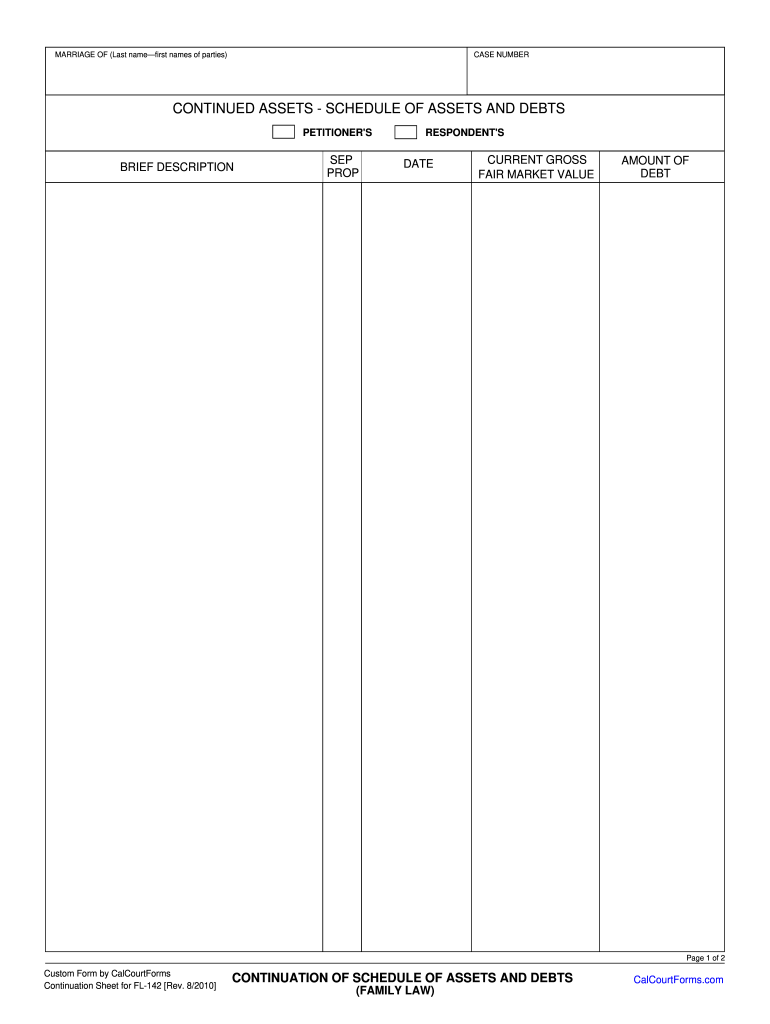







Definition and Meaning of Schedule Of Assets And Debts (Continuation of Assets)
The Schedule Of Assets And Debts (Continuation of Assets), known in legal terms as form FL-143A, is a document utilized within the California judicial system, specifically in family law cases. Its primary purpose is to provide a comprehensive overview of a couple’s financial situation during divorce or legal separation proceedings. This form allows for the clear and organized presentation of both parties' assets and debts, ensuring transparency and facilitating equitable distribution as mandated by California law.
This particular form serves as a continuation sheet for the FL-142, which outlines the primary information regarding a couple's financial assets. The continuation form is essential when the list of assets and debts exceeds the space available on the FL-142. By using FL-143A, individuals can provide detailed information regarding:
- Property Ownership: Real estate, vehicles, personal property.
- Financial Accounts: Bank accounts, investment accounts, retirement accounts.
- Liabilities: Mortgages, credit card debts, personal loans.
Providing accurate and complete information on this form is crucial, as it directly impacts the court's decisions regarding property division, alimony, and debt allocation.
Steps to Complete the Schedule Of Assets And Debts (Continuation of Assets)
Completing the Schedule Of Assets And Debts (Continuation of Assets) requires careful attention to detail. Here are the recommended steps to ensure that the form is filled out accurately:
-
Gather Financial Documents: Before starting the form, collect all necessary financial records. This includes statements from banks, investments, credit cards, and any documents related to real estate or personal property.
-
Identify and Categorize Assets:
- List real property, including the primary residence and any rental properties.
- Include all financial accounts, specifying account numbers and current balances.
- Document personal property, assigning estimated values for items such as vehicles or valuable collectibles.
-
Detail Your Debts:
- Record all liabilities, including mortgages, loans, and credit card balances.
- Ensure you provide details such as account numbers, creditors, and outstanding amounts.
-
Fill Out the Form:
- Transfer the gathered information onto the FL-143A form. Ensure to allocate the correct assets and debts to the correct party (petitioner or respondent).
- Use separate entries for different categories to maintain clarity.
-
Review and Verify Information: After completing the form, review all entries for accuracy. Cross-check this information against your gathered documents.
-
Sign and Date the Form: Both parties must sign and date the form to validate the information presented.
-
File with the Court: Submit the completed form to the appropriate California family court along with any other required documents.
-
Keep Copies: It's crucial to retain copies of the completed form and all accompanying documents for your records.
Important Terms Related to Schedule Of Assets And Debts
Understanding the terminology used in the Schedule Of Assets And Debts (Continuation of Assets) is vital for accurate completion. Here are some key terms:
Assets
Assets refer to items of value that an individual owns and can include tangible goods like real estate and vehicles, as well as intangible items like stocks and bonds.
Debts
Debts encompass all liabilities that an individual is obligated to repay. This includes outstanding loans, credit card debts, and any other financial obligations.
Fair Market Value
This term refers to the price that an asset would sell for on the open market. It’s important to provide an accurate fair market value for each asset to ensure an equitable division.
Community Property
In California, community property is defined as all assets and debts acquired during the marriage. Understanding what constitutes community property is essential for properly filling out the form.
How to Use the Schedule Of Assets And Debts (Continuation of Assets)
Using the Schedule Of Assets And Debts (Continuation of Assets) effectively involves multiple steps and considerations. It is an essential tool for individuals navigating legal processes related to divorce or separation, allowing them to present their financial circumstances in an organized manner. Here are various points on effective usage:
Filing Process
- Complete the form with accurate information regarding assets and debts.
- Ensure compliance with all state requirements by including all necessary supporting documents.
- Submit the form within the designated timeline set by the court.
Importance of Accuracy
- Provide truthful and transparent information. Misrepresentation can lead to legal penalties or complications.
- Regularly update the form if financial situations change during the divorce proceedings.
Dispute Resolution
- The form can serve as a basis for negotiation between parties. Accurate asset documentation helps in fair negotiations.
- In case of disputes regarding the value of assets, having documented evidence will support your claims.
Examples of Using the Schedule Of Assets And Debts (Continuation of Assets)
Practical examples of how to utilize the Schedule Of Assets And Debts (Continuation of Assets) can help clarify its purpose and function. Here are a few scenarios:
Example One: Divorcing Couple
A couple going through a divorce needs to separate their significant assets, which include a family home valued at $500,000, a joint bank account with $25,000, and two credit cards with outstanding balances of $10,000. Both parties will fill out FL-143A to ensure all assets and liabilities are accounted for accurately.
Example Two: Legal Separation
In a legal separation scenario, both parties are required to disclose their individual assets and debts even if they continue living together. The Schedule Of Assets And Debts (Continuation of Assets) becomes essential in ensuring that each party's financial contributions are fairly represented.
Example Three: Debt Allocation
If one spouse is responsible for certain debts accrued during the marriage, such as a personal loan, clarity in the FL-143A regarding who is responsible for which debts is crucial. This form facilitates transparency and reduces future conflicts related to debt repayment.
By understanding how to complete and utilize the Schedule Of Assets And Debts (Continuation of Assets), individuals engaged in family law proceedings can navigate the complexities of financial disclosures with greater ease, ensuring a fair outcome for both parties involved.




