







Definition and Context of Mexican Contract Formalities
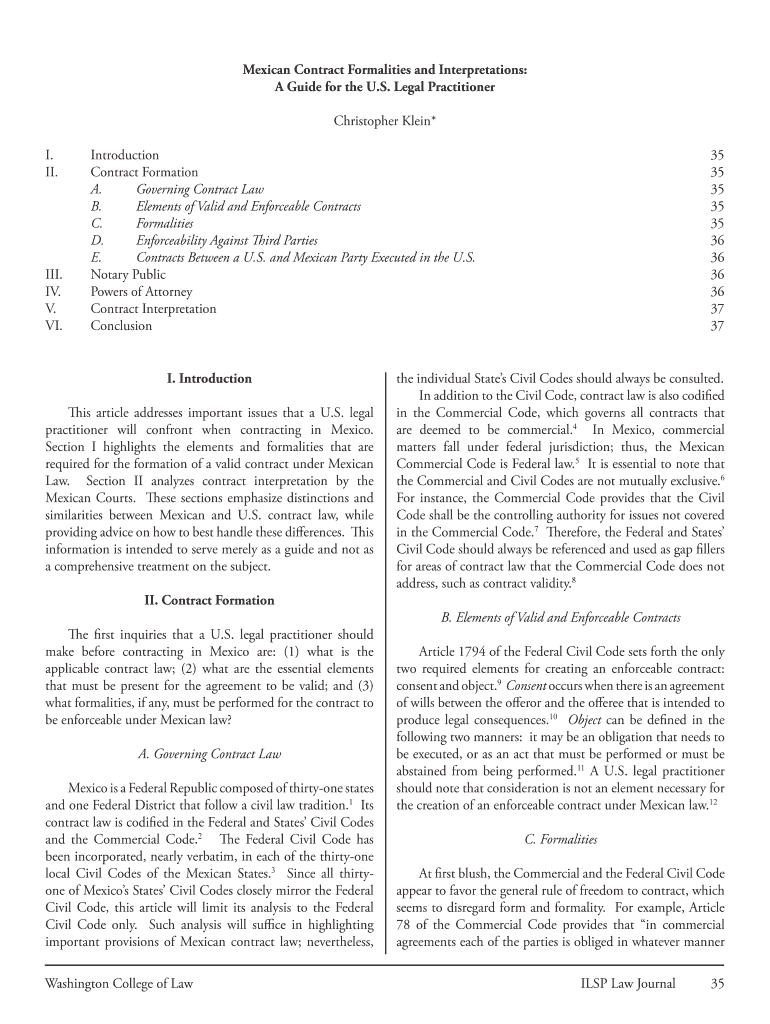
Mexican contract formalities refer to the legal requirements and principles governing the formation, interpretation, and enforcement of contracts under Mexican law. Unlike U.S. contract law, Mexican contract law often necessitates the involvement of a notary public to authenticate documents, especially in transactions involving real estate or significant financial agreements. Contracts must adhere to the legal framework established by the Mexican Civil Code, ensuring validity, enforceability, and protection against third-party claims. A thorough understanding of these formalities is crucial for legal practitioners engaged in cross-border transactions involving Mexican parties.
Key Elements of Mexican Contract Formalities
A valid contract under Mexican law includes several key elements such as offer, acceptance, consideration, and the legal capacity of the parties. Additionally, contracts must comply with required formalities like written documentation and, in certain cases, notarized verification. The choice of language can also play a critical role, and it's advisable to draft contracts in both Spanish and English to avoid misinterpretations. Moreover, the contract should clearly specify the governing law and dispute resolution mechanisms, whether through local courts or arbitration.
Differences Between U.S. and Mexican Contract Law
There are significant contrasts between U.S. and Mexican contract law, primarily regarding the concept of "cause." While U.S. law focuses on the concept of consideration, Mexican law requires a lawful "cause" to justify the obligations assumed by the parties. Additionally, Mexican law places greater emphasis on public interest, which can affect the interpretation and enforcement of contractual terms. Another noteworthy distinction is the absence of jury trials in Mexico, with judges solely responsible for interpreting contracts.
Understanding Mexican Contract Interpretation Principles
Contract interpretation in Mexico is governed by principles aimed at understanding the true intention of the parties and ensuring fairness in enforcement. Courts prioritize the literal meaning of the language used unless ambiguity necessitates further analysis of the parties' intent. Good faith is a fundamental principle in Mexican contract law, influencing how terms are understood and disputes are resolved. In complex cases, expert testimony may be used to clarify technical terms or industry-specific standards.
Legal Use of Mexican Contract Formalities
Mexican contract formalities are legally binding under the country's jurisdiction and carry significant weight in international agreements involving Mexican entities. These formalities ensure contracts are executed legally and afford protection to parties involved. They are used in various contexts, including mergers and acquisitions, joint ventures, real estate transactions, and service agreements. Understanding these formalities helps international businesses and counsel navigate the legal landscape when establishing operations or partnerships in Mexico.
Steps to Complete Mexican Contract Documentation
- Drafting: Begin with drafting a comprehensive contract that includes all essential terms, conditions, and obligations.
- Reviewing: Have the contract reviewed by a legal professional familiar with both U.S. and Mexican law to ensure compliance with local requirements.
- Translation: Prepare translations if needed, ensuring accuracy to avoid future disputes.
- Notarization: For certain contracts, schedule notarization by a Mexican notary public to authenticate the document.
- Execution: Sign the contract in the presence of required witnesses and, if applicable, a notary public.
- Filing: In some cases, file the executed contract with relevant Mexican authorities for public record and enforceability.
Important Terms Related to Mexican Contract Formalities
- Apostille: A certification used to verify the authenticity of a document for international use.
- Notary Public: A legal professional with the authority to verify and authenticate legal documents in Mexico.
- Consideration: The value exchanged between parties in a contract, known as "cause" in Mexican law.
- Good Faith: A principle that underlines fair dealing and honesty in contract execution and interpretation.
Examples of Using Mexican Contract Formalities
Consider a U.S. company entering a joint venture with a Mexican firm. The U.S. legal team must draft a contract aligning with Mexican law, ensuring it includes relevant formalities such as notarization by a Mexican notary public. Another example involves a real estate purchase in Mexico by a foreign investor, where adherence to local contract formalities is essential for secure property transactions and legal recognition.
By understanding these critical elements of Mexican contract formalities, legal practitioners and businesses can effectively engage in cross-border dealings, ensuring legal compliance and safeguarding their interests.




