




01. Edit your bc600 online
Type text, add images, blackout confidential details, add comments, highlights and more.

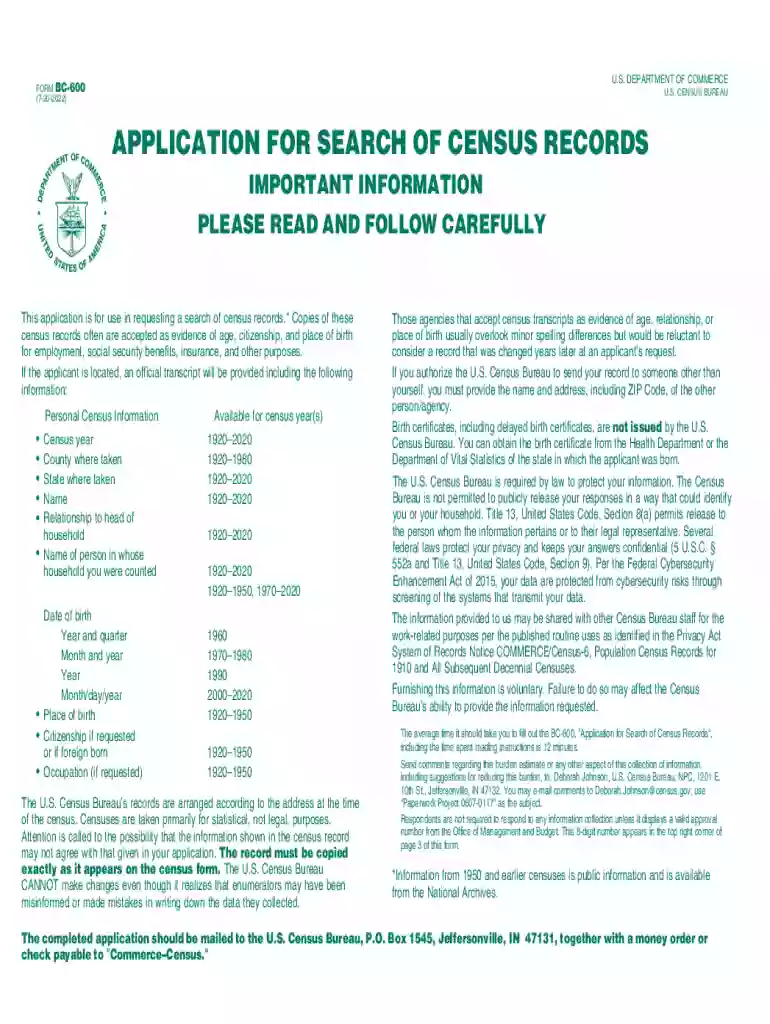
Type text, add images, blackout confidential details, add comments, highlights and more.

Draw your signature, type it, upload its image, or use your mobile device as a signature pad.

Send bc 600 census via email, link, or fax. You can also download it, export it or print it out.
Census Data Archiving and Preservation involves the systematic storage and maintenance of census data to ensure its availability for future research, policy-making, and historical reference. The data encompasses a wide range of information collected during census periods, such as demographics, economic statistics, and social trends. Preservation ensures that these records remain intact and accessible over time, following standardized practices for data integrity and security. This process is crucial for analyzing historical population changes and assisting governments and researchers in understanding long-term societal developments.
Understanding the process of completing the Census Data Archiving and Preservation form is essential to securing historical census data. Below is a structured guide:
Download the form: Access the official U.S. Census Bureau website to find the BC-600 form.
Fill in personal information: Provide your full name, contact details, and any identifiers required to verify your identity.
Specify data request: Clearly outline the type of census data you require, including the years and census records sought.
Provide purpose of request: Include a brief explanation of why the data is needed, such as genealogical research or academic study.
Submit identification documentation: Attach copies of government-issued ID to comply with verification protocols.
Pay associated fees: Check the latest fee schedule and make the payment as directed, often through check or electronic transfer.
Submit form: Send the completed form and documentation to the address or upload via the designated online portal.
Failure to accurately complete and submit the form can delay the processing of your request, so attention to detail is critical.
The primary components of Census Data Archiving and Preservation focus on both technical and procedural elements:
Understanding these elements is vital in ensuring that census data serves its purpose as a vital historical and analytical tool.
Census Data Archiving and Preservation serves a diverse group of users including:
Each user group depends on the integrity and accessibility of census data for precise and informed decision-making.
The use of Census Data Archiving and Preservation is governed by both federal and state regulations to protect individuals' privacy and ensure data integrity. Key legal aspects include:
Adhering to these regulations ensures that data use remains ethical and within the bounds of the law.
There are three main methods for submitting the Census Data Archiving and Preservation request form:
Understanding these methods can aid in choosing the most efficient means of submitting your request.
Not everyone may be eligible to access census data. The following criteria generally apply:
Meeting eligibility criteria is crucial to gaining timely access to the data.


Understanding specific terminology will help navigate census data requests more effectively:
These terms are integral to grasping the nuances of census data handling and preservation.
We've got more versions of the bc600 form. Select the right bc600 version from the list and start editing it straight away!
At DocHub, your data security is our priority. We follow HIPAA, SOC2, GDPR, and other standards, so you can work on your documents with confidence.
This technical note provides guidance on the special procedures and protocols required to securely archive and preserve individual census records.
May 6, 2026 This website is the primary tool for accessing information from the U.S. Census Bureau. Learn how to preserve archival materials like photos,


