




01. Edit your form online
Type text, add images, blackout confidential details, add comments, highlights and more.

Type text, add images, blackout confidential details, add comments, highlights and more.

Draw your signature, type it, upload its image, or use your mobile device as a signature pad.

Send it via email, link, or fax. You can also download it, export it or print it out.
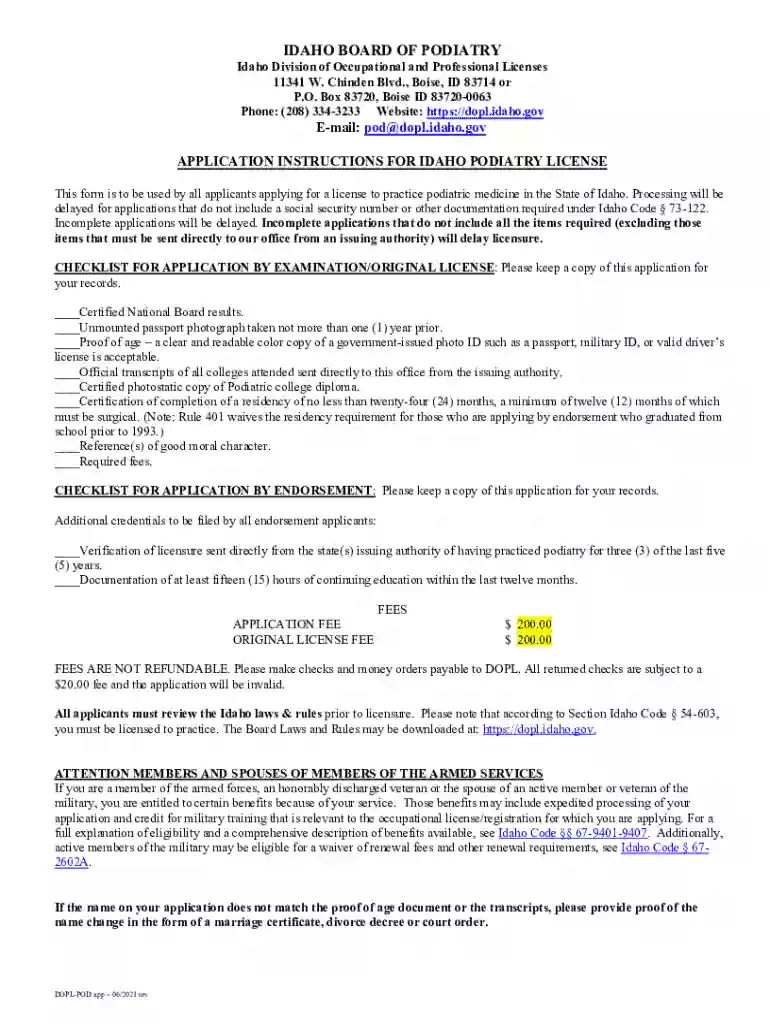
The "Board of PodiatryDivision of Occupational and" appears to be a form related to licensing and regulation within the field of podiatry. While the form name is not fully specified, it likely pertains to the governance and certification process for podiatry practitioners. Such forms play a crucial role in ensuring that podiatric professionals meet the necessary qualifications and adhere to professional standards mandated by a state board or agency. This ensures the safe and effective practice of podiatry within a given jurisdiction, protecting public health and safety.
To utilize the "Board of PodiatryDivision of Occupational and" form, applicants must first gather all necessary personal and professional documentation. This includes educational qualifications, professional licenses, and any relevant work experience in the field of podiatry. The form may require detailed information about the applicant's background, including any previous or current disciplinary actions. It's important for applicants to carefully follow the instructions provided with the form to ensure all information is accurately captured and submitted.
Gather Required Documents: Collect all necessary documents such as transcripts, existing licenses, and letters of recommendation.
Fill Out Personal Information: Enter your personal details including name, contact information, and social security number if required.
Provide Professional Details: Include your educational background, work history, and any other relevant qualifications specific to podiatry.
Submit Supporting Documentation: Attach all required documentation, making sure that each document is clearly labeled and easily identifiable.
Review and Sign: Carefully review all entered information for accuracy. Complete any sections requiring your signature.
Submit the Form: Follow the specified method of submission, whether online, by mail, or in-person, to submit the form for review.
Applicants must prepare and submit a range of documents with the form. These typically include:
Using the form legally is essential to uphold the integrity of the podiatric profession. Legally, the form acts as a binding document where the applicant must honestly disclose all requested information. Any attempt to misrepresent information could result in denial of the license, legal action, or both. The form serves as a legal record used by the Board of Podiatry to verify an applicant's eligibility to practice within the state, ensuring compliance with all statutes and regulations.
The form likely includes several key sections, such as:
Different states may have specific rules regarding the form's completion and submission. For example, certain states may require additional background checks, while others mandate specific fee structures for application processing. States might also have unique deadlines, and compliance with these is necessary to ensure timely application processing. It's crucial for applicants to review the state's specific guidelines and contact the respective Board office for any clarifications.
Failing to comply with the requirements of the form can lead to several penalties. These may include:
Understanding these potential penalties underscores the importance of accurate and truthful completion of the form.
We've got more versions of the Board of PodiatryDivision of Occupational and form. Select the right Board of PodiatryDivision of Occupational and version from the list and start editing it straight away!
| Versions | Form popularity | Fillable & printable |
|---|---|---|
| 2021 | 4.6 Satisfied (44 Votes) |
At DocHub, your data security is our priority. We follow HIPAA, SOC2, GDPR, and other standards, so you can work on your documents with confidence.


