
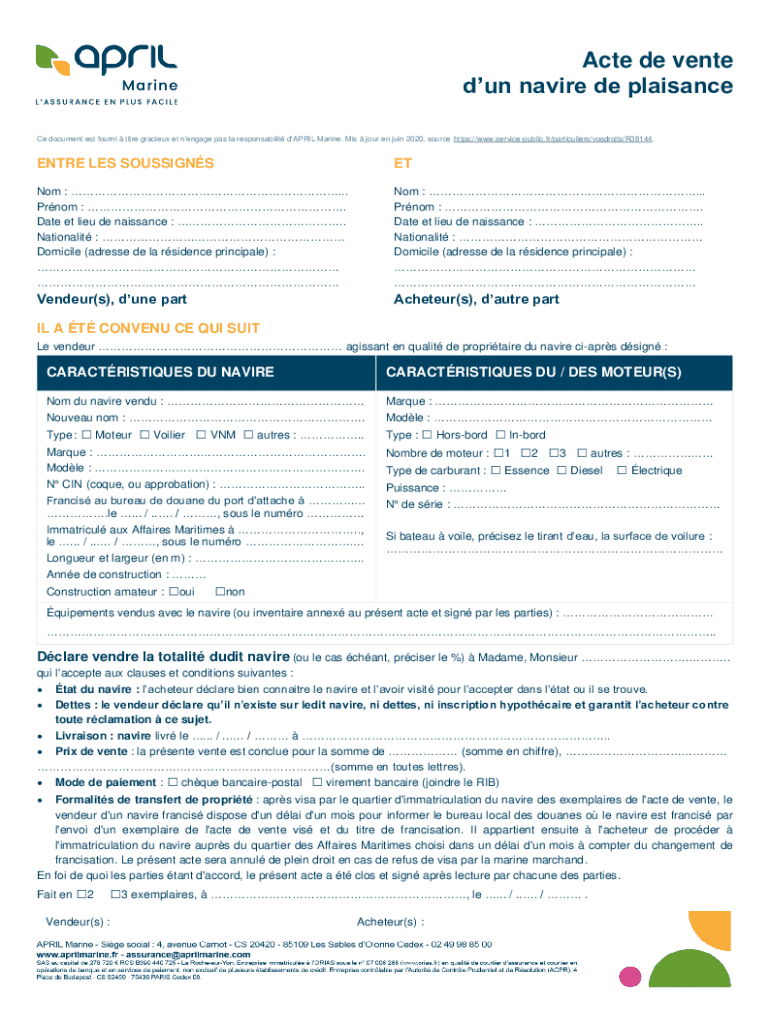







Definition and Purpose of the Sales Agreement for a Pleasure Boat
The "acte de vente d'un navire de plaisance - Mer gouv" is a legal document used to formalize the sale of a pleasure boat. This sales agreement outlines the terms and conditions under which the transaction is to take place, ensuring that both the buyer and seller have a clear understanding of their rights and responsibilities. The document details various elements, including vessel specifications, payment terms, and the procedure for transferring ownership.
Key Components
- Seller and Buyer Information: Includes names, addresses, and contact details.
- Vessel Specifications: Description of the boat, including make, model, year, and identification numbers.
- Payment Terms: Total sale amount, deposit, and any installment agreement.
- Transfer of Ownership Procedure: Steps to legally transfer the boat’s title to the new owner.
Steps to Complete the Sales Agreement
Completing the acte de vente requires careful attention to detail. Below are step-by-step instructions for finalizing the agreement:
- Gather Required Information: Collect all necessary details about the buyer, seller, and the vessel.
- Fill Out the Form: Accurately enter all information into the designated sections of the document.
- Review the Terms and Conditions: Ensure both parties agree to all terms regarding payment, warranty, and delivery.
- Execute the Agreement: Both parties must sign and date the document to make it legally binding.
- Transfer Ownership: Follow legal procedures to transfer the boat’s title and registration to the buyer.
How to Obtain the Sales Agreement Document
To get a copy of the acte de vente d'un navire de plaisance, follow these steps:
- Official Sources: Contact your local maritime authority or visit their website to download the official form.
- Commercial Providers: Some companies offer standardized forms for a fee.
- Legal Assistance: Consult with a legal professional who can draft a customized agreement based on your specific circumstances.
Who Typically Uses This Document
The primary users of the acte de vente d'un navire de plaisance include:
- Private Individuals: Those buying or selling pleasure boats for personal use.
- Boat Dealers: Entities engaged in the commercial sale of recreational vessels.
- Maritime Lawyers: Professionals managing the legal aspects of boat transactions for clients.
Important Terms Related to the Sales Agreement
Understanding specific terms in the sales agreement is crucial for both parties:
- "As-Is" Clause: Indicates the boat is being sold in its current condition, with no warranties.
- Deposit: A sum paid to secure the purchase, usually non-refundable.
- Lien: A legal claim on the boat in the event of non-payment.
Legal Use and Compliance
The sales agreement must comply with relevant maritime laws to ensure its enforceability:
- Regional Regulations: Laws may vary by state or region, affecting terms related to registration and taxation.
- Warranty Disclosures: Any existing warranties must be clearly stated within the agreement.
- Tax Implications: Buyers and sellers should be aware of applicable taxes, such as sales and use taxes.
Form Submission Methods
Submitting the completed form can be done through various methods, depending on jurisdictional requirements:
Online Submission
- Many regions allow electronic submission through government or maritime authority websites.
- Ensure all digital signatures are valid to maintain legal integrity.
Mail Submission
- Printed forms can be mailed to the appropriate maritime authority, typically requiring tracking for verification.
- Include any required supporting documents.
In-Person Submission
- Some regions require in-person submission at designated offices.
- This method often allows for immediate review and correction of any errors.
Penalties for Non-Compliance
Failure to properly complete or file the acte de vente d'un navire de plaisance can result in significant legal and financial penalties:
- Void Transactions: An incomplete or incorrect agreement may render the sale void.
- Fines: Non-compliance with tax or registration requirements could result in fines.
- Legal Disputes: Ambiguities in the document can lead to disputes between the buyer and seller.
Digital vs. Paper Version
The sales agreement can be completed in either digital or paper formats, with considerations:
Digital Version
- Advantages: Faster processing, electronic signatures, and easily shareable.
- Considerations: Ensure software compatibility for document editing and signing.
Paper Version
- Advantages: Some buyers or sellers may prefer physical copies for personal records.
- Considerations: Physical signatures and possible delays in mailing can slow the process.




