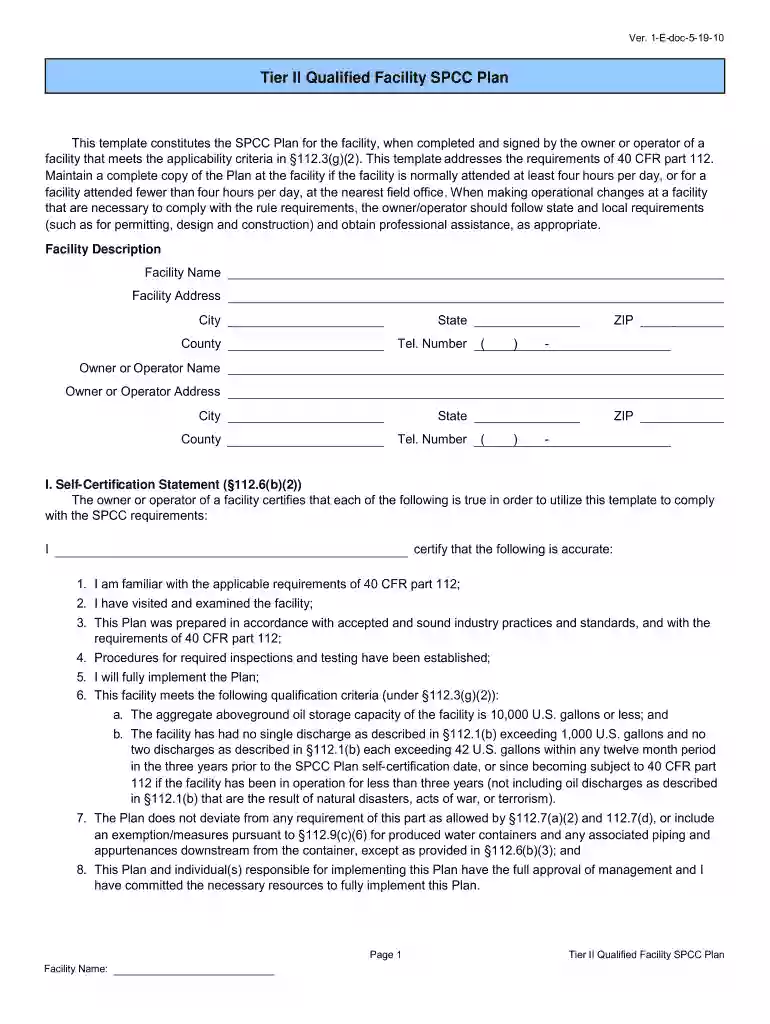
TIER II QUALIFIED FACILITY SPCC PLAN TEMPLATE 2026

Get Form
california qualified facility spcc plan Preview on Page 1

Here's how it works

01. Edit your california qualified facility spcc plan online
Type text, add images, blackout confidential details, add comments, highlights and more.

02. Sign it in a few clicks
Draw your signature, type it, upload its image, or use your mobile device as a signature pad.

03. Share your form with others
Send it via email, link, or fax. You can also download it, export it or print it out.

Definition and Meaning

The TIER II QUALIFIED FACILITY SPCC PLAN TEMPLATE is a structured document template specifically designed for Tier II qualified facilities as per the Aboveground Petroleum Storage Act (APSA). It serves as a guideline to help facilities create a comprehensive Spill Prevention, Control, and Countermeasure (SPCC) Plan, which is required under federal regulations to prevent oil spills into navigable waters. The template provides detailed instructions on complying with these regulations by outlining processes for facility assessments, self-certification, inspections, emergency responses, and recordkeeping. Despite being optional, using this template can streamline compliance efforts by helping facilities systematically address all regulatory requirements.

Key Elements of the SPCC Plan Template

  • Facility Description: Provides a detailed overview of the facility, including location, type of operation, and storage capacity.
  • Spill History and Risk Assessment: Summarizes past incidents and assesses potential risks, helping to identify vulnerable areas that may require additional preventive measures.
  • Containment and Diversionary Structures: Describes physical structures and management practices employed to contain or divert potential spills away from water sources.
  • Inspection and Testing Protocols: Details regular inspection schedules and testing procedures to ensure all preventative controls are functioning as intended.
  • Spill Response Procedures: Lays out step-by-step actions to be taken in the event of a spill, including notification protocols and emergency contacts.
  • Training Requirements: Ensures personnel are trained and knowledgeable about the SPCC plan, enabling effective implementation during spill situations.
  • Recordkeeping: Documents all actions taken regarding the plan, such as inspections and training logs, in compliance with regulatory requirements.

Steps to Complete the SPCC Plan Template

  1. Gather Facility Information: Collect all essential details about your facility, including maps, diagrams, and storage tank information.
  2. Conduct a Risk Assessment: Analyze previous spill incidents and potential risks to determine the necessary preventative measures.
  3. Develop Control Measures: Design physical and operational controls to prevent spills, ensuring they meet regulatory standards.
  4. Outline Response Procedures: Draft detailed response actions for potential spill scenarios, including required resources and contact lists.
  5. Implement Training Programs: Establish and document training sessions to ensure all staff are aware of and understand their roles within the SPCC plan.
  6. Finalize and Review the Plan: Compile all sections into the template, review for completeness, and obtain necessary certification and approvals.

Legal Use of the SPCC Plan Template

The SPCC Plan Template is legally required for facilities covered under federal regulations that store more than 1,320 gallons of oil in aboveground containers. The plan must be self-certified or certified by a Professional Engineer (PE), depending on the facility's size and type. Compliance with the template's guidelines ensures adherence to the Oil Pollution Prevention regulations outlined in the Clean Water Act, thus minimizing legal risks and potential fines for non-compliance. Facilities must update the plan every five years or after any significant changes to operations or physical layout.

Important Terms Related to SPCC Plan

  • Aboveground Petroleum Storage Act (APSA): Legislation governing the storage of oil products in aboveground tanks, crucial for facilities developing an SPCC Plan.
  • Self-Certification: A process where qualifying facilities can certify their SPCC Plan internally without requiring a Professional Engineer's certification.
  • Professional Engineer (PE): A licensed engineer responsible for certifying complex SPCC Plans to ensure all technical and operational aspects meet regulatory standards.
  • Spill Prevention: Measures taken to reduce the probability of oil spills due to equipment failure or operational errors.
  • Countermeasure: Actions or equipment used to respond to and mitigate the impact of oil spills, reducing environmental damage.

Examples of Using the SPCC Plan Template

  • Manufacturing Facility: A Tier II manufacturing site uses the template to develop a spill prevention strategy involving routine tank inspections and advanced containment barriers.
  • Fuel Storage Terminal: Implements the template to ensure compliance by outlining emergency response drills and equipment testing schedules.
  • Agricultural Operation: Adapts the plan to include specific countermeasures for pesticide and fertilizer storage, integrating these into the SPCC strategy.
  • Municipal Utility: Utilizes the template to establish a coordinated response plan that includes local emergency responders and government agencies.

Who Typically Uses the SPCC Plan Template

Facilities subject to SPCC regulations include a wide range of industries, such as agriculture, manufacturing, oil and gas, transportation, and utilities. Primarily, facilities that store or use significant amounts of oil and petroleum products in various forms must use the SPCC Plan Template to comply with environmental protection standards. This includes factories, farms, oil depots, distribution centers, and government or municipal facilities. By leveraging the template, these entities can ensure all critical aspects of oil spill prevention and countermeasure planning are addressed thoroughly.


decoration image ratings of Dochub

State-Specific Rules for the SPCC Plan Template

While the federal SPCC regulations provide the baseline, several states may have additional or more stringent requirements concerning oil spill prevention and response. For instance, states like California require specific documentation and additional spill prevention measures. Facilities should consult state-specific environmental regulatory agencies to ensure compliance with both federal and state requirements. Adapting the template to include state-mandated elements helps facilities address all necessary regulations comprehensively.

Penalties for Non-Compliance

Failure to comply with SPCC Plan requirements can lead to severe penalties, including substantial fines imposed by the Environmental Protection Agency (EPA) and potential legal action. Non-compliance may result in enforcement actions, mandated corrective measures, and sustained oversight. Facilities found in violation may also face reputational damage and operational disruptions, emphasizing the importance of adhering to the prescribed SPCC Plan guidelines.

be ready to get more

Complete this form in 5 minutes or less

Get form

Got questions?

We have answers to the most popular questions from our customers. If you can't find an answer to your question, please contact us.
Contact us
The SPCC regulations require that all oil-handling personnel at SPCC-regulated facilities be trained. In order for your SPCC Plan to be effective, all oil-handling personnel (new and existing) must be trained on how to implement the elements of the SPCC Plan.
Tier I qualified facility owners or operators can complete a self-certified Spill Prevention, Control, and Countermeasure (SPCC) Plan template in lieu of a full SPCC Plan.
The SPCC plan must describe all measures taken at your facility to prevent and control a release of oil or petroleum products, including but not limited to: facility operations, staffing, site security, spill history and documentation of annual training for oil-handling employees; oil release scenarios that include
In order to break down SPCC plans into their simplest forms, they break down like this: Tier I Plans Over 1,320-gallons, less than 10,000-gallons, no tanks over 5,000-gallons. Tier II Plans Over 1,320-gallons, less than 10,000-gallons, at least one tank over 5,000-gallons.
The SPCC rule requires the owner or operator of the facility prepare and implement an SPCC Plan. The Plan must be maintained at the location of the facility that is normally attended at least four hours per day.

Security and compliance

At DocHub, your data security is our priority. We follow HIPAA, SOC2, GDPR, and other standards, so you can work on your documents with confidence.

Learn more
ccpa2
pci-dss
gdpr-compliance
hipaa
soc-compliance

People also ask

The SPCC rule requires subject facilities to develop and implement an SPCC Plan, which is intended to provide a site-specific framework for preventing oil spills, and to establish procedures for personnel to properly contain and respond to spills or releases.
So a Tier II Plan, also known as the Self Certified Plan, is for a facility with no oil spills in the last 3 years, with at least 1,320-gallons of oil products on-site, an oil tank equal to or larger than 5,000-gallons, and total oil storage under 10,000-gallons. If you think you might need an SPCC Plan, dont delay.
The owner or operator of a qualified facility can prepare and self-docHub an SPCC Plan rather than have a Professional Engineer (PE) review and docHub the Plan. There are two types of qualified facilities, Tier I and II.

Related links