




01. Edit your form soc 295 online
Type text, add images, blackout confidential details, add comments, highlights and more.

Type text, add images, blackout confidential details, add comments, highlights and more.

Draw your signature, type it, upload its image, or use your mobile device as a signature pad.

Send it via email, link, or fax. You can also download it, export it or print it out.
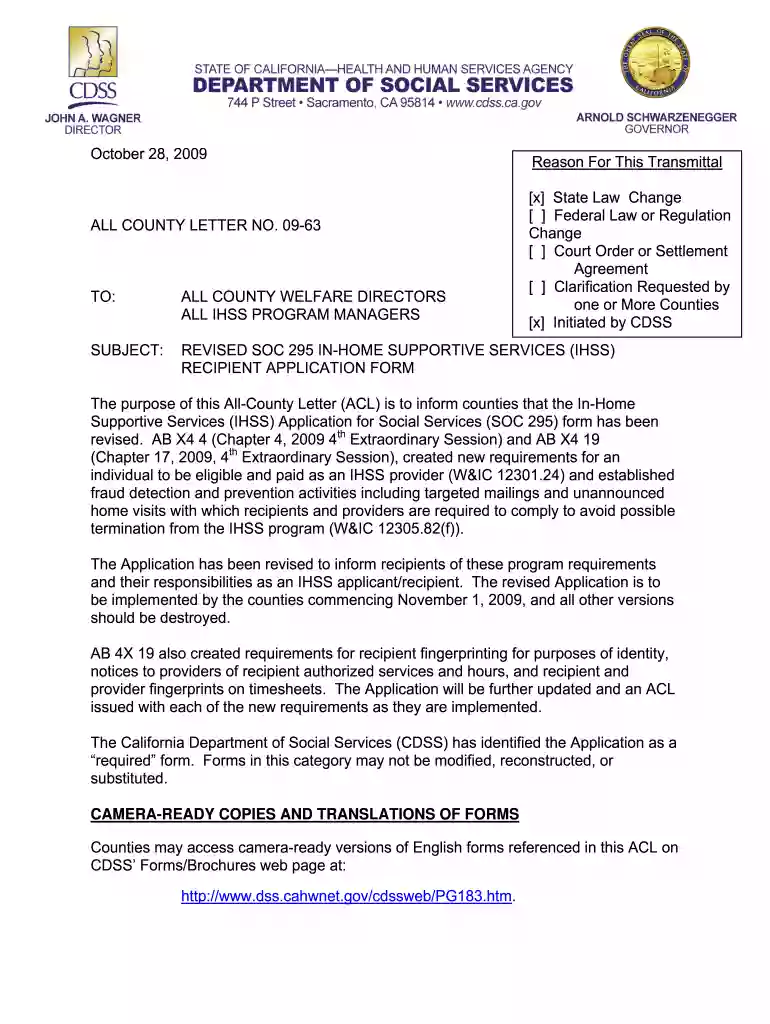
The SOC 295 form, issued by the California Department of Social Services (CDSS), serves as an application for In-Home Supportive Services (IHSS) within the state of California. This form is critical for individuals seeking assistance through IHSS, which provides aid to the elderly and disabled, allowing them to remain safely in their homes. The SOC 295 includes information regarding eligibility criteria, application procedures, and participant responsibilities within the IHSS program.
Acquiring the SOC 295 form entails several options tailored to user convenience. Applicants can access the form through the CDSS website, where they can download a PDF version available for printing and completion. For those without internet access, local county social services offices provide physical copies of the form. Additionally, individuals can request the form to be mailed to them directly by contacting their local IHSS office, ensuring broad accessibility.
Completing the SOC 295 requires attention to detail to ensure an accurate and comprehensive application. Here are the crucial steps involved:
Applicants should review the form thoroughly before submission to avoid errors or omissions that could delay processing.
Understanding the core components of the SOC 295 form is vital for accurate completion. Key elements include:
California has specific rules governing the use and submission of the SOC 295 form. These include:
These regulations ensure the proper allocation of resources and maintain the program's integrity.
The SOC 295 is legally binding and serves as an official document within the framework of the IHSS program. Completing the form accurately is crucial to prevent misunderstandings or potential legal issues. The document solidifies the agreement between the applicant and the CDSS regarding recipient responsibilities and program adherence.
Familiarity with terms associated with the SOC 295 enhances comprehension and completion accuracy. Important terms include:
Understanding these terms aids in the form's accurate completion and applicants' familiarity with the underlying program structure.
Applicants have multiple options for submitting the completed SOC 295 form:
Applicants should select the method that best suits their circumstances and ensures timely processing.
At DocHub, your data security is our priority. We follow HIPAA, SOC2, GDPR, and other standards, so you can work on your documents with confidence.
Develop your skills with guided training and prove your expertise with industry certifications. Become a market-ready cybersecurity professional.Read more
The In-Home Supportive Services (IHSS) program provides in-home assistance to eligible aged, blind, and disabled individuals. SOC 295 - Application for In-Home
The Community Leadership Internship provides students with training opportunities with local community organizations. Students engage directly with


