
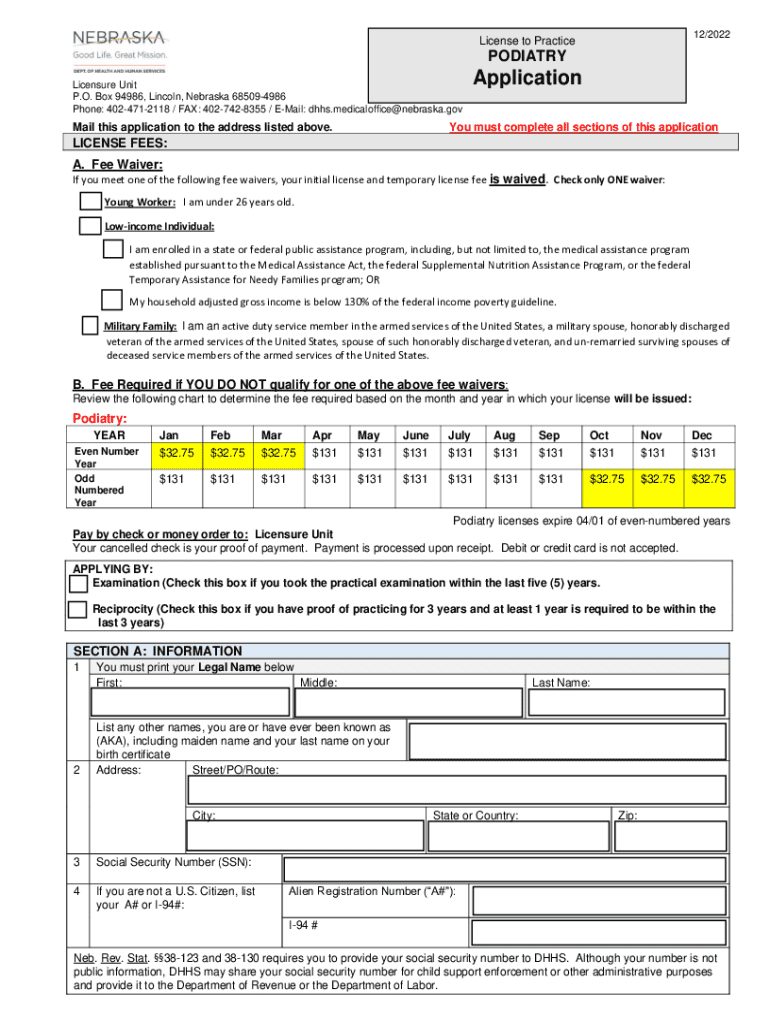







Definition and Purpose of the Podiatry License Application
The Podiatry License Application is a formal document required to practice podiatry legally within a state's jurisdiction. This application is vital for ensuring that all practicing podiatrists meet the necessary qualifications and adhere to professional standards. The process involves a comprehensive review of the candidate's educational background, professional competence, and ethical standards. It serves as a safeguard for public health by ensuring practitioners are qualified and capable of providing safe and effective care.
Importance of Obtaining a Podiatry License
- Legal Requirement: Practicing podiatry without a license is illegal and subject to penalties.
- Public Safety: Ensures practitioners have the necessary skills and knowledge.
- Professional Credibility: Provides validation and trustworthiness to patients and peers.
- Access to Practice: Required to work in hospitals, clinics, and private practices across the state.
Steps to Complete the Podiatry License Application
- Gather Required Documents: Collect proof of education, examination scores, and citizenship.
- Submit Fingerprinting: Complete background checks with fingerprint submission.
- Complete Application Form: Fill out all sections with accurate and current information.
- Review and Sign: Double-check for completeness before signing.
- Submit Application and Fees: Apply via the designated submission method and pay necessary fees.
Detailed Breakdown of Application Steps
- Educational Proof: Include transcripts from accredited podiatry schools.
- Background Checks: Perform through authorized fingerprinting services.
- Application Review: Confirm all information aligns with personal and professional records.
Required Documents for Application
- Proof of Citizenship: Provide valid government-issued identification.
- Educational Transcripts: Accredited podiatric medical college documentation.
- Examination Scores: Passing scores from recognized board exams.
- Criminal History Report: Detailed records, if applicable.
Additional Documentation
- Fee Waiver Eligibility: May apply based on age, income, or military status.
- Conviction Disclosures: Mandatory to disclose all misdemeanor and felony charges.
Eligibility Criteria for Podiatry License
To apply for a podiatry license, applicants must fulfill specific criteria:
- Educational Background: Graduation from an accredited podiatry program.
- Board Examinations: Success in state or national level exams.
- Good Moral Character: No history of malpractice or severe criminal record.


Considerations for Special Cases
- Military Service Members: Potential eligibility for certain fee waivers.
- Age or Income-Based Criteria: May influence fee structures.
State-Specific Rules and Differences
Nebraska-Specific Details
Nebraska applicants must adhere to additional requirements such as:
- Fee Waivers: Vary by state; available for eligible groups.
- Fingerprinting Process: State-specific authorized vendors.
- Document Verification: Direct submission from the issuing institution may be required.
Legal Use and Compliance
Adhering to the legal stipulations within the podiatry practice ensures compliance and maintains professional integrity. Each licensed podiatrist must:
- Conform to State Laws: Practice must align with current local regulations.
- Maintain License Validity: Renew as required, usually every two years.
- Ethical Practice Standards: Adhere to the podiatry board's code of conduct.
Examples and Scenarios in Podiatry Licensing
Real-World Application
Consider a recent graduate from a podiatry medical school:
- They must first pass the board exams and gather their education proofs.
- Subsequently, they apply for a license with the state's podiatry board.
- After approval, they can legally practice anywhere within state boundaries.
Common Challenges
- Documentation Delays: Often encountered with verifying past academic records.
- Background Disclosures: Must provide full details and may slow the process if records exist.
By understanding these elements, applicants can effectively navigate the Podiatry License Application, ensuring compliance and readiness for professional practice.




