







Definition & Meaning
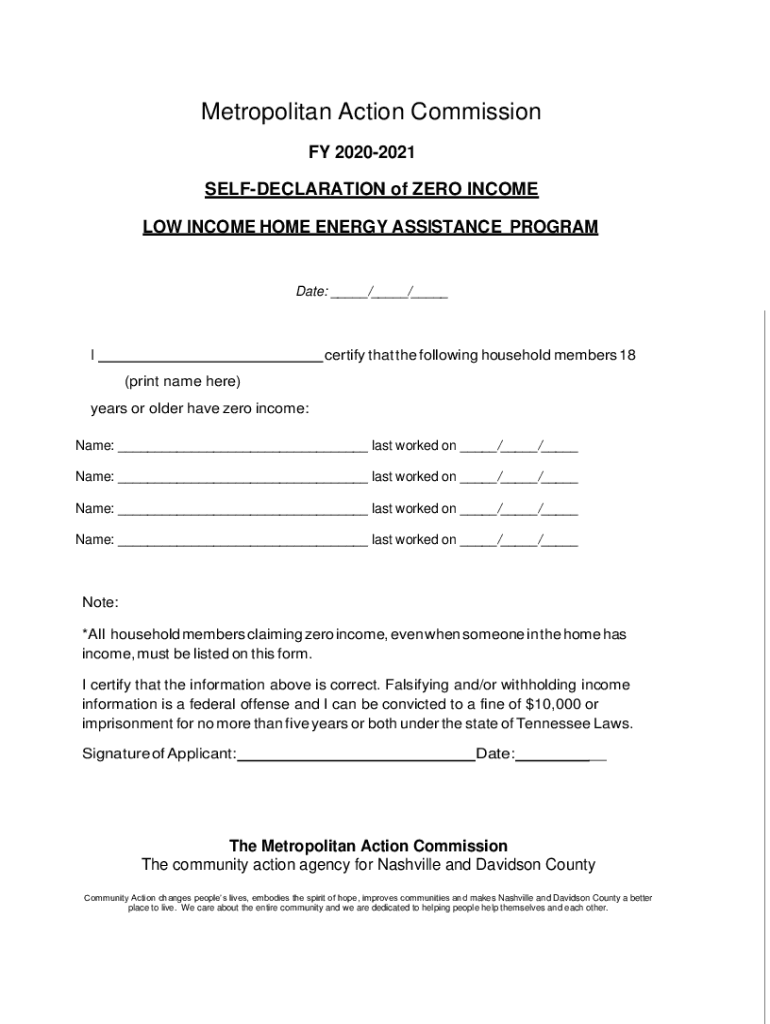
A Self Declaration For Income - Fill and Sign Printable form serves as a formal statement, affirming a lack of income for a specified period. Individuals complete this form to declare their zero income status, often for eligibility verification in various assistance programs, such as the Low Income Home Energy Assistance Program (LIHEAP). This document is vital for those who must officially report their financial situation to qualify for benefits without providing conventional proof of income, like pay stubs or tax returns.
Key Elements of the Form
The Self Declaration For Income form includes several crucial components that applicants must complete accurately. The form typically requires:
- Personal Information: Full name, date of birth, and address.
- Zero Income Declaration: An explicit statement confirming the absence of income during the relevant period.
- Employment Details: Previous employment information, including the last day worked, if applicable.
- Certification and Signature: The applicant's assertion of the form's truthfulness, often accompanied by a warning regarding the consequences of providing false information.
Steps to Complete the Form
Completing the Self Declaration For Income - Fill and Sign Printable involves several steps:
- Download and Open: Access the form via DocHub or a similar platform, ensuring compatibility with your preferred file formats.
- Personal Details: Fill in your name, address, and contact information.
- Income Declaration: Clearly state your lack of income, specifying the period relevant to this statement.
- Previous Employment: Note the last date of employment and employer's details if applicable.
- Signature Section: Electronically sign the form using DocHub’s legally binding signature tools.
Who Typically Uses the Form
The primary users of the Self Declaration For Income form include individuals with no recent income who require proof for various reasons:
- Low-Income Applicants: Individuals seeking assistance programs like LIHEAP.
- Students and Retirees: Those not earning income during the academic year or retirement.
- Unemployed Individuals: People actively seeking job opportunities without current earnings.


Legal Use of the Form
The form is legally utilized in programs requiring validation of income status for eligibility. Users should understand:
- Compliance with Laws: Complies with federal regulations such as the ESIGN Act.
- False Declaration Penalties: Federal laws penalize any false income reporting on this form, ensuring the authenticity of declarations.
IRS Guidelines
While the Self Declaration For Income form itself is not directly submitted to the IRS, it plays a role in how income or lack thereof is reported. Taxpayers should be aware of:
- Verification Needs: Situations where the form might complement tax documents as proof of financial status.
- Record Keeping: It is essential to maintain accurate records to support any potential IRS inquiries about declared zero income.
Penalties for Non-Compliance
Failing to complete the Self Declaration For Income form accurately can lead to:
- Denial of Benefits: Incorrect declarations may result in ineligibility for assistance programs.
- Legal Repercussions: Falsely declaring information can incur legal actions or fines under federal laws.
Examples of Using the Form
Practical scenarios for using the Self Declaration For Income form include:
- Program Applications: When applying for assistance programs that require proof of income status.
- Educational Grants: Students applying for financial aid who did not earn income in the previous year.
- Benefit Renewals: Periodic verification for continued eligibility for ongoing support benefits.




