




01. Edit your fhsaa florida high school athletic association online
Type text, add images, blackout confidential details, add comments, highlights and more.

Type text, add images, blackout confidential details, add comments, highlights and more.

Draw your signature, type it, upload its image, or use your mobile device as a signature pad.

Send it via email, link, or fax. You can also download it, export it or print it out.
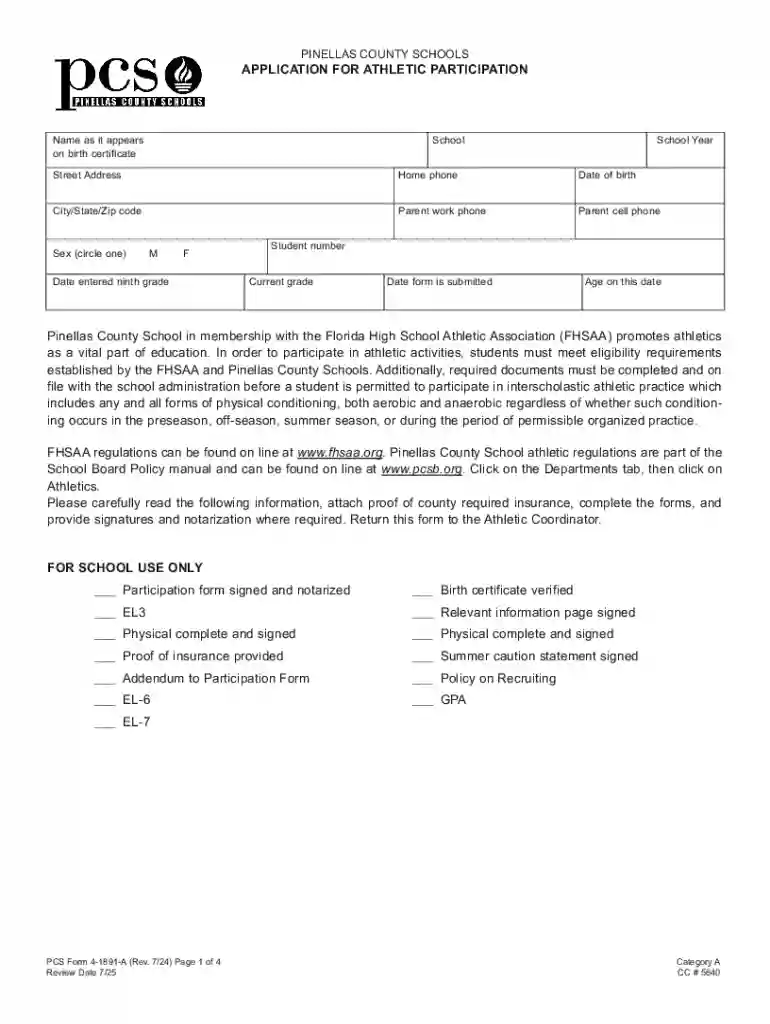
The Florida High School Athletic Association (FHSAA) Clearance for Participation Form is a critical document designed for student-athletes wishing to participate in interscholastic sports within Florida. This form serves multiple purposes, ensuring that students meet eligibility requirements, obtaining necessary parental consent for athletic involvement, and verifying acceptance of the inherent risks associated with sports participation. The form emphasizes the importance of eligibility criteria, which include academic benchmarks and the completion of various documentation.
Purpose of the FHSAA Form:
Completing the FHSAA form involves several detailed steps to ensure accuracy and compliance. Here's a breakdown of the process:
When submitting the FHSAA form, several documents must accompany the form to verify the eligibility and readiness of the student-athlete. These include:
Failing to attach any of these documents could lead to delays or rejection of the form.
Eligibility for participation in Florida high school athletics is stringently outlined by the FHSAA to maintain fairness and safety. Key criteria include:


The FHSAA form is comprehensive and includes several crucial elements that ensure clarity and completeness:
These components are integral to the form and work together to secure a student's place in athletic programs while ensuring all legal and safety requirements are met.
The FHSAA form can be submitted through various channels, providing flexibility for students and schools. Options include:
Ensuring legal compliance is paramount when dealing with the FHSAA form, as it involves minors and contractual obligations. The form's legal uses include:
Failure to comply with these legalities can result in disqualification of the student-athlete or potential legal repercussions for the school.
Understanding real-world applications of the FHSAA form can provide clarity. Consider these scenarios:
These examples highlight the form's critical role in facilitating smooth athletic participation under various circumstances.
The FHSAA form is used predominantly by:
These stakeholders ensure that all aspects of student athlete participation are managed legally and efficiently.

Non-compliance with FHSAA requirements can lead to significant penalties. Schools or students failing to adhere might face:
It is vital for all parties involved to meticulously follow FHSAA guidelines to avoid these penalties.
We've got more versions of the fhsaa florida high school athletic association form. Select the right fhsaa florida high school athletic association version from the list and start editing it straight away!
At DocHub, your data security is our priority. We follow HIPAA, SOC2, GDPR, and other standards, so you can work on your documents with confidence.
The school sued, alleging violations of their free speech and free exercise rights, and the Athletic Association changed their defense to claim that using theRead more
The Florida High School Athletic Association (FHSAA) is designated as a governing nonprofit organization of athletics in Florida public schools. If the FHSAARead more


