




01. Edit your aadt drug online
Type text, add images, blackout confidential details, add comments, highlights and more.

Type text, add images, blackout confidential details, add comments, highlights and more.

Draw your signature, type it, upload its image, or use your mobile device as a signature pad.

Send aadt drug testing via email, link, or fax. You can also download it, export it or print it out.
AADT drug testing is a process utilized by the American Alliance Drug Testing service to evaluate individuals for the presence of drugs and alcohol. This testing is essential for maintaining compliance with regulations, particularly in safety-sensitive industries such as transportation, where adherence to Department of Transportation (DOT) guidelines is crucial. It involves collecting biological samples, typically urine, to identify the presence of substances that may impair an individual's ability to perform their duties safely. The results from these tests are used to ensure public safety, uphold workplace standards, and maintain compliance with federal regulations.
Understanding the significance of AADT drug testing requires recognizing its role in safety-sensitive industries. In fields such as aviation, trucking, and public transportation, ensuring employees are free from substance abuse is critical. Drug testing helps prevent accidents and ensure that those responsible for public safety are performing optimally. The tests also serve as a deterrent against substance abuse, encouraging a drug-free workplace policy that aligns with legal and ethical standards.
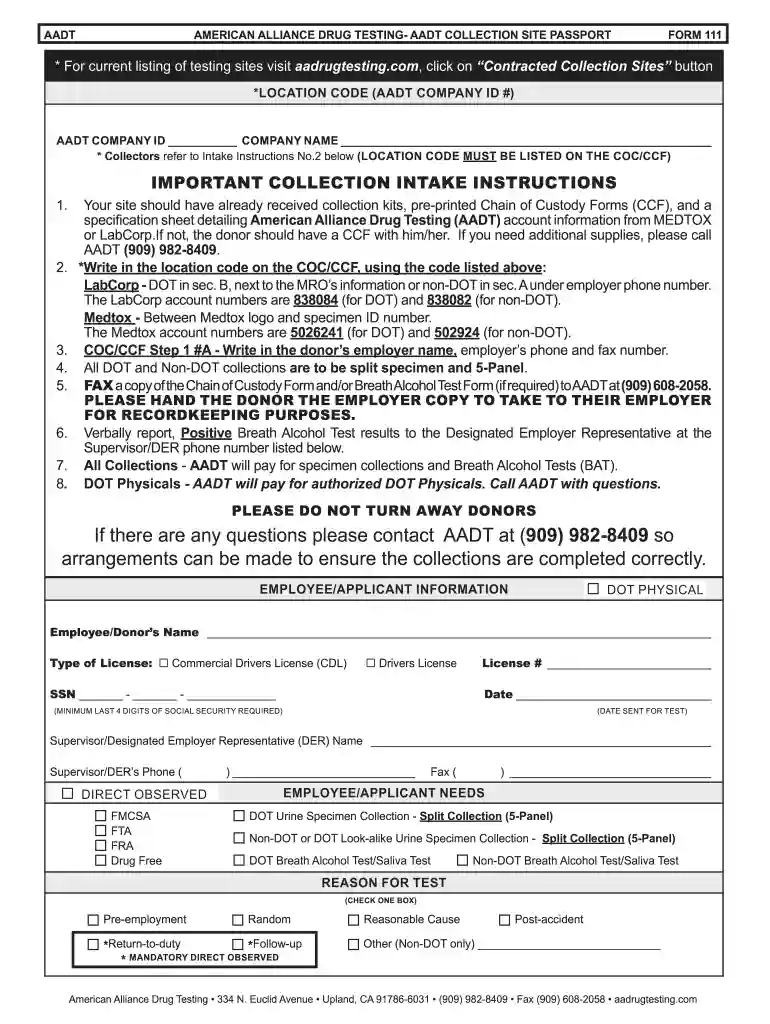
The core components of AADT drug testing include the collection of samples, the utilization of Chain of Custody Forms (CCF), and the analysis of results. Sample collection is a standardized procedure that ensures accuracy and reliability. Chain of Custody Forms are vital for maintaining the integrity of the samples, documenting each stage from collection to analysis. This form provides a documented trail that is necessary for handling legal and compliance issues. Analysis is performed in certified laboratories, ensuring that results are accurate and compliant with federal standards.
The Chain of Custody Form is a critical document that tracks the handling and storage of samples. It ensures that the sample integrity is maintained from the collection point to the laboratory. Accurate completion of this form is essential for the validity of the test, safeguarding against any potential tampering or misidentification.
To initiate AADT drug testing, an individual or organization must contact a certified collection site associated with the American Alliance Drug Testing network. These sites are responsible for collecting samples, managing the documentation process, and sending the samples to accredited labs for evaluation. Businesses often set up agreements with testing providers to regularly test employees as part of their occupational health and safety programs.
Organizations should identify a certified collection site by consulting with AADT's network, which is documented in the form of a Collection Site Passport. This passport contains pertinent information about locations, testing procedures, and contact details necessary for setting up appointments or walk-in testing.
Completing the AADT drug testing involves several steps to ensure compliance with established protocols. These stages include pre-test preparations, sample collection, documentation, and result reporting.
The collector plays a crucial role during the sample collection process. They ensure the correct procedures are followed, verify the identity of the test subject, and maintain sample integrity through proper handling and documentation.
The legal foundation for AADT drug testing is built upon compliance with federal and state laws, including the DOT regulations. Employers must adhere to these legal frameworks to ensure the tests are legally binding and the results defensible in a court of law. Privacy laws must also be considered, ensuring the information is handled confidentially and only shared with authorized personnel.
Organizations in transportation are particularly concerned with DOT compliance, as failure to comply can result in significant penalties. Regular testing as per DOT guidelines helps maintain operational licenses and protects against potential liabilities stemming from drug-related incidents.
Though federal regulations provide a general framework for drug testing, state-specific laws may impose additional requirements or stipulations. These can affect how tests are administered, privacy policies, and what substances are included in the testing panel. Organizations must be aware of state laws where they operate to ensure full compliance.
In some states, there may be additional notification requirements for employees, differing thresholds for permissible substance levels, or distinct privacy protections. Employers should routinely review the regulations in their state to align their drug testing policies with legal expectations.
Understanding key terminologies within AADT drug testing is essential for interpreting testing protocols, results, and compliance requirements. Some important terms include:
DOT vs. non-DOT testing involves different processes and legal implications. DOT collections are mandated for employees in safety-sensitive positions, ensuring consistent safety standards nationally. In contrast, non-DOT collections may be determined by company policy or state laws, offering more flexibility in how they are conducted.
Organizations that fail to comply with AADT drug testing requirements may face significant penalties. These include fines, suspension of operational licenses, and damage to reputation. Ensuring adherence to all testing protocols minimizes these risks and supports a safe and compliant workplace environment.
Penalties vary depending on the nature and severity of the non-compliance. Minor paperwork errors may result in corrective action, whereas significant breaches, such as failing to perform mandated tests, can result in heavier fines or operational shutdowns.
We've got more versions of the aadt drug form. Select the right aadt drug version from the list and start editing it straight away!
At DocHub, your data security is our priority. We follow HIPAA, SOC2, GDPR, and other standards, so you can work on your documents with confidence.
A blood test can easily diagnose AATD. These tests may include: Blood tests to check liver function. An ultrasound of the belly and liver. A liver biopsy.
American Alliance Drug Testing (AADT), 326 N Euclid Avenue, Upland, CA 91786-6031, (800) 820-9314. Any Time Analysis, 1507 S College Ave, Bryan, TX 77801, (979)Read more


