




01. Edit your form online
Type text, add images, blackout confidential details, add comments, highlights and more.

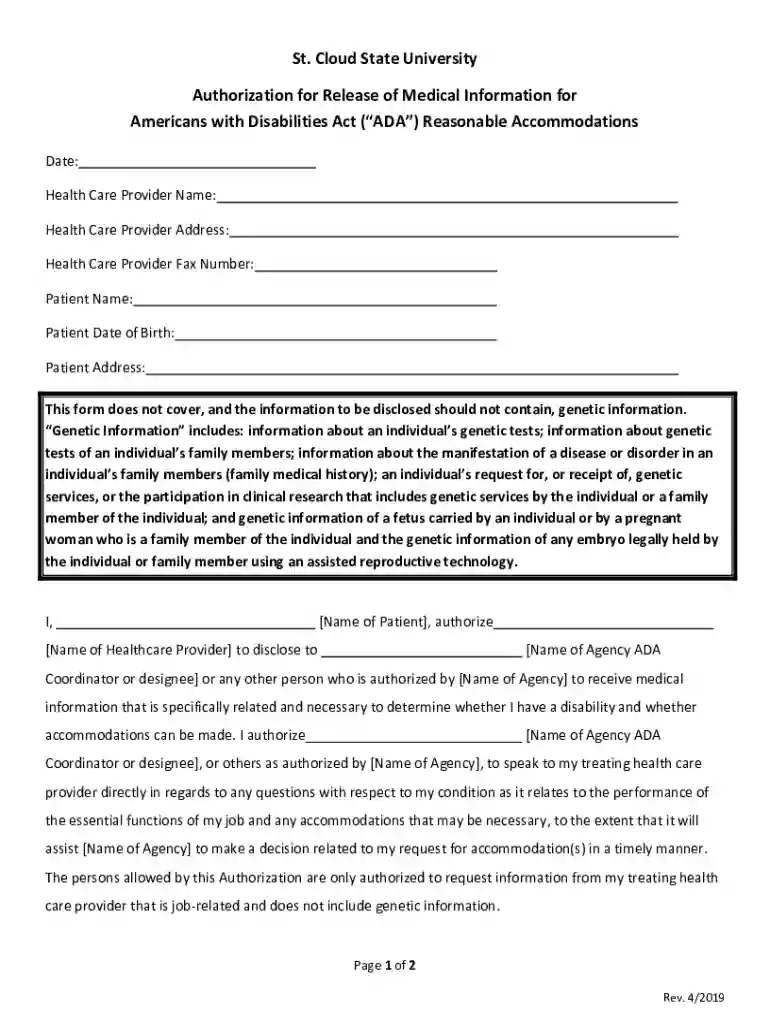
Type text, add images, blackout confidential details, add comments, highlights and more.

Draw your signature, type it, upload its image, or use your mobile device as a signature pad.

Send it via email, link, or fax. You can also download it, export it or print it out.
The ADA Authorization for Release of Medical Information Form is a crucial document used primarily within the context of the Americans with Disabilities Act (ADA). This form allows individuals to grant permission for their healthcare providers to disclose pertinent medical information necessary for establishing reasonable accommodations at workplaces or educational institutions. Importantly, the form specifies that genetic information should not be shared, ensuring that privacy concerns are respected.
Using the ADA Authorization for Release of Medical Information Form involves several key steps to ensure that it is completed and submitted correctly.
Understanding the key elements of this form is essential for its effective use.
This form is used by various stakeholders in different contexts.


The legal foundation of this form is supported by various regulations to ensure privacy and compliance.
There are numerous scenarios where this form proves indispensable.
Different states may have variances in handling these forms.
The choice between digital and paper versions can impact convenience and accessibility.
We've got more versions of the ADA Authorization for Release of Medical Information Form form. Select the right ADA Authorization for Release of Medical Information Form version from the list and start editing it straight away!
| Versions | Form popularity | Fillable & printable |
|---|---|---|
| 2025 | 4.6 Satisfied (36 Votes) | |
| 2024 | 4.8 Satisfied (57 Votes) | |
| 2024 | 4.5 Satisfied (54 Votes) | |
| 2024 | 4.6 Satisfied (24 Votes) | |
| 2024 | 4.2 Satisfied (22 Votes) | |
| 2023 | 4.6 Satisfied (29 Votes) | |
| 2023 | 4.2 Satisfied (33 Votes) | |
| 2023 | 4.8 Satisfied (51 Votes) | |
| 2023 | 4.3 Satisfied (30 Votes) | |
| 2023 | 4.4 Satisfied (43 Votes) | |
| 2023 | 4.1 Satisfied (50 Votes) | |
| 2023 | 4.8 Satisfied (43 Votes) | |
| 2023 | 4.3 Satisfied (48 Votes) | |
| 2022 | 4.8 Satisfied (52 Votes) | |
| 2022 | 4.1 Satisfied (32 Votes) |
At DocHub, your data security is our priority. We follow HIPAA, SOC2, GDPR, and other standards, so you can work on your documents with confidence.


