




01. Edit your practice add subtract fractions online
Type text, add images, blackout confidential details, add comments, highlights and more.

Type text, add images, blackout confidential details, add comments, highlights and more.

Draw your signature, type it, upload its image, or use your mobile device as a signature pad.

Send it via email, link, or fax. You can also download it, export it or print it out.
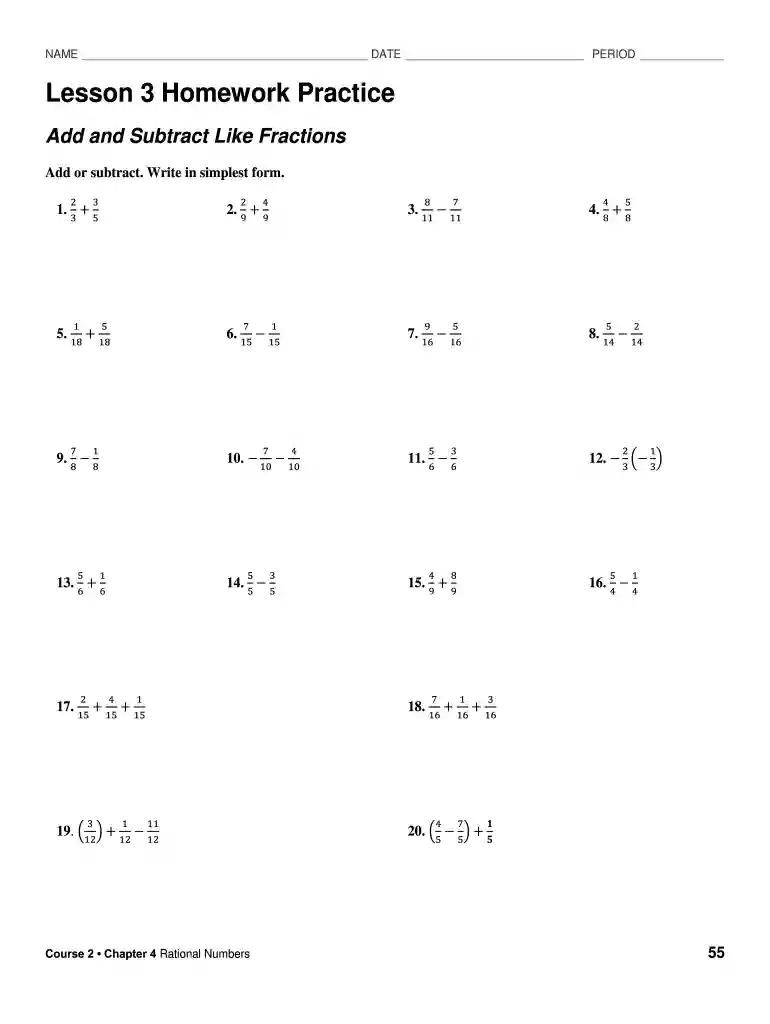
Rational numbers, discussed in course 2 chapter 4, are numbers that can be expressed as a fraction of two integers, where the numerator is an integer and the denominator is a non-zero integer. These numbers represent a significant concept in mathematics as they introduce students to the idea of numbers beyond simple whole numbers and integers, emphasizing the breadth of the number system. This chapter covers the fundamental properties of rational numbers, including their place on the number line and their ability to represent real-world quantities that are not whole numbers, such as distances, times, and portions.
Utilizing the content from course 2 chapter 4 involves understanding key operations with rational numbers, such as addition, subtraction, multiplication, and division. These operations help students develop proficiency in manipulating fractions and decimals, which are vital skills in both academic and practical environments. Students are encouraged to use these skills to solve complex problems, interpret data, and understand proportions and ratios. Engaging with exercises on rational numbers equips students to handle topics in algebra and other higher-level math courses effectively.
One practical scenario in which rational numbers are applied is grocery shopping. When calculating costs, particularly with products priced by weight, rational numbers become essential. For example, if apples are priced at $1.50 per pound, buying 2.5 pounds results in a cost of $3.75. Here, both the quantity and total cost involve rational numbers.
Rational numbers are prevalent in various real-world scenarios, such as:
While rational numbers themselves are a universal concept, teaching methodologies and curriculum integration may vary by state. Some states may prioritize different areas of focus or require alignment with specific educational standards, influencing how chapter 4 content is delivered in classrooms.
Textbooks and educational resources might offer variations or alternatives to the standard presentation of rational numbers. These can include interactive digital tools, visual aids, or supplementary workbooks that provide additional exercises and examples to enhance understanding and retention of the material.
We've got more versions of the practice add subtract fractions form. Select the right practice add subtract fractions version from the list and start editing it straight away!
| Versions | Form popularity | Fillable & printable |
|---|---|---|
| 2014 | 4.1 Satisfied (50 Votes) |
At DocHub, your data security is our priority. We follow HIPAA, SOC2, GDPR, and other standards, so you can work on your documents with confidence.
We will find out that we can solve some of these quadratic equations using the techniques of this chapter and only using rational numbers. (7x2 4) (6x2 +Read more
Operations with Rational Numbers. Course 2 mathematics common core emphasizes fluency with rational numbers, which include fractions, decimals, and integers


