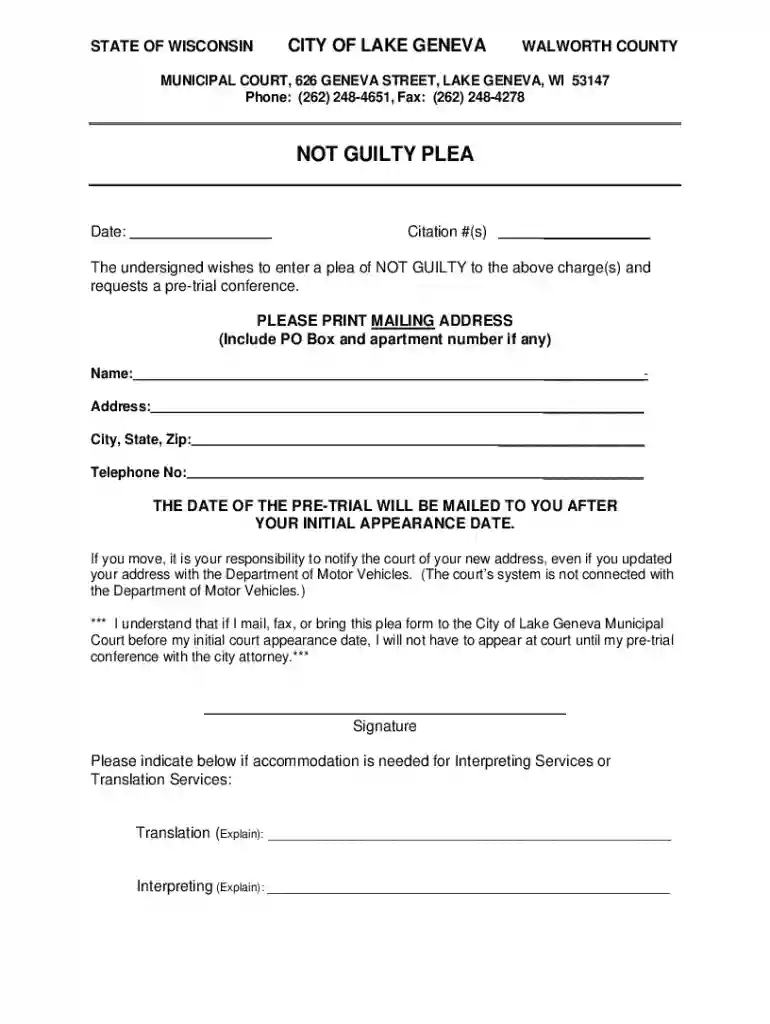
Not Guilty Plea doc 2026

Get Form
Not Guilty Plea doc Preview on Page 1

Here's how it works

01. Edit your form online
Type text, add images, blackout confidential details, add comments, highlights and more.

02. Sign it in a few clicks
Draw your signature, type it, upload its image, or use your mobile device as a signature pad.

03. Share your form with others
Send it via email, link, or fax. You can also download it, export it or print it out.

Definition and Meaning

The Not Guilty Plea document is a legal form used to formally declare an individual’s intent to contest the charges brought against them in a court of law. This form is integral in the judicial process as it sets the stage for further legal proceedings, typically leading to a pre-trial conference. By filing this plea, a defendant asserts their right to challenge the evidence presented by the prosecution.

Contextual Importance

  • Formal Declaration: The document serves as a written declaration of the defendant's plea of not guilty.
  • Legal Right: It upholds the individual's legal right to a fair trial.

Real-world Scenario

For example, if a person is accused of a traffic violation they did not commit, they can use the Not Guilty Plea form to dispute the charge and seek a trial where they can present their case before a judge or jury.

Key Elements of the Not Guilty Plea Document

Understanding the components of this form is crucial for its correct execution and submission. The form typically requires the following elements:

Personal Information

  • Name, Address, and Contact Details: Necessary for court records and communication.
  • Case Number: Identifies the specific charges being contested.

Plea Declaration

  • Statement of Intent: Clearly indicates the plea of not guilty to the charges.

Additional Requests

  • Pre-trial Conference Request: Optional section where defendants can request a meeting with the prosecution to discuss the case.
  • Interpretation Services: A section for requesting an interpreter if needed.

Practical Example

Suppose an individual, John Doe, is charged with disorderly conduct in Wisconsin. The document would include his full name, address, the charge details, and an explicit statement that he pleads not guilty.

How to Obtain the Not Guilty Plea Document

Acquiring the form is a straightforward process that can vary slightly depending on jurisdiction and the method chosen.

Sources for Acquisition

  1. Court Website: Most state and municipal courts offer downloadable versions of the plea form on their websites.
  2. Physical Copies: Available for pickup at the courthouse where the case is filed.
  3. Legal Aid Offices: Provide assistance and copies of the form for those who qualify.

Detailed Steps

  • Online Access: Search for the specific court's site where your case is assigned to download the form.
  • In-Person Collection: Visit the court clerk's office to obtain a physical copy.

Steps to Complete the Not Guilty Plea Document

Properly completing the form is essential to ensure it is accepted by the court.

Step-by-Step Process

  1. Fill Personal Information: Enter your legal name, address, and contact details.
  2. Identify the Case: Include the case number and any relevant details specific to the charge.
  3. Declare the Plea: Clearly mark or write "Not Guilty" in the appropriate section.
  4. Sign and Date: Provide a signature which serves as a verification of the information provided.
  5. Optional Requests: Indicate any requests for pre-trial conferences or translation services if necessary.

Edge Cases

In situations where you have multiple charges, each charge must be addressed individually within the document or with separate forms if required by the court.

Who Typically Uses the Not Guilty Plea Document

This document applies to various individuals and entities based on legal necessity and circumstance.


decoration image ratings of Dochub

Typical Users

  • Individuals Charged with Crimes: Persons facing misdemeanors or felonies.
  • Traffic Violations: Drivers disputing tickets or charges.
  • Legal Representatives: Attorneys filing on behalf of clients.

Example Scenarios

  • A store owner charged with a zoning ordinance violation would use this form to contest the allegation.
  • Students or tourists charged with misdemeanor offenses like vandalism or loitering.

Legal Use of the Not Guilty Plea Document

The form plays a significant role within the legal framework and comes with specific implications.

Compliance and Rights

  • Invoke the Right to a Trial: Submitting the plea emphasizes your commitment to a legal defense in court.
  • Avoids Default Judgment: Prevents the court from automatically convicting you in absentia.

State-specific Considerations

Each state may have unique nuances regarding how plea documents are processed, though most adhere to a fundamental legal structure ensuring defendants can contest charges effectively within the judicial system.

Important Terms Related to the Not Guilty Plea Document

Familiarity with specific legal terms enhances comprehension and improves form accuracy.

Relevant Terms

  • Defendant: The individual disputing charges.
  • Pre-trial Conference: A meeting between the defense and prosecution.
  • Interpreter Services: Provided for non-English speakers or those with disabilities that affect communication.

Explanation of Terms

For instance, during the pre-trial conference, the defense might negotiate reduced charges, or reach an agreement on potential plea bargains.

State-specific Rules for the Not Guilty Plea Document

Notable differences exist in procedural and substantive law among U.S. states.

Variations Across States

  • Filing Deadlines: Time limits for filing can differ, affecting how quickly one needs to act.
  • Supplementary Requirements: Some states might require additional affidavits or declarations with the plea.

Wisconsin-specific Example

In Wisconsin, filing must occur after the initial court date but before the deadline specified by the court, which is often outlined during the first appearance.

By understanding these elements and following a structured approach, individuals can effectively leverage the Not Guilty Plea form within the U.S. legal system, ensuring that their rights are preserved and defended appropriately.

be ready to get more

Complete this form in 5 minutes or less

Get form

Got questions?

We have answers to the most popular questions from our customers. If you can't find an answer to your question, please contact us.
Contact us
Pleading not guilty means that you say you didnt do the crime. Or that you did, but you had an excuse which the law recognises as a defence. The court will then have a trial to decide whether youre guilty. If the court decides that you are guilty, youll be convicted. The court will decide what sentence to give you.
Pleading not guilty You will be able to challenge the prosecution and, if you choose to give your own evidence, this will be on oath, where you must swear to tell the truth. Usually your lawyer will act as your defence but you do have the right to represent yourself in court without a lawyer.
Not guilty refers to either a type of plea or verdict in a criminal case. A defendant can make a not guilty plea which means the defendant denies committing the accused crime or one of the facets of the crime.
If you plead not guilty, you are contesting the charge and the case will proceed to a hearing or trial. This allows you to: challenge the evidence presented by the prosecution. present your own evidence and witnesses.
A not guilty plea denies the charge and none of your constitutional rights are waived unless you expressly wish to do so. You are presumed innocent, and the prosecution must prove your guilt beyond a reasonable doubt at a subsequent trial. The next hearing will be a pretrial and trial-setting conference.

Security and compliance

At DocHub, your data security is our priority. We follow HIPAA, SOC2, GDPR, and other standards, so you can work on your documents with confidence.

Learn more
ccpa2
pci-dss
gdpr-compliance
hipaa
soc-compliance

People also ask

The government can never appeal from a Not Guilty finding, whether it was made by a Judge or Jury. At that point, the case is dismissed, all orders are vacated, bail is exonerated, and the Defendant is discharged. The Double Jeopardy Clause of the US Constitution prohibits the jurisdiction from re-trying the case.

Related links