




01. Edit your tab hearing by mail online
Type text, add images, blackout confidential details, add comments, highlights and more.

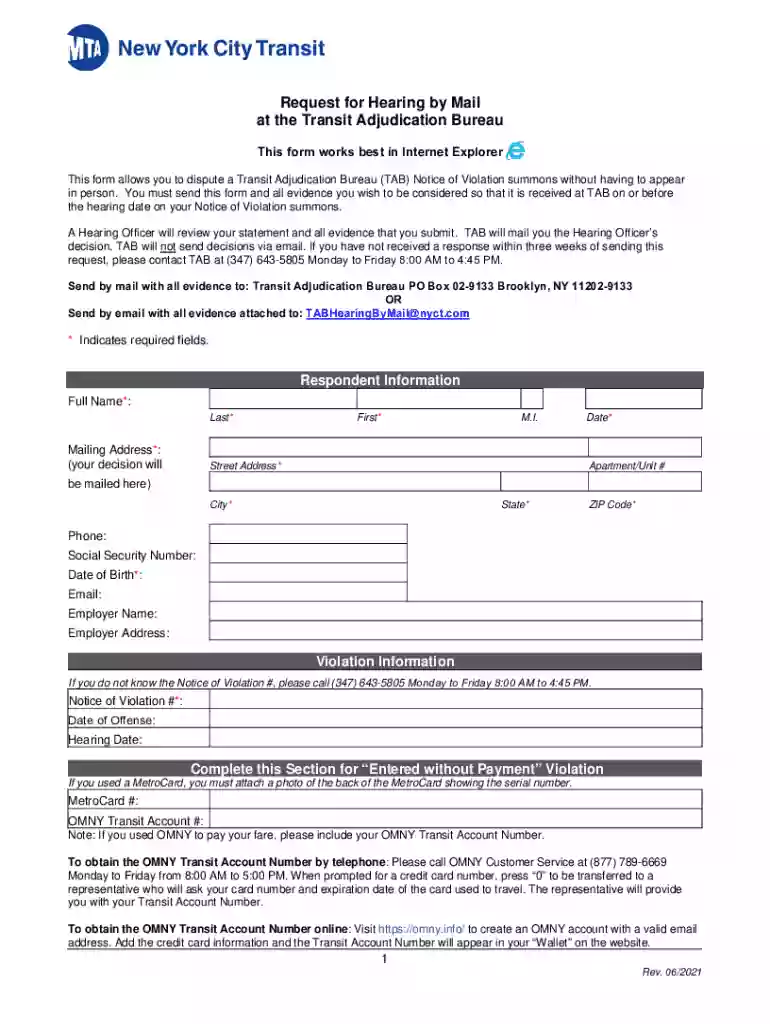
Type text, add images, blackout confidential details, add comments, highlights and more.

Draw your signature, type it, upload its image, or use your mobile device as a signature pad.

Send transit adjudication bureau violation number via email, link, or fax. You can also download it, export it or print it out.
The Transit Adjudication Bureau Hearing by Email refers to the process where individuals can contest a Notice of Violation issued by public transit authorities without needing to appear in person. Typically applicable in the context of transit systems in the United States, this process allows individuals to submit evidence and statements via email. It facilitates the adjudication of disputes such as fare evasion or misconduct on public transportation.
Engaging in the hearing process by email serves multiple purposes:
Using the Transit Adjudication Bureau hearing by email involves adhering to specific steps and requirements to ensure that the process is successful.
Receive the Notice of Violation: Upon receiving an initial violation notice, review it for specifics on the alleged infraction.
Prepare Documentation: Gather all relevant documents, such as tickets, identification, and any other evidence that supports your case.
Compose Your Response: Clearly outline your case, addressing the specifics of the violation. Include any mitigating factors or explanations.
Submit via Email: Send your documentation and response to the designated email address provided within the notice.
Confirmation Receipt: Await confirmation that your submission has been received and is under review.
Completing the hearing process involves systematic steps, each requiring attention to detail to ensure accuracy and compliance.
A successful email appeal will often hinge on the documentation provided. Essential documents typically include:
Understanding relevant terminology is essential for successfully engaging with the hearing process.
The legal framework of utilizing email for the hearing process rests on the principles of fair adjudication and access to justice. In line with U.S. regulations, this medium allows for an efficient resolution while maintaining procedural fairness.
Though the Transit Adjudication Bureau primarily operates within New York City, similar processes may exist elsewhere under different frameworks. State-specific considerations could affect the procedure:
Understanding how others have leveraged this process can provide practical insights.
The above details reflect comprehensive elements essential for anyone involved in a Transit Adjudication Bureau Hearing by Email, providing guidance through an effective, streamlined process.
We've got more versions of the tab hearing by mail form. Select the right tab hearing by mail version from the list and start editing it straight away!
At DocHub, your data security is our priority. We follow HIPAA, SOC2, GDPR, and other standards, so you can work on your documents with confidence.
May 29, 2026 Transit Adjudication Bureau (TAB). Transit Adjudication Bureau Notice of Violation and Hearing Served. Contact Us (518) 282-0175 (text) )
Click any tag in the cloud to see all articles tagged with it. The AI Drafter and First Appeal tools will pre-fill with the tag context, so you can draft an RTIRead more


