




01. Edit your trauma history questionnaire thq pdf online
Type text, add images, blackout confidential details, add comments, highlights and more.

Type text, add images, blackout confidential details, add comments, highlights and more.

Draw your signature, type it, upload its image, or use your mobile device as a signature pad.

Send it via email, link, or fax. You can also download it, export it or print it out.
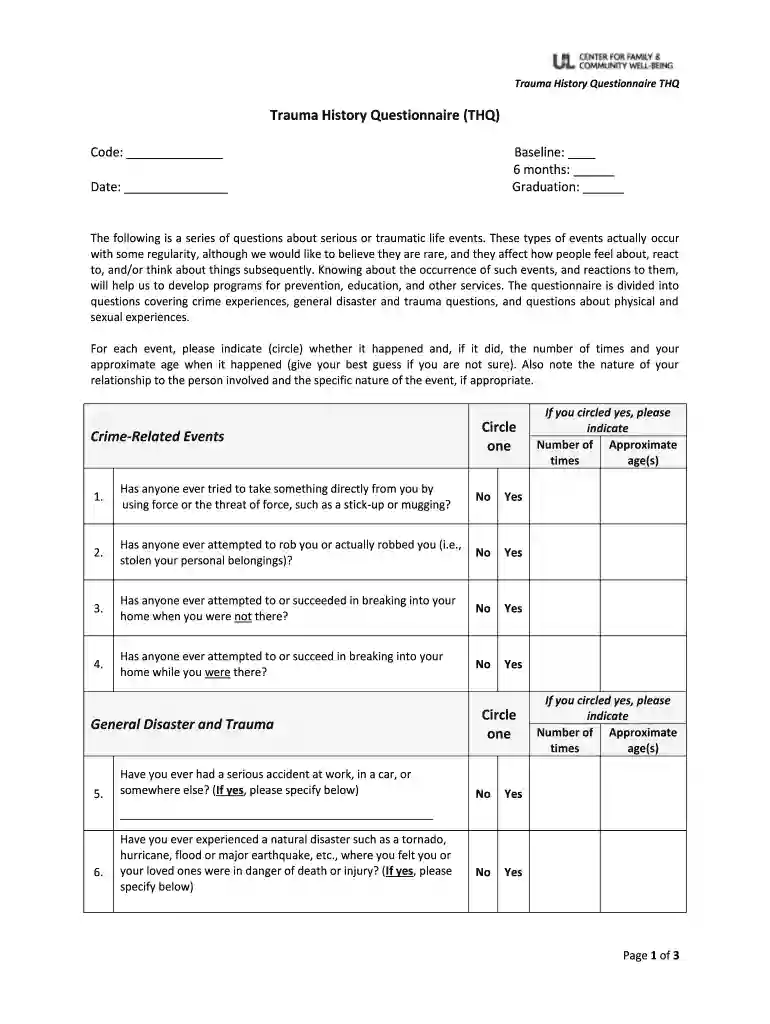
The Trauma History Questionnaire (THQ) is a critical tool used to evaluate individuals' exposure to traumatic events across various scenarios. It is designed to collect comprehensive information about life-threatening occurrences, including natural disasters, accidents, and instances of abuse. This detailed assessment helps practitioners tailor prevention strategies and educational initiatives to address and mitigate the impacts of trauma on individuals. By capturing frequency and context, the THQ assists in identifying patterns and providing insight into the support needed for recovery and resilience.
The THQ consists of several segments that focus on life events which could potentially be traumatic:
Understanding these key components allows respondents and evaluators to gain a clear picture of past traumas, enabling effective analysis and subsequent intervention.
Using the THQ involves a structured process to ensure accuracy and thoroughness:
Completing the THQ requires attention to detail and sensitivity to the personal nature of the questions:
The THQ is widely used by:
Understanding its use in various professional contexts highlights its versatility and importance in trauma-informed care.


Legal frameworks govern the use of the Trauma History Questionnaire to protect respondent privacy:
By maintaining strict confidentiality, the THQ becomes a trusted tool for gathering sensitive information, essential for ethical and effective trauma assessment.
There are numerous benefits to using the THQ:
The THQ can be administered in both digital and paper formats, each with its advantages:
Balancing these mediums allows administrators to choose the most appropriate format for their specific needs, enhancing the accessibility and efficiency of the THQ.
Real-world applications of the THQ illustrate its utility in various settings:
These examples highlight how the THQ supports meaningful improvements in individual and community well-being.
We've got more versions of the trauma history questionnaire thq pdf form. Select the right trauma history questionnaire thq pdf version from the list and start editing it straight away!
| Versions | Form popularity | Fillable & printable |
|---|---|---|
| 2019 | 4.2 Satisfied (22 Votes) |
At DocHub, your data security is our priority. We follow HIPAA, SOC2, GDPR, and other standards, so you can work on your documents with confidence.
The Trauma History Questionnaire (THQ) is a 24-item self-report measure that examines experiences with potentially traumatic events such as crime, generalRead more
The questionnaire is divided into questions covering crime experiences, general disaster and trauma questions, and questions about physical and sexualRead more


