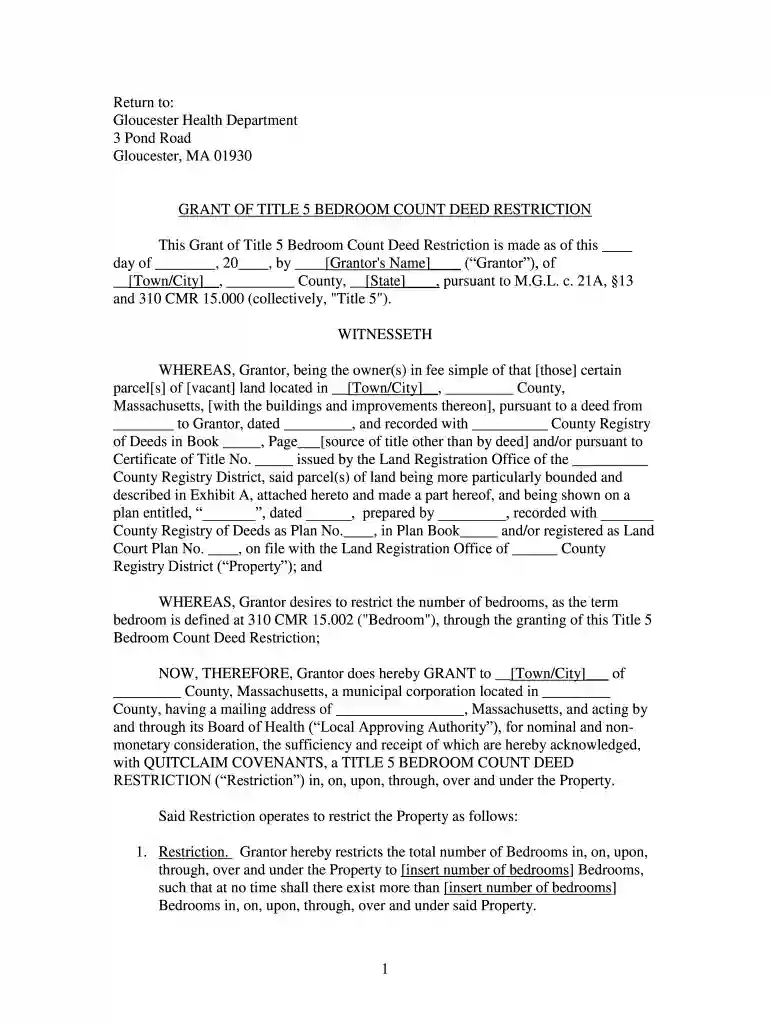
Massachusetts Title 5 Bedroom Count Deed Restriction 2026

Get Form
Massachusetts Title 5 Bedroom Count Deed Restriction Preview on Page 1

Here's how it works

01. Edit your form online
Type text, add images, blackout confidential details, add comments, highlights and more.

02. Sign it in a few clicks
Draw your signature, type it, upload its image, or use your mobile device as a signature pad.

03. Share your form with others
Send it via email, link, or fax. You can also download it, export it or print it out.

Definition and Purpose of the Massachusetts Title 5 Bedroom Count Deed Restriction

The Massachusetts Title 5 Bedroom Count Deed Restriction is a legal instrument used to limit the number of bedrooms in a specified property in Massachusetts. This restriction ensures that the property complies with local wastewater management regulations, which are essential for environmental protection and public health. By restricting the bedroom count, it helps manage the potential impact on local sewage systems and prevents overloading.

This deed restriction runs in perpetuity, meaning it remains in effect indefinitely, unless formally amended or removed through a legal process. It is enforced by local authorities, who oversee compliance to ensure that the environmental standards are being maintained.

Steps to Obtain the Massachusetts Title 5 Bedroom Count Deed Restriction

To obtain a Title 5 Bedroom Count Deed Restriction, property owners must follow these steps:

  1. Consult Local Authorities: Start by contacting local municipal offices to understand the specific requirements and guidelines in the area.
  2. Prepare Required Documentation: Gather necessary documents, including the current title deed, property plans, and any previous assessments regarding sewage and waste management.
  3. Submit an Application: Fill out the official application for a deed restriction, which may be available at local government offices or their websites.
  4. Undergo an Inspection: A site inspection by local authorities might be required to assess the property’s current state and confirm that it meets the necessary requirements.
  5. Record the Restriction: Once approved, the deed restriction must be formally recorded with the appropriate registry of deeds to become effective.

Key Elements of the Massachusetts Title 5 Bedroom Count Deed Restriction

The deed restriction consists of several critical elements:

  • Number of Bedrooms: Clearly defines the maximum number of bedrooms allowed on the property.
  • Enforcement Mechanisms: Details the measures that local authorities can take if the restriction is violated, including possible penalties.
  • Recordation and Amendment Provisions: Explains how the restriction is recorded and the process for making any amendments or lifting the restriction in the future.
  • Legal Obligations: Outlines the responsibilities of property owners concerning the maintenance of the restriction and ensuring continued compliance with local laws.

How to Use the Massachusetts Title 5 Bedroom Count Deed Restriction

Using the deed restriction requires understanding and adherence to the terms specified within the document. Property owners must:

  • Conduct Regular Checks: Ensure that any construction or renovation plans adhere to the restrictions.
  • Consult Experts: Engage with legal or environmental experts to ensure full compliance with state and local regulations.
  • Work with Local Authorities: Maintain open communication with municipal offices to report any changes or request amendments if the property conditions change or if expansions are considered.

Legal Use and Compliance

The deed restriction legally binds current and future property owners to comply with specified bedroom counts. Compliance involves:

  • Regular Inspections: Property owners should expect periodic inspections to verify adherence.
  • Amendments: If the circumstances change, amendments can be pursued through a formal application process with the approval of local authorities.
  • Reporting Violations: Violations must be reported and corrected promptly, with the possibility of fines or enforcement actions for non-compliance.

State-Specific Rules for Deed Restrictions

In Massachusetts, Title 5 is a comprehensive set of regulations governing septic systems. This deed restriction is part of that framework, focusing on wastewater management:

  • Environmental Standards: Adhering to the standards prevents environmental degradation and protects natural resources.
  • Local Compliance: Policies can vary by municipality, requiring property owners to familiarize themselves with local ordinances beyond state guidelines.

Important Terms Related to the Massachusetts Title 5 Bedroom Count Deed Restriction

Understanding key terms is vital:

  • Title 5: Refers to a set of state regulations concerning septic systems and wastewater treatment.
  • Deed Restriction: A binding legal obligation recorded with the property deed, limiting property use.
  • Registry of Deeds: The government office where property documents are filed for public record.

Examples of Using the Massachusetts Title 5 Bedroom Count Deed Restriction

Consider scenarios where this restriction is utilized:

  • New Construction: A developer must conform to bedroom limits during planning to secure project approval.
  • Property Sale: Prospective buyers should be informed of the restriction to avoid future compliance issues.
  • Environmental Conservation Projects: Such restrictions support efforts to preserve local wildlife habitats and water quality by limiting residential density.

Variations and Exceptions in the Massachusetts Title 5 Bedroom Count Deed Restriction

While generally uniform, exceptions may occur:

  • Special Permits: In some cases, local zoning boards may grant exceptions through special permitting processes.
  • Amendments: Existing restrictions might be amended for unforeseen circumstances affecting sewage capacity, requiring additional documentation and approval.

Property owners are encouraged to work closely with legal experts to ensure comprehensive understanding and adherence to these requirements.

be ready to get more

Complete this form in 5 minutes or less

Get form

Got questions?

We have answers to the most popular questions from our customers. If you can't find an answer to your question, please contact us.
Contact us
Title 5 Guidance A deed notice that must be included in the chain of title for a property served by an alternative sewage-disposal system. This deed restriction serves to limit the number of bedrooms that a property can have according to the Title 5 regulations.
Deed restrictions are a common tool for creating and maintaining affordable housing units. Affordability restrictions typically limit the sale or lease of a property to households earning at or below a certain income threshold.
Many homes in Massachusetts have septic systems. Title 5 rules specify how to , use, and maintain these systems. Learn how to care for your septic system, get it inspected, and more.
There are some limited exceptions for which a Title 5 Inspection is not required such as, taking a mortgage on a property, refinancing, a change in the form of ownership among the same owners, such as placing the property in a family trust, adding or deleting a spouse or transfer of a property between spouses.
These restrictions run with the land and apply to all future owners of the property. Historically, deed restrictions were common in residential properties but are rarely used today except in the case of a property that is part of a homeowners association or structured as a condominium.

Security and compliance

At DocHub, your data security is our priority. We follow HIPAA, SOC2, GDPR, and other standards, so you can work on your documents with confidence.

Learn more
ccpa2
pci-dss
gdpr-compliance
hipaa
soc-compliance
be ready to get more

Complete this form in 5 minutes or less

Get form

People also ask

If you are selling your home, you cannot close without a passing Title V inspection of your septic system, completed by an inspector who is licensed by the state and your town. A Title V Inspection is good for 2 years.
Title 5 requires the proper siting, construction, and maintenance of all on-site wastewater disposal systems. On-site systems that are not properly located and maintained can contribute pathogens and nutrients to surface and ground waters, endangering drinking water supplies, wildlife habitat, and surface water bodies.
To remove or modify them, owners typically negotiate a release or amendment with the original party--in this case, 7-11 Corporation. This process involves reviewing the original deed restriction documents, possibly hiring a real estate attorney, and drafting an agreement to lift or alter the restriction.

Related links