




01. Edit your form online
Type text, add images, blackout confidential details, add comments, highlights and more.

Type text, add images, blackout confidential details, add comments, highlights and more.

Draw your signature, type it, upload its image, or use your mobile device as a signature pad.

Send it via email, link, or fax. You can also download it, export it or print it out.
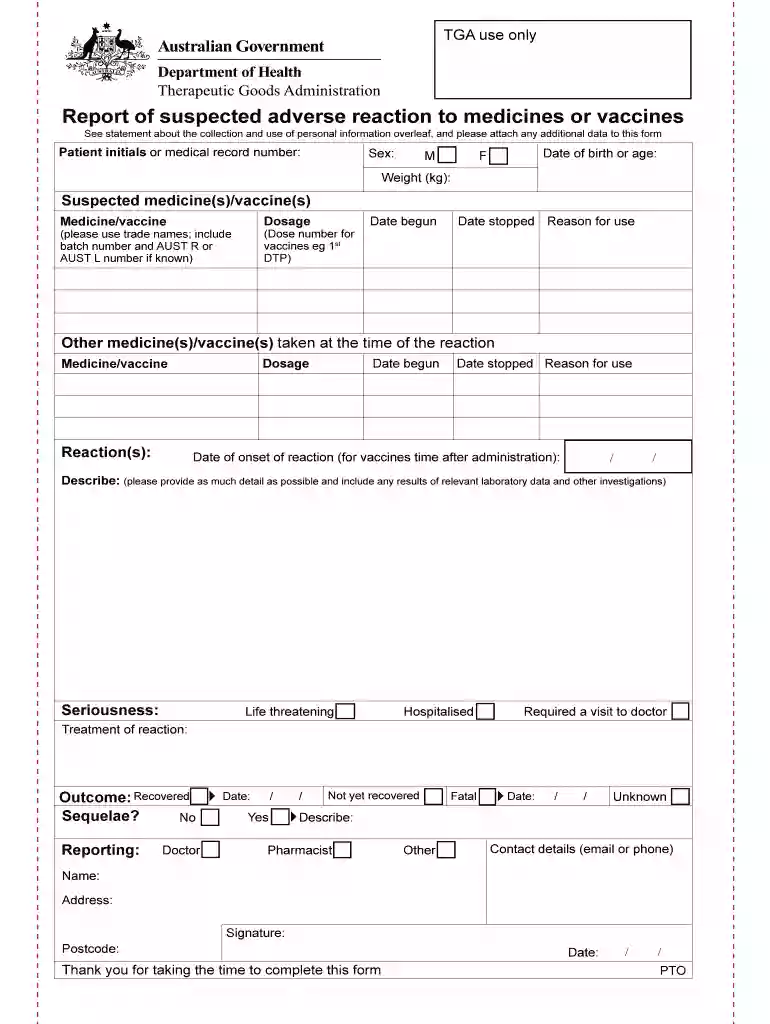
The "Blue Card - Report of Suspected Adverse Reaction to Medicines or Vaccines" is a form used to report any adverse reactions a patient experiences after taking medicines or vaccines. This report is intended for the Therapeutic Goods Administration (TGA) in Australia. By gathering this data, the TGA can better understand the safety and efficacy of drugs and vaccines in the market. This form collects personal and medical information, details about the suspected medicine or vaccine, and nature of the adverse reaction. Ultimately, the Blue Card serves as a vital tool in maintaining public health safety and ensuring regulatory compliance under the Therapeutic Goods Act 1989.
Using the Blue Card requires several key steps to ensure accurate and complete reporting. Initially, the individual reporting the adverse reaction should gather all relevant information, including the patient's medical history, details of the medicine or vaccine taken, and the specific reaction experienced.
Completing the Blue Card involves a structured approach to provide comprehensive information. Paying attention to detail is essential to ensure accurate reporting.
Patient Information: Fill in the patient's personal details, including name, age, and contact information. This section ensures that the report can be traced back if further information is needed.
Medicine or Vaccine Details: Specify the name, batch number, and dosage of the medicine or vaccine suspected to have caused the adverse reaction. Include any other medications the patient is taking.
Adverse Reaction Description: Provide a detailed account of the adverse reaction, including the onset timing, symptoms, and severity. This helps in understanding the potential health risk associated with the drug or vaccine.
Medical History: Offer a brief overview of the patient's medical history, especially any pre-existing conditions that could have influenced the reaction.
Health Professional Input: If a healthcare professional is involved, include their observations and recommendations regarding the adverse reaction.
Review and Submit: After completing the form, review all entries for accuracy before submission.
Encouraging the use of the Blue Card for reporting suspected adverse reactions is critical for several reasons:
The Blue Card is typically used by various stakeholders within the healthcare sector to ensure comprehensive data collection on adverse reactions:


Several key components are integral to the Blue Card, each serving a specific purpose:
The legal framework governing the use of the Blue Card ensures that it serves its intended purpose effectively:
Real-world scenarios illustrate how the Blue Card plays a role in public health:
Each of these scenarios demonstrates the critical role played by accurate and timely adverse reaction reporting.
We've got more versions of the Blue Card - Report of suspected adverse reaction to medicines or vaccines reporting problems form. Select the right Blue Card - Report of suspected adverse reaction to medicines or vaccines reporting problems version from the list and start editing it straight away!
At DocHub, your data security is our priority. We follow HIPAA, SOC2, GDPR, and other standards, so you can work on your documents with confidence.
by JH Martin 2021 Cited by 27 The blue card is now only available on the TGA website. If these hard copies, which are no longer printed, were visual cues for prescribers,Read more
In my case, as a professional science communicator who is employed at the university, one of my main tasks is to help scientists disseminate their findings,Read more


