




01. Edit your form online
Type text, add images, blackout confidential details, add comments, highlights and more.

Type text, add images, blackout confidential details, add comments, highlights and more.

Draw your signature, type it, upload its image, or use your mobile device as a signature pad.

Send it via email, link, or fax. You can also download it, export it or print it out.
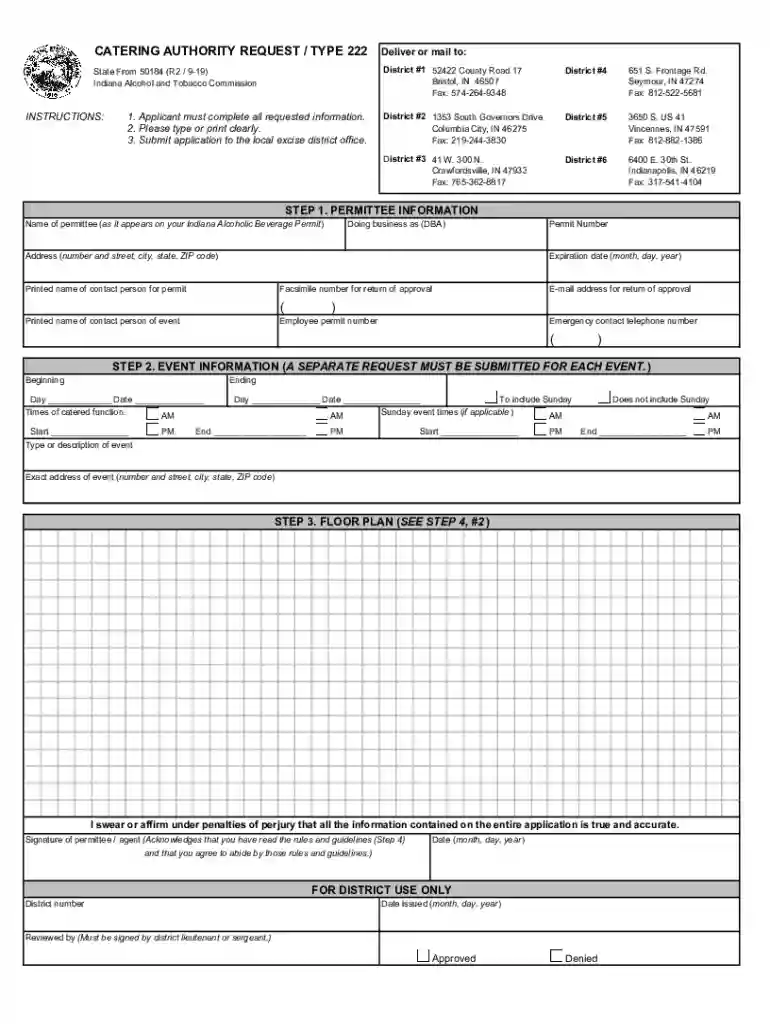
The "CATERING AUTHORITY REQUEST TYPE 222 Deliver or" form is an official document utilized by caterers in Indiana to request authorization for delivering and serving alcoholic beverages at specific events. It is mandated by the Indiana Alcohol and Tobacco Commission and ensures that caterers comply with state laws related to the distribution of alcohol at catered events. This form is essential for legal compliance and helps maintain order and safety at functions where alcohol is served. By understanding the significance of the form, caterers can effectively plan and execute events within legal boundaries, minimizing risks of non-compliance penalties.
The form contains several crucial components that must be accurately completed. These elements include the caterer’s personal and business information, such as business name, contact details, and liquor license number. Event specifics, like the location, date, and nature of the gathering, are also required. Additionally, the form stipulates guidelines for alcohol service, emphasizing quantities, service types, and staff qualifications. Each section serves a particular purpose to ensure the responsible handling and distribution of alcoholic beverages at events. Providing complete and truthful responses is not only mandatory but aids in efficient approval processing.
Acquire the Form: Start by obtaining the official "CATERING AUTHORITY REQUEST TYPE 222 Deliver or" form, which can be accessed through the Indiana Alcohol and Tobacco Commission’s website.
Fill Out Personal Details: Enter the caterer’s personal and business details. This includes contact information and any relevant business identification numbers.
Provide Event Information: Accurately describe the event, including date, time, location, and expected attendance. Specify any additional activities that might influence alcohol service.
Detail Alcohol Service Plans: Outline plans for alcohol service at the event, including types of beverages, quantities, and timing.
Review and Attach Required Documents: Ensure all required supporting documentation is attached, such as copies of your liquor license or proof of insurance.
Submit the Form: The form can be submitted through the designated channels, either via mail or online portal, as directed by the Indiana Alcohol and Tobacco Commission.
Await Approval: After submission, keep track of the approval process. Timely communication with the commission is advised for any clarifications if needed.
Legal compliance when serving alcohol at public or private events is mandatory under Indiana state law. The "CATERING AUTHORITY REQUEST TYPE 222 Deliver or" form serves as a regulatory tool ensuring caterers adhere to specific legal standards. It protects both the caterer and event organizers from any legal repercussions due to improper alcohol distribution. Employing this form helps confirm that all alcohol-related activities meet the requisite legal criteria, including staff licensing, age verification measures, and insurance requirements. Adhering to these legal prerequisites safeguards against violations and promotes a responsible service environment.
The primary users of this form are businesses in the catering industry that provide alcoholic beverage services at events throughout Indiana. This includes large catering firms, independent caterers, and mobile bar services that may operate at weddings, corporate functions, festivals, and private parties. Event planners and venues also often collaborate with caterers to ensure the proper filing of this form, integrating compliance into the broader event planning process. This document is equally important for organizations hosting fundraisers or community events where alcohol service is provided by a licensed caterer.


The state of Indiana imposes unique regulations on the distribution and service of alcohol at events. Caterers must adhere to these state-specific rules when completing and submitting the "CATERING AUTHORITY REQUEST TYPE 222 Deliver or" form. Indiana law requires businesses to have a supplemental catering permit in addition to a retail permit for liquor distribution. Furthermore, staff responsible for serving alcohol must be trained and certified under state drinking laws. Understanding and following these stipulations ensure compliance, thereby avoiding any operational disruptions or legal fines.
Failing to submit or improperly completing the "CATERING AUTHORITY REQUEST TYPE 222 Deliver or" form can result in several penalties. Non-compliance may lead to fines, revocation of permits, or cessation of operations. In extreme cases, criminal charges may be filed against the caterer or involved parties. These penalties are put in place to enforce the responsible distribution of alcohol and to prevent its misuse. Ensuring the form is submitted accurately and on time is key to avoiding such outcomes, promoting adherence to state regulations, and maintaining reputable standing in the industry.
When submitting the "CATERING AUTHORITY REQUEST TYPE 222 Deliver or" form, several supporting documents are mandatory:
These documents validate the form’s details and provide transparency in the authorizing process, ensuring readiness and compliance for the planned event.
We've got more versions of the CATERING AUTHORITY REQUEST TYPE 222 Deliver or form. Select the right CATERING AUTHORITY REQUEST TYPE 222 Deliver or version from the list and start editing it straight away!
At DocHub, your data security is our priority. We follow HIPAA, SOC2, GDPR, and other standards, so you can work on your documents with confidence.
CATERING AUTHORITY REQUEST / TYPE 222 Deliver or. Fax: 574-264-9348 Fax: 812-522-5681. Applicant must complete all requested information. All applications
This thesis explores the notion of a human right to higher education (HRHE) as it is articulated under public international law, and examines progressRead more
Feb 1, 2023 Starting a catering business requires that you obtain the proper permits and licenses, including a catering license and business license.


