
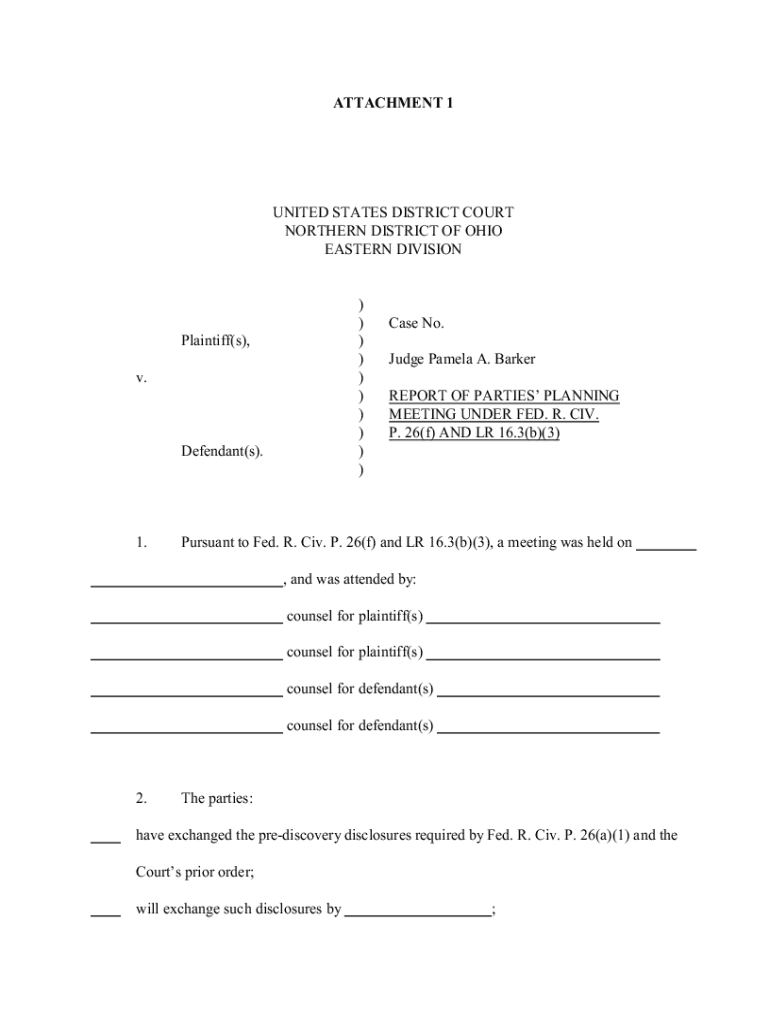







Definition and Meaning of ATTACHMENT 1 - Northern District of Ohio United States
Attachment 1 for the Northern District of Ohio is a supplementary document often used in legal proceedings within this jurisdiction. It typically forms part of a larger collection of legal documents required in a case under the Federal Rules of Civil Procedure. Its primary purpose is to provide additional information that supports the main legal case documentation, including details about involved parties, procedural agreements, and other relevant information specific to the case. Understanding the precise role of this attachment is crucial for legal professionals and involved parties to ensure proper case management and compliance with legal standards in the Northern District of Ohio.
Purpose and Applications of ATTACHMENT 1
Legal Context and Importance
The use of Attachment 1 is integral to civil procedures in the U.S. District Court for the Northern District of Ohio. It assists in delineating areas of agreement and disagreement between parties before full discovery. This preparation aids judges and referees in organizing cases efficiently by outlining necessary disclosures and setting the stage for motions and discovery processes. It also helps determine the suitability for alternative dispute resolution (ADR) mechanisms, such as mediation or arbitration, which can expedite the legal process and reduce court burdens.
Case Management Structure
By establishing an agreed framework for pre-discovery disclosures, Attachment 1 streamlines subsequent legal processes. It categorizes the case into recommended tracks and sets timelines for essential actions such as discovery exchanges and the filing of motions. This helps ensure that all parties are synchronized and aware of procedural expectations and deadlines, minimizing delays and misunderstandings throughout the proceedings.
Obtaining ATTACHMENT 1 - Northern District of Ohio United States
To obtain this document, parties involved in a legal case must access it through court documentation systems relevant to the Northern District of Ohio. Typically, these documents can be procured directly from the court's records or through legal counsel engaged in the case. Some legal databases or law firms might offer templates of such documents for preparatory purposes, ensuring that all procedural requirements are adequately met before submission.
Steps to Complete ATTACHMENT 1
Step-by-Step Guidance
-
Gather Required Information: Assemble all pertinent case details, including identities of involved parties, legal representatives, and initial case structures.
-
Pre-Discovery Disclosure Agreements: Clearly detail any agreements or disagreements about the scope of discovery, ensuring that these points comply with the court's expectations.
-
Identify Case Tracks: Determine and document which recommended track the case should follow based on complexity, expected trial length, and procedural needs.
-
Suitability for ADR: Assess whether alternative dispute resolution is appropriate and document any preliminary agreements regarding mediation or arbitration.
-
Propose Timelines: Establish and indicate timelines for completing discovery, filing motions, and other critical procedural steps.
-
Review and Approval: Before submission, ensure that all entries are accurate and review them with legal counsel to confirm compliance with local rules.
Key Elements of the Form
Core Information and Requirements
- Party Information: Names, contact details, and roles of all parties and their legal representatives
- Pre-Discovery Details: Defined agreements on initial disclosures and the scope of discovery.
- Case Track Recommendation: Categorization according to complexity and anticipated judicial requirements.
- ADR Considerations: Evaluations of alternative dispute resolution options.
- Timelines: Proposal of deadlines for procedural milestones.
Who Uses the ATTACHMENT 1?
Attachment 1 is predominantly used by legal professionals, including attorneys and legal assistants, who are preparing for civil litigation in the Northern District of Ohio. It is crucial for judges and court officials in managing and overseeing cases, ensuring legal process efficiency and adherence to procedural expectations. It may also be relevant for the parties involved who need to be informed and compliant with its requirements.
State-Specific Rules
Ohio-Specific Legal Procedures
The document must comply with Ohio's specific civil procedure rules, which can differ slightly from federal rules or those in other states. Understanding these nuances is crucial for legal practitioners involved in cases within this jurisdiction to avoid procedural missteps. It is also essential for understanding the timeline and procedural expectations specific to Ohio's legal environment and ensuring that all steps align with the state’s requirements.
Consequences of Non-Compliance
Legal Implications
Failure to correctly complete or submit Attachment 1 can lead to legal consequences, including the dismissal of motions, delays in case proceedings, or unfavorable judicial decisions. Non-compliance may hinder the accurate and timely exchange of essential information, potentially leading to strategic disadvantages in the legal process. Therefore, precision, adherence to deadlines, and full compliance with the procedural requirements specified by the Northern District of Ohio are paramount for all parties involved.




