




01. Edit your ohio no exposure certification online
Type text, add images, blackout confidential details, add comments, highlights and more.

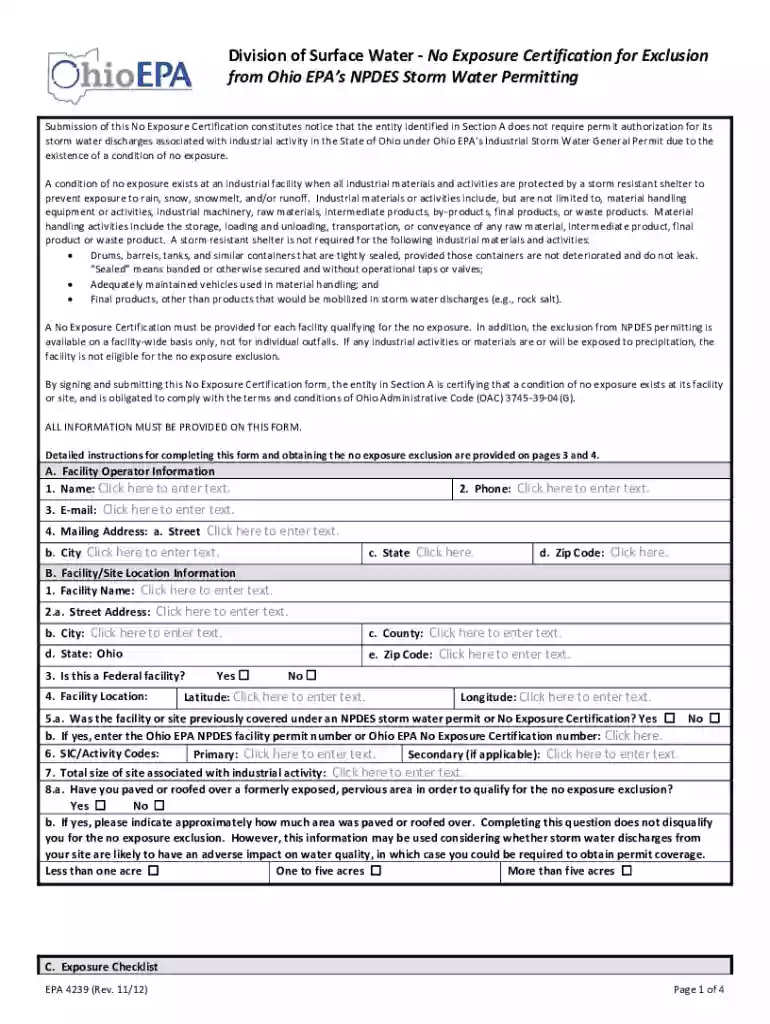
Type text, add images, blackout confidential details, add comments, highlights and more.

Draw your signature, type it, upload its image, or use your mobile device as a signature pad.

Send ohio epa no exposure certification via email, link, or fax. You can also download it, export it or print it out.
The "assets vbt iopublicfilesDivision of Surface Water - No Exposure Certification for" refers to a specialized document used primarily for the purpose of exempting certain industrial facilities from needing an NPDES stormwater permit. This certification is a declaration to the Ohio Environmental Protection Agency (EPA) that no industrial materials or activities are exposed to precipitation, thereby eliminating potential pollution. By obtaining this certification, businesses affirm their compliance with the environmental standards set to protect water quality.
The certification process involves several key elements that applicants must address to ensure compliance:
Industrial Sector: Facilities need to specify their industrial sector according to the North American Industry Classification System (NAICS) to identify the nature of their operations.
Site Description: A detailed description of the facility, including location, size, and operations. This is crucial for assessing whether the site qualifies for no exposure conditions.
Materials and Activities: Documentation of materials and activities managed within the facility to ensure none are exposed to precipitation. This includes storage areas, loading docks, and material handling activities.
Preventive Measures: Description of measures in place to prevent exposure, such as roofing, containment areas, or diversion techniques.
Facilities are eligible for the No Exposure Certification if they meet specific criteria:
Complete Enclosure: All industrial materials and activities must be completely sheltered from potential stormwater exposure.
No Runoff: The facility cannot discharge stormwater from exposed operations.
Regular Inspections: Regular environmental inspections must be conducted to ensure ongoing compliance with no exposure standards.
Documentation: Facilities must maintain comprehensive documentation supporting their eligibility, allowing for verification by regulatory authorities.


To complete the certification, facilities must follow these steps:
Review Eligibility: Ensure the facility meets all eligibility criteria for no exposure status.
Site Assessment: Conduct a thorough site inspection to confirm that there is no exposure of industrial materials or activities to precipitation.
Gather Documentation: Compile all necessary documentation, including facility maps, photographs, and descriptions of preventive measures.
Complete the Form: Fill out the certification form, providing detailed information about the facility, materials, and activities.
Submit Certification: Submit the completed form to the Ohio EPA for review and approval.
Maintain Compliance: Continuously monitor and document the facility's conditions to ensure ongoing compliance with no exposure requirements.
Using the certification involves several practical applications:
Regulatory Compliance: As a document of compliance, the certification helps facilities avoid unnecessary stormwater permitting processes.
Inspections: It serves as a reference during inspection by environmental authorities, proving that the facility adheres to set environmental standards.
Corporate Responsibility: Demonstrating a commitment to environmental protection, enhancing the facility's reputation and stakeholder trust.
For Ohio-based facilities, specific state rules apply:
Ohio Administrative Code Compliance: Facilities must adhere to Ohio's specific administrative codes regarding surface water management and no exposure criteria.
State Inspections: The Ohio EPA reserves the right to inspect facilities to verify compliance, ensuring all certified operations meet the state's stringent environmental requirements.
Renewal and Updates: Facilities are required to update or renew their certification as stipulated by state regulations, usually on a five-year cycle.
Understanding critical deadlines is essential:
Initial Filing: Facilities must submit the certification before commencing operations to avoid any regulatory penalties.
Renewal Deadlines: Typically, certifications must be renewed every five years, with reminders issued by the Ohio EPA.
Inspection Cycles: Regular inspections are recommended at least annually to ensure ongoing compliance and readiness for potential EPA audits.
Non-compliance with the no exposure certification requirements can result in:
Fines and Penalties: Significant financial penalties may be levied against non-compliant facilities.
Legal Action: Persistent non-compliance can lead to legal action from the Ohio EPA.
Revocation of Certification: Failure to maintain no exposure conditions can result in the revocation of the certification, necessitating the need for NPDES stormwater permitting.
We've got more versions of the ohio no exposure certification form. Select the right ohio no exposure certification version from the list and start editing it straight away!
At DocHub, your data security is our priority. We follow HIPAA, SOC2, GDPR, and other standards, so you can work on your documents with confidence.


