Employee Offboarding in 7 Steps +Free Offboarding Checklist 2026

Get Form
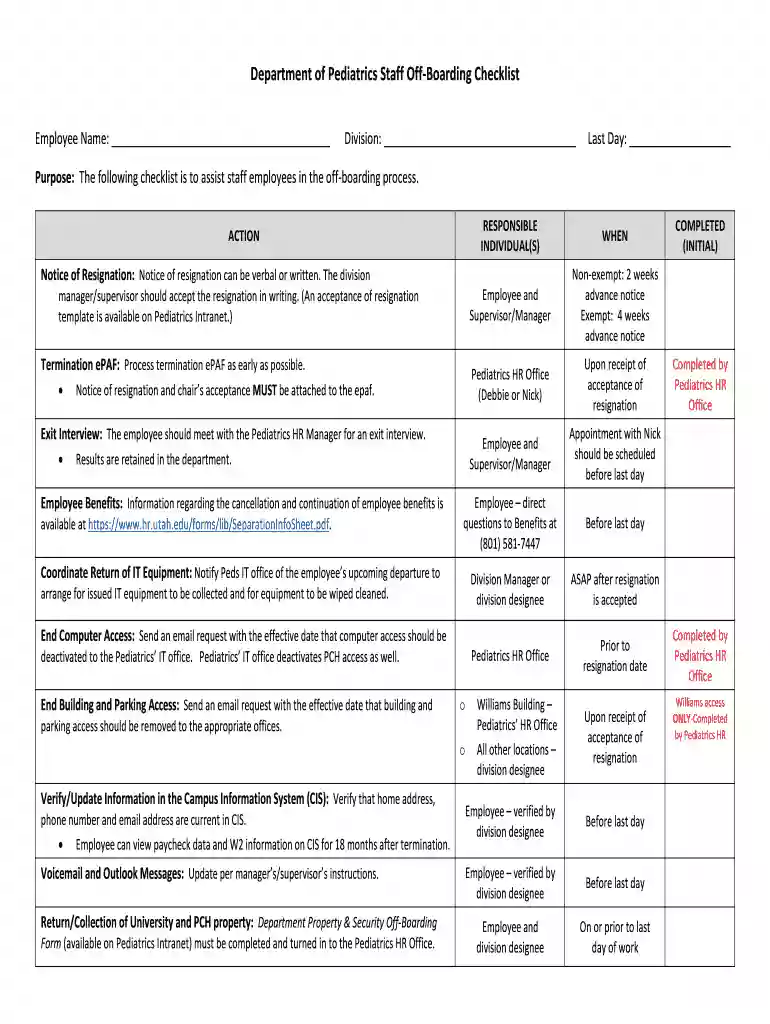
Employee Offboarding in 7 Steps +Free Offboarding Checklist Preview on Page 1

Here's how it works

01. Edit your form online
Type text, add images, blackout confidential details, add comments, highlights and more.

02. Sign it in a few clicks
Draw your signature, type it, upload its image, or use your mobile device as a signature pad.

03. Share your form with others
Send it via email, link, or fax. You can also download it, export it or print it out.

Definition & Meaning

Employee offboarding refers to the systematic process that occurs when an employee leaves a company. It involves crucial steps to ensure a smooth transition, such as ensuring all company property is returned, conducting exit interviews, and finalizing necessary paperwork. The "Employee Offboarding in 7 Steps +Free Offboarding Checklist" serves as a structured guide to manage these processes efficiently. By following this checklist, organizations can safeguard their operations, maintain security, and ensure positive experiences for departing employees.

Steps to Complete the Offboarding Checklist

The offboarding checklist comprises essential steps to streamline the process:

  1. Notice of Resignation: Ensure formal resignation notice is received, detailing the employee’s last working day.
  2. Termination Processing: Initiate HR procedures to update employee status and handle final payments.
  3. Exit Interviews: Conduct interviews to understand the employee's experience and gather feedback for future improvements.
  4. Return of IT Equipment: Collect all company-issued equipment, such as laptops and smartphones.
  5. Access Revocation: Disable digital access to company accounts and systems to maintain security.
  6. Updating Personal Information: Confirm that contact details are accurate for any post-employment correspondence.
  7. Knowledge Transfer: Facilitate a smooth transfer of responsibilities and information to remaining team members.

Key Elements of the Employee Offboarding Checklist

Critical components of the checklist include:

  • Resignation Acknowledgment: Formal acceptance of resignation.
  • Final Payroll Processing: Ensuring all financial payments and benefits are reconciled.
  • Feedback Collection: Gaining insights through exit interviews.
  • Property and Access Management: Secure return and disablement of assets.
  • Compliance Documentation: Ensuring all legal and internal compliance forms are signed.

Why You Should Use the Offboarding Checklist

Utilizing an offboarding checklist minimizes potential risks and enhances organizational efficiency. It helps:

  • Prevent Data Breaches: By ensuring all security protocols are followed during offboarding.
  • Maintain Employee Relations: Leaving on good terms can aid in future networking and referrals.
  • Facilitate Smooth Transitions: Structured processes help prevent disruption of workflows and continuity.
  • Comply with Legal Requirements: Ensures that all employment laws and company policies are adhered to during separation.

Who Typically Uses the Offboarding Checklist

This checklist is primarily used by HR professionals, managers, and IT departments to ensure a structured and consistent offboarding experience. It is also valuable for:


  • Line Managers: To oversee the transition and handover processes seamlessly.
  • IT Personnel: For managing system access and securing company data.
  • Legal Teams: To ensure compliance and document retention.
decoration image ratings of Dochub

Important Terms Related to Employee Offboarding

Familiarity with specific terminology can enhance understanding and execution:

  • Final Settlement: Completes due compensation and benefits.
  • Non-Compete Clause: A legal agreement restricting departing employees from joining competitors.
  • NDAs (Non-Disclosure Agreements): Ensures confidentiality post-employment.
  • Security Clearance Revocation: Withdrawal of access to sensitive information upon departure.

Legal Use of the Employee Offboarding Checklist

In the U.S., adhering to an offboarding checklist helps comply with federal and state employment laws:

  • COBRA: Ensures compliance with health coverage regulations post-employment.
  • Document Retention: Adheres to record-keeping requirements mandated by the Department of Labor.
  • Intellectual Property Protection: Secures proprietary information, reflecting legal adherence.

Examples of Using the Offboarding Checklist

Real-world scenarios demonstrate its utility:

  • A Mid-Sized Tech Firm: Implemented the checklist to effectively manage multiple departures during restructuring, resulting in a 35% improvement in workflow continuity.
  • Healthcare Providers: Utilized offboarding processes to safeguard patient data by revoking access promptly, aligning with HIPAA regulations.
  • Educational Institutions: Used structured exit interviews to refine staff retention strategies based on common feedback themes.

Digital vs. Paper Version

Choosing between digital and paper versions can impact efficiency:

  • Digital Checklist: Offers real-time updates and integrations with HR software, providing ease of access and tracking.
  • Paper Version: May be preferred in environments requiring tangible records or lacking digital infrastructure, but often involves manual updates.

State-Specific Rules for Offboarding

While the checklist provides a general framework, organizations must consider state-specific laws, such as final paycheck laws and mandatory notices. For instance:

  • California: Requires immediate payment of final wages upon termination.
  • New York: Mandates written notice regarding continuation of benefits.

By comprehensively addressing each facet of the offboarding process, organizations can ensure an efficient, compliant, and respectful transition for departing employees.

be ready to get more

Complete this form in 5 minutes or less

Get form

Got questions?

We have answers to the most popular questions from our customers. If you can't find an answer to your question, please contact us.
Contact us
What is offboarding? Offboarding an employee consist of all the decisions and processes that take place when an employee leaves their employment. It is the process that leads to the formal separation between an employee and a company through resignation, termination, or retirement.
The offboarding process is the reverse and helps complete the employee lifecycle in a structured way. Employees must return any company equipment, be logged out of the company network and have their access revoked, hand over responsibilities to other team members, and say goodbye to their colleagues.
Offboarding is the process of managing an employees departure from a company.
Steps in the offboarding process Notify relevant teams. Notify pertinent teams as soon as you terminate an employee, or they give notice, starting with finance, HR, IT, and security. Conduct an exit interview. Retrieve company property. Terminate access and permissions. Transfer knowledge. Provide support and assistance.
HR can create a comprehensive and compassionate offboarding program which includes these components: Update co-workers. HR can email company members as soon as they know team member will be leaving. This minimizes rumors that could potentially damage the departing persons reputation.

Security and compliance

At DocHub, your data security is our priority. We follow HIPAA, SOC2, GDPR, and other standards, so you can work on your documents with confidence.

Learn more
ccpa2
pci-dss
gdpr-compliance
hipaa
soc-compliance

People also ask

Offboarding process can be initiated from SAP SuccessFactors Employee Central. Offboarding process starts with Initiate Offboarding and ends with the employee exit. After Offboarding is initiated, the Manager collects the employees information, reviews the data only if cetain rules are set.
Theres lots of important information to include in your offboarding packet so heres a full breakdown for you: Goodbye message. Explain the purpose of the document and why they should read it. A list of deliverables and/or outcomes (and where to find things) A list of things that you will be canceling/removing.

Related links