




01. Edit your form online
Type text, add images, blackout confidential details, add comments, highlights and more.

Type text, add images, blackout confidential details, add comments, highlights and more.

Draw your signature, type it, upload its image, or use your mobile device as a signature pad.

Send it via email, link, or fax. You can also download it, export it or print it out.
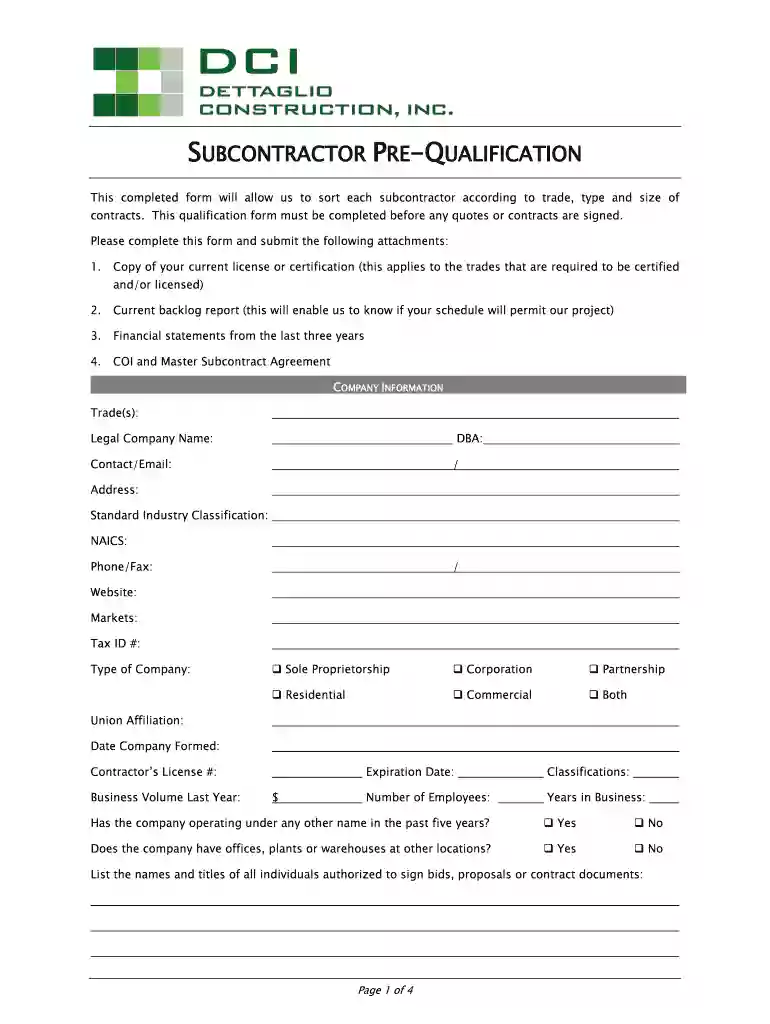
The Subcontractor Pre-Qualification form is a crucial document for evaluating potential subcontractors before formalizing any contractual agreements. This form encompasses various sections aimed at obtaining comprehensive information about subcontractor companies. It helps businesses sort and assess subcontractors based on their qualifications and compliance with necessary standards.
Completing the Subcontractor Pre-Qualification form involves multiple steps ensuring that all sections are thoroughly filled out.
Using this form enables businesses to mitigate risks by thoroughly examining subcontractors' qualifications. It provides a structured approach to evaluate compliance, financial capability, and reliability, ensuring that subcontractors meet specific project requirements.
Typically, project managers or procurement teams within construction or large-scale manufacturing industries initiate the use of this form. It is reviewed by company leaders responsible for project oversight to confirm that potential subcontractors are viable partners for work.
Compliance with legal and safety regulations is a highlighted aspect of the form. This section requires subcontractors to declare any legal disputes, safety violations, or workers' compensation claims. It ensures all potential partners adhere to industry standards and minimizes legal risks.
Consider a construction firm dealing with multiple projects across different states. Using the Subcontractor Pre-Qualification form, the firm can efficiently assess various subcontractors to find those best suited for specific projects based on location, expertise, and available resources.
While the Subcontractor Pre-Qualification form is broadly similar across the U.S., certain variations exist based on state regulations. For instance, California may have additional requirements related to environmental compliance, while Texas might emphasize more on financial solvency and project delivery history.
For digital management and processing of the Subcontractor Pre-Qualification form, platforms like DocHub facilitate the importing, editing, and signing of these forms, improving efficiency. Features such as real-time collaboration and secure cloud storage streamline the administrative workflow associated with subcontractor evaluations.
To complete the Subcontractor Pre-Qualification form, individuals must have:
Processing the Subcontractor Pre-Qualification form digitally offers advantages such as easier document management and reduced environmental impacts. Platforms like DocHub enable electronic signatures making the submission process more seamless compared to paper-based systems.
By implementing these structured guidelines and practices, businesses can enhance their subcontractor evaluation process, ensuring that only qualified and reliable subcontractors are enlisted for their projects.
At DocHub, your data security is our priority. We follow HIPAA, SOC2, GDPR, and other standards, so you can work on your documents with confidence.
May 21, 2021 Form for documenting subcontractor safety qualifications and incident rates.
Each of the prequalification forms lists the definitions of firms considered to be affiliated. All existing affiliates, whether prequalifying or not, mustRead more


