




01. Edit your student teacher contract template online
Type text, add images, blackout confidential details, add comments, highlights and more.

Type text, add images, blackout confidential details, add comments, highlights and more.

Draw your signature, type it, upload its image, or use your mobile device as a signature pad.

Send student teacher agreement template via email, link, or fax. You can also download it, export it or print it out.
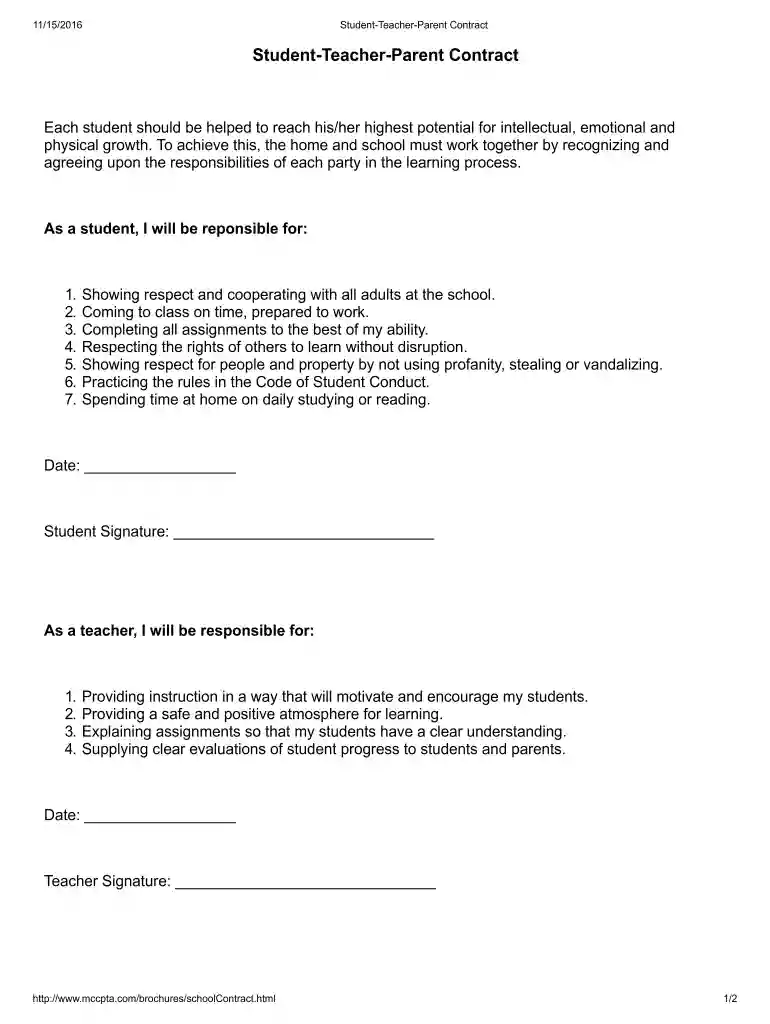
A parent-student-teacher contract is a formal document that outlines the responsibilities and expectations of students, parents, and teachers in the educational process. This contract serves as a mutual agreement to foster collaboration among all stakeholders, aiming for students' academic and personal growth. It emphasizes the importance of communication, respect, and shared commitment to learning.
The contract should be clear and concise, allowing each party to understand their roles in the educational partnership.
Using the parent-student-teacher contract involves several steps:
This structured approach helps create a shared understanding and commitment towards achieving educational goals.
The parent-student-teacher contract must incorporate several essential elements to be effective:
Including these elements provides clarity and promotes a supportive educational community.
Downloading a parent-student-teacher contract offers several benefits:
Utilizing the contract enhances the educational experience by fostering a collaborative approach.
The legal use of a parent-student-teacher contract is pivotal for ensuring that the agreement is both enforceable and respected. Here are important aspects to consider:
Legal considerations help safeguard the educational environment by ensuring everyone's rights and responsibilities are protected.
Here are practical scenarios demonstrating the usefulness of the parent-student-teacher contract:
These examples illustrate how a parent-student-teacher contract can facilitate effective communication and foster a proactive educational environment.
With DocHub, it’s pretty simple. The platform offers users an add-on called DocHub for Gmail, which you can find in the Google Workspace Marketplace without being charged. Set it up and grant it access to your Google account. Open your email with your teacher student contract attached and click on the add-on button in the right-side panel. Log in to your DocHub account, and import the file to our editor, where you can fill it out and sign.
You can find the latest and most relevant version of the teacher student contract template in our DocHub forms library. Search it by categories or utilize the search field to find the exact template that suits your situation. You can open this form for editing after you find it.
At DocHub, your data security is our priority. We follow HIPAA, SOC2, GDPR, and other standards, so you can work on your documents with confidence.
by NR Guidance 2025 1) Whether the students teacher. has met State qualification and licensing criteria for the grade levels and subject areas in which the teacher providesRead more
Dec 29, 2017 View it online in HTML, as a PDF, or download it to your mobile de- vice as an eBook. You may also be able to access tax law in- formationRead more
This agreement is a promise to work together as a team to help. achieve in school. Student. Parent/Guardian. Teacher. It is important that I be successful inRead more


