




01. Edit your form online
Type text, add images, blackout confidential details, add comments, highlights and more.

Type text, add images, blackout confidential details, add comments, highlights and more.

Draw your signature, type it, upload its image, or use your mobile device as a signature pad.

Send it via email, link, or fax. You can also download it, export it or print it out.
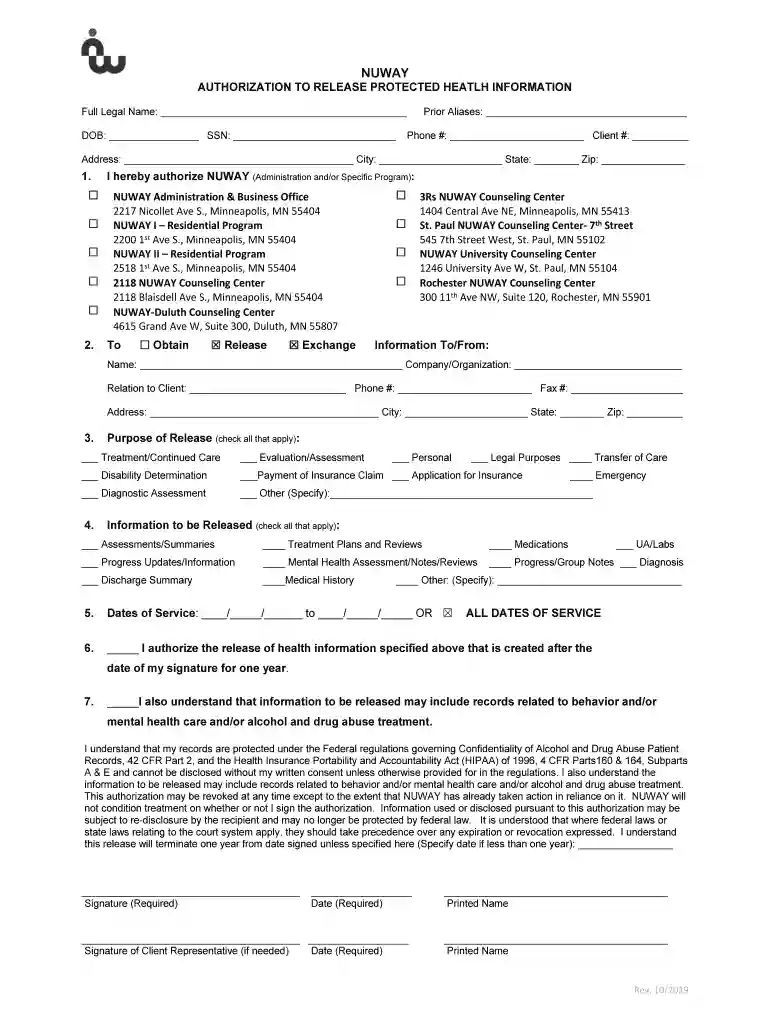
The "AUTHORIZATION TO RELEASE PROTECTED - NUWAY" form is a legal document used to authorize the release of protected health information. This authorization enables NUWAY, a healthcare organization, to share your confidential health information with specified parties. It plays a crucial role in maintaining patient privacy while meeting legal and healthcare system requirements under federal confidentiality regulations, such as HIPAA. The form outlines the scope and limitations of the information release, ensuring that sensitive health details are disclosed only to authorized recipients for specified purposes.
Using the AUTHORIZATION TO RELEASE PROTECTED - NUWAY form involves several key steps. First, an individual must obtain and fill out the form accurately. You must then identify the specific data to be shared and the parties authorized to receive it. Before completing the form, it's important to thoroughly understand the reasons for the information release. Once filled, submit it to the appropriate department within NUWAY for processing. Ensure you keep a copy for your records. This form is often used for transferring records between healthcare providers, securing treatment at external facilities, or enabling family members or caregivers to access medical information.
Personal Information: Begin by entering your full name, date of birth, and contact details in the designated sections.
Recipient Information: List the organizations or individuals authorized to receive your protected health information.
Information to be Released: Clearly specify the types of health information that can be shared. This may include medical history, treatment records, or billing information.
Purpose of Release: State the reasons for the information release, such as treatment coordination, legal purposes, or personal use.
Expiration Date: Indicate the date or event upon which the authorization will expire.
Signature & Date: Sign and date the form to validate it. If applicable, a witness or healthcare representative may need to sign as well.
Ensure all fields are completed accurately, as incomplete forms may delay processing.
The AUTHORIZATION TO RELEASE PROTECTED - NUWAY form comprises several critical components:
These elements are designed to protect patient privacy while ensuring the necessary information is shared accurately and legally.
The legal aspects of using the AUTHORIZATION TO RELEASE PROTECTED - NUWAY form are centered around compliance with federal laws such as the Health Insurance Portability and Accountability Act (HIPAA). The form allows health information to be shared legally, ensuring the data is used according to the patient's consent. Compliance safeguards both the healthcare provider and the patient, ensuring that sensitive information is not disclosed improperly. Legal use also includes setting limitations on what can be shared, ensuring information is restricted to what is necessary for the stated purpose.
Typical users of the AUTHORIZATION TO RELEASE PROTECTED - NUWAY form include patients seeking treatment from new healthcare providers, family members needing access to medical information, legal representatives handling health-related cases, and healthcare providers needing to share patient information for continued care. Organizations such as hospitals, clinics, and specialized care facilities also use the form to ensure compliance when transferring patient information between entities or across state lines.


While the AUTHORIZATION TO RELEASE PROTECTED - NUWAY form generally complies with federal laws, users should be aware of state-specific regulations that may affect its use. These variations could include stricter privacy laws or specific requirements for information release. For instance, some states may have additional consent requirements or restrict the type of information that can be shared without explicit patient approval. Users should consult state laws or legal professionals to ensure compliance with both state and federal regulations when using the form.
Practical examples of using the AUTHORIZATION TO RELEASE PROTECTED - NUWAY form include:
These scenarios highlight the form's flexibility in addressing various needs while maintaining compliance and confidentiality.
We've got more versions of the AUTHORIZATION TO RELEASE PROTECTED - NUWAY form. Select the right AUTHORIZATION TO RELEASE PROTECTED - NUWAY version from the list and start editing it straight away!
At DocHub, your data security is our priority. We follow HIPAA, SOC2, GDPR, and other standards, so you can work on your documents with confidence.
NUWAY, a nonprofit program in Minneapolis, MN, co-occurring care for substance use and mental health disorders. achieving institutional accreditation and
Research staff or NUWAY staff can remove you from the research study without your approval. Possible reasons for removal include: Displaying offensiveRead more


