Liquid crystal display device having a pattern for - Google Books 2025

Get Form
Liquid crystal display device having a pattern for - Google Books Preview on Page 1

Here's how it works

01. Edit your form online
Type text, add images, blackout confidential details, add comments, highlights and more.
02. Sign it in a few clicks
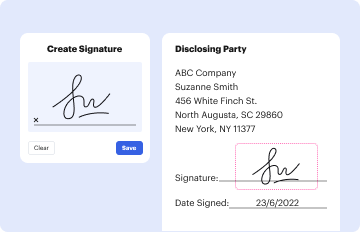
Draw your signature, type it, upload its image, or use your mobile device as a signature pad.
03. Share your form with others
Send it via email, link, or fax. You can also download it, export it or print it out.

How to use or fill out Liquid crystal display device having a pattern for - Google Books

Form edit decoration
9.5
Ease of Setup
DocHub User Ratings on G2
9.0
Ease of Use
DocHub User Ratings on G2
  1. Click ‘Get Form’ to open it in the editor.
  2. Begin by reviewing the form sections, which include details about the liquid crystal display device's components such as gate signal lines and pixel electrodes.
  3. Fill in the required fields, ensuring you accurately describe the first and second thin-film transistors, including their channel lengths and widths.
  4. Provide information on the configuration of pixel electrodes, specifically noting how they superpose on the capacity line.
  5. Double-check all entries for accuracy before proceeding to save or share your completed form.

Start using our platform today to streamline your document editing and form completion for free!

be ready to get more

Complete this form in 5 minutes or less

Get form

Got questions?

We have answers to the most popular questions from our customers. If you can't find an answer to your question, please contact us.
Contact us
LCDs are used in a wide range of applications, including LCD televisions, computer monitors, instrument panels, aircraft cockpit displays, and indoor and outdoor signage.
TFT LCDs have been around since the 1950s and have improved dramatically over time. There are three main types of panel: The oldest one, twisted nematic (TN), vertical alignment (VA) and in-plane switching (IPS).
LCD is a type of flat panel display technology used in various electronic devices like televisions, computer monitors, smartphones, and calculators.
In 1973, Brody, J. A. Asars and G. D. Dixon at Westinghouse Research Laboratories demonstrated the first thin-film-transistor liquid-crystal display (TFT LCD). As of 2013, all modern high-resolution and high-quality electronic visual display devices use TFT-based active matrix displays.
An LCD module (also known as a liquid crystal module, LCD panel module, LCD display module, liquid crystal display module, or TFT-LCD module) is a device used to display information such as images and text on a liquid crystal display.

People also ask

LCDs have a wide range of applications. They are commonly used in televisions, computer monitors, laptops, tablets, smartphones, digital cameras, portable gaming devices, and car displays. They are also found in industrial equipment, medical devices, and various consumer electronics.
The characteristic orientational order of the liquid crystal state is between the traditional solid and liquid phases and this is the origin of the term mesogenic state, used synonymously with liquid crystal state.
A thin-film-transistor liquid-crystal display (TFT LCD) is a type of liquid-crystal display that uses thin-film-transistor technology to improve image qualities such as addressability and contrast.

Related links