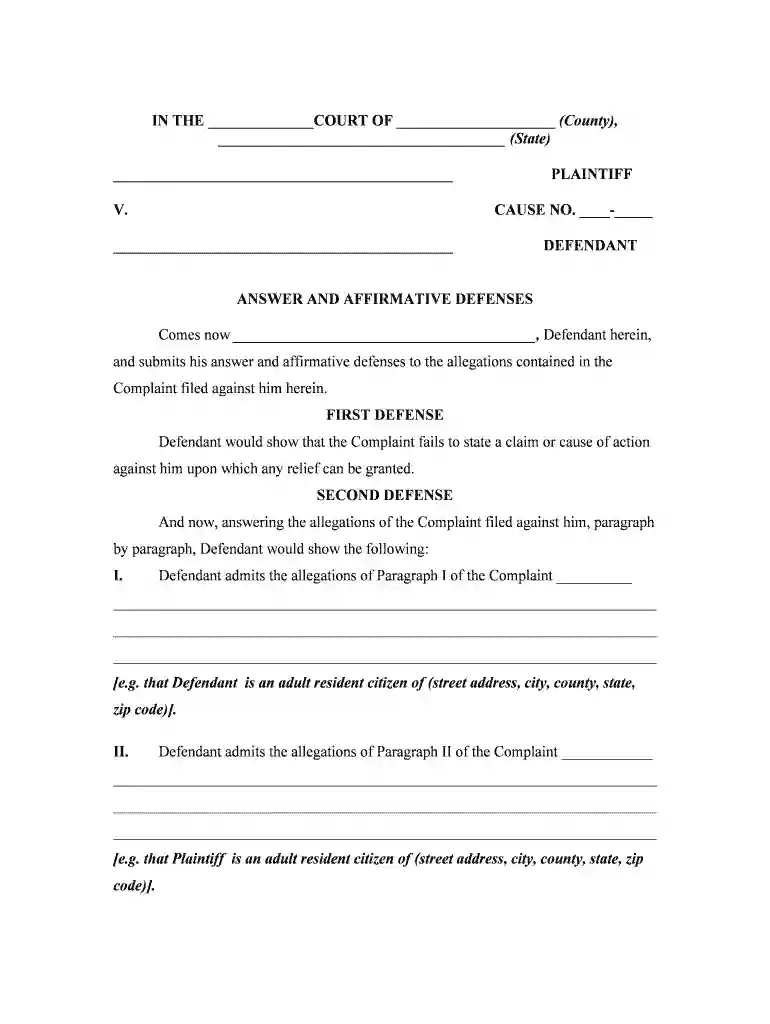
Form answer defendant 2026

Get Form
general civil Preview on Page 1

Here's how it works

01. Edit your general civil online
Type text, add images, blackout confidential details, add comments, highlights and more.

02. Sign it in a few clicks
Draw your signature, type it, upload its image, or use your mobile device as a signature pad.

03. Share your form with others
Send example of answer in texas civil proceeding via email, link, or fax. You can also download it, export it or print it out.

Definition & Meaning

The "form answer defendant" is a legal document used by a defendant in a civil lawsuit to formally respond to a plaintiff's complaint. It details the defendant’s responses to each allegation made by the plaintiff, often containing admissions, denials, or claims of insufficient knowledge, thus requiring the plaintiff to prove the allegation. Additionally, the form can outline affirmative defenses, which are justifications for the defendant’s actions that, if proven, can absolve them of liability. The objective is to set the stage for the litigation process by clearly establishing the facts and arguments of both parties.

How to Use the Form Answer Defendant

To use the form answer defendant effectively, the defendant must first carefully review the complaint served by the plaintiff. Identify all allegations, and corresponding paragraphs or counts, to ensure a comprehensive response. Each allegation typically requires a direct answer: admit, deny, or state the lack of sufficient information to admit or deny, resulting in a default denial. It's advisable to consult with legal counsel to determine any affirmative defenses that apply to the case, ensuring they are included in the answer. Once completed, the document must be filed with the court where the complaint was filed and served on the plaintiff according to local rules of civil procedure.

Steps to Complete the Form Answer Defendant

  1. Review the Complaint: Carefully examine each allegation listed in the complaint.
  2. Draft Responses:
    • Respond to each numbered paragraph by admitting, denying, or claiming insufficient information.
  3. State Affirmative Defenses:
    • List any legal defenses applicable to the allegations. Examples include statute of limitations or self-defense.
  4. Include Additional Requests:
    • Such as a motion to dismiss or for summary judgment if applicable.
  5. Certification of Service:
    • Attach a certificate of service indicating the form has been sent to the plaintiff.
  6. File and Serve:
    • Submit the answer to the court and serve a copy to the plaintiff within the designated time frame.

Important Terms Related to Form Answer Defendant

  • Admission: Acknowledging that a specific allegation in the complaint is true.
  • Denial: Refusing to accept the truth of a specific allegation.
  • Affirmative Defense: New information or arguments the defendant uses to avoid legal responsibility.
  • Certificate of Service: A document attached to court filings that certifies the delivery of copies to the opposing party.

Legal Use of the Form Answer Defendant

The primary legal use of the form answer defendant is to officially record the defendant's stance on each allegation of the complaint, establish any defenses, and make formal procedural requests, like dismissals. It's a critical component of the litigation process as it helps set parameters for the dispute resolution and assists in expediting the court proceedings. Filing the answer prevents a default judgment against the defendant, ensuring they retain a voice in the process.

Key Elements of the Form Answer Defendant

  • Response to Each Allegation:
    • Detailed responses to the plaintiff’s claims.
  • Affirmative Defenses:
    • Essential defenses raised must be disclosed at this stage.
  • Requests for Dismissal:
    • Arguments for dismissing the case before trial.
  • Certification of Service:
    • Proof of serving copies to all parties involved.

State-Specific Rules for the Form Answer Defendant

Different states have unique rules regarding the filing and content of a defendant's answer. These may include specific deadlines for filing, formatting requirements, and the types of acceptable affirmative defenses. Understanding and complying with these rules are crucial, as missing deadlines or filing incorrectly formatted documents can lead to adverse consequences, like sanctions or default judgments.

Examples of Using the Form Answer Defendant

  • In a breach of contract case, a defendant might admit to some allegations but deny liability due to the plaintiff’s prior failure to fulfill part of the contract.
  • In a personal injury case, a defendant can use affirmative defenses, such as assumption of risk or comparative negligence, to mitigate or eliminate liability.
  • In a defamation case, defendants often use the truth as an absolute defense to contest false claims.
be ready to get more

Complete this form in 5 minutes or less

Get form

Got questions?

We have answers to the most popular questions from our customers. If you can't find an answer to your question, please contact us.
Contact us
For either a counterclaim against the plaintiff or a crossclaim against another defendant, state briefly the facts showing why the defendant asserting the counterclaim or crossclaim is entitled to the damages or other relief sought. Do not make legal arguments.
In law, an answer refers to a defendants first formal written statement to a plaintiffs initial petition or complaint. This opening written statement will admit or deny the allegations, or demand more information about the claims of wrongdoing.
The answer may contain affirmative defenses and counterclaims against the plaintiff. If there are counterclaims asserted, the plaintiff must then serve and file a written reply to the counterclaims.
Be Respectful: Address the judge appropriately (eg, ``Your Honor) and maintain a respectful tone throughout the exchange. Stay Relevant: Focus on the specific question without providing unnecessary information. Answer precisely and directly. Be Honest: If you know the answer, provide it truthfully.

Security and compliance

At DocHub, your data security is our priority. We follow HIPAA, SOC2, GDPR, and other standards, so you can work on your documents with confidence.

Learn more
ccpa2
pci-dss
gdpr-compliance
hipaa
soc-compliance