




01. Edit your unsw tr5 form online
Type text, add images, blackout confidential details, add comments, highlights and more.

Type text, add images, blackout confidential details, add comments, highlights and more.

Draw your signature, type it, upload its image, or use your mobile device as a signature pad.

Send tr5 form via email, link, or fax. You can also download it, export it or print it out.
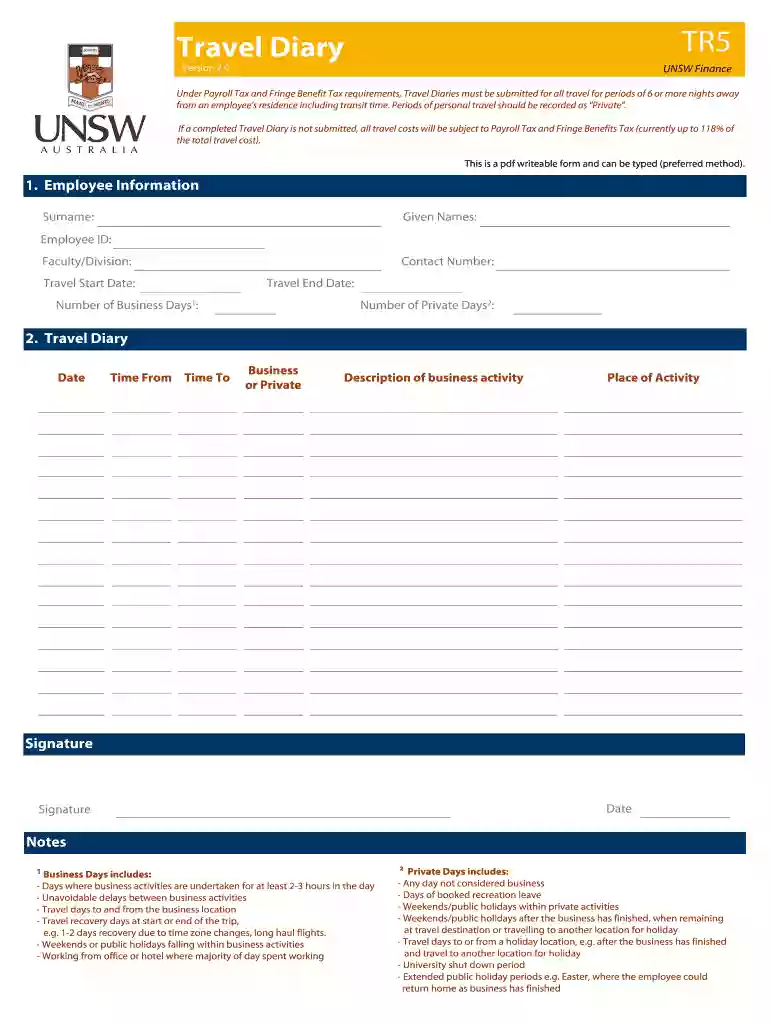
The Travel Diary TR5 - University of New South Wales is a documentation tool required for recording travel activities, primarily serving employees affiliated with UNSW Finance. It is a formal record-keeping instrument designed to document the itinerary of travel journeys lasting six or more nights, differentiating between business and private travel days. This differentiation is crucial to ensure compliance with Payroll Tax and Fringe Benefit Tax regulations, thus helping mitigate increased tax liabilities.
The travel diary not only acts as a log for trips undertaken but also substantiates the purpose of each travel day. Having a detailed travel diary is necessary to demonstrate to tax authorities that an employee’s travel expenses are legitimate business expenses rather than personal indulgences. This meticulous division into business and personal days also aids in determining the exact calculation of any possible tax benefits and obligations.
Filling out the Travel Diary TR5 involves noting down specific details of each travel day, capturing the essence of what each journey entailed. Here's a step-by-step guide on how to properly utilize this form:
Date Entry: Each diary entry should commence with the accurate dates of travel. This includes both the departure and return dates, ensuring the duration is clearly mapped out.
Location Details: Clearly document the places visited. This includes the city, country, or region, detailing each location visited during the travel period.
Purpose of Travel: Specify the business or private nature of each travel day. Examples are attending a conference, meeting with clients, or conducting research.
Duration of Stay: For every location, note down the number of days spent. Differentiate explicitly between business days and personal days.
Receipts and Supporting Documentation: Attach receipts or additional documents that validate the travel's purpose, expenditure, and duration. This may include hotel invoices, meeting agendas, or registration confirmations for conferences.
By adhering to these instructions, employees can ensure their travel diary serves both as an accurate record of travel activities and as a valid document for tax and compliance purposes.
To complete the Travel Diary TR5 accurately, it's imperative to follow a structured process. Here's how you can do it effectively:
Gather Necessary Information: Prior to starting, collect all travel itineraries, hotel bookings, conference itineraries, and other documentation that might support the travel's purpose.
Detailed Recording by Date: Begin by logging each day of travel, ensuring dates are entered sequentially without gaps.
Describe Each Activity: For every entry, provide a concise description of the day's activities. This should clearly state the work-related nature of the activities if any business tasks were performed.
Attach Verification Documents: Securely attach all supplementary documentation like boarding passes, accommodation receipts, and correspondence related to business meetings or events.
Review for Completeness and Accuracy: Before final submission, double-check each section for errors or omissions. Ensure that all business activities and personal rest days are clearly identified.
Following this method will help maintain the diary's integrity and credibility while simplifying the review and approval process.
Understanding key terminology associated with the Travel Diary TR5 is crucial for both accuracy and compliance. Below are some of the most important terms:
Grasping these terms will aid in completing the travel diary accurately, ensuring all regulatory requirements are met.
The travel diary consists of several crucial elements that are essential for proper documentation:
Each element plays a pivotal role in ensuring the diary’s effectiveness and compliance with UNSW’s financial documentation protocols.
Incorporating electronically signed entries in the Travel Diary TR5 provides several advantages, ensuring authenticity and security:
Legal Recognition: Electronic signatures collected on the diary hold the same legal weight as traditional handwritten signatures, meeting ESIGN Act standards.
Security Measures: Digital signatures are safeguarded with encryption protocols, reducing the risk of unauthorized modifications or access.
Ease of Use: Employees can electronically sign their diaries using a mouse, trackpad, or touchscreen, simplifying the signature process.
These unique attributes of electronic signatures ensure the integrity and legal compliance of the Travel Diary TR5.
Failure to properly complete and submit the Travel Diary TR5 can result in significant repercussions:
Understanding these potential ramifications underscores the importance of diligent compliance with travel diary requirements.
UNSW offers multiple avenues for submitting the Travel Diary TR5 to accommodate diverse user preferences:
Acknowledging the various submission methods ensures that employees can select the process that aligns best with their convenience and deadlines.
We've got more versions of the unsw tr5 form form. Select the right unsw tr5 form version from the list and start editing it straight away!
| Versions | Form popularity | Fillable & printable |
|---|---|---|
| 2015 | 4.5 Satisfied (42 Votes) |
At DocHub, your data security is our priority. We follow HIPAA, SOC2, GDPR, and other standards, so you can work on your documents with confidence.
Determining Potential for Breakoff in Time Diary Survey. Ph.D., CS (committee), 2005. University of Wollongong, New South Wales, Australia
May 30, 2013 only fully bonded, independent motorsport travel specialist. self-Drive packages from 175 including On-Circuit Camping or Hotel Grandstand seats


