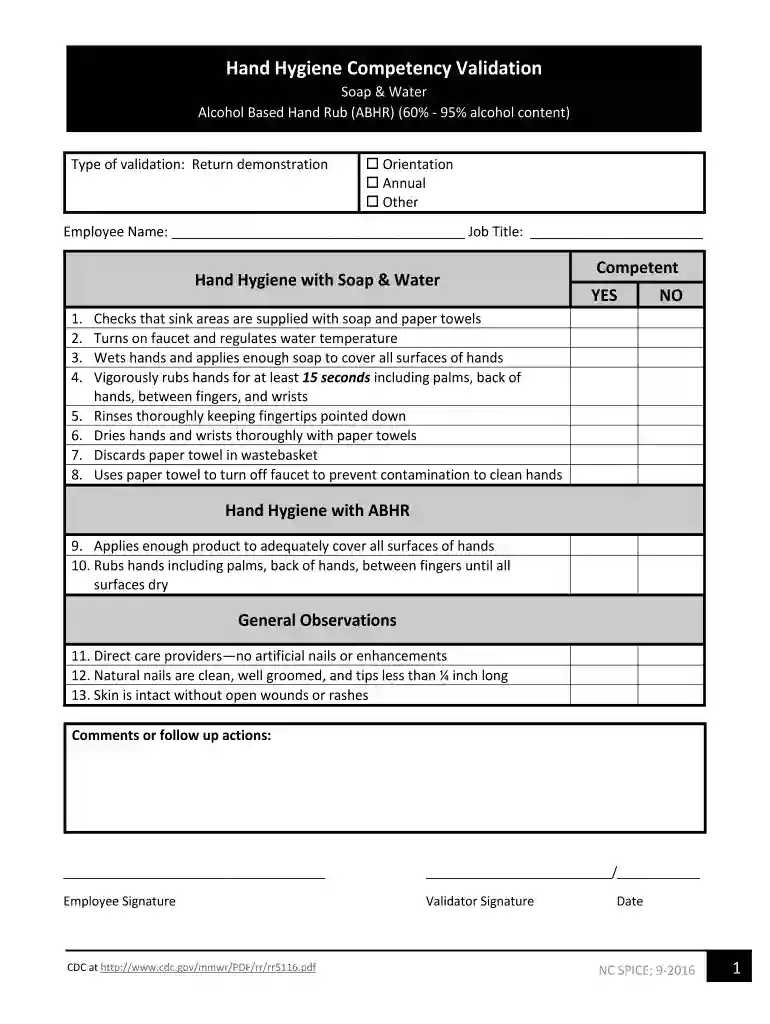
Hand Hygiene Competency 2026

Get Form
hand hygiene competency Preview on Page 1

Here's how it works

01. Edit your hand hygiene competency online
Type text, add images, blackout confidential details, add comments, highlights and more.

02. Sign it in a few clicks
Draw your signature, type it, upload its image, or use your mobile device as a signature pad.

03. Share your form with others
Send it via email, link, or fax. You can also download it, export it or print it out.

Definition and Importance of Hand Hygiene Competency

Hand hygiene competency encompasses the knowledge and practical skills necessary to perform effective hand hygiene practices, essential in preventing healthcare-associated infections. It includes understanding when to wash hands with soap and water versus using alcohol-based hand rubs (ABHR) and recognizing the significance of maintaining skin integrity and nail care.

Effective hand hygiene reduces the transmission of pathogens, playing a crucial role in patient safety and public health. The Centers for Disease Control and Prevention (CDC) emphasizes that hand hygiene is a foundational practice in infection prevention strategies across healthcare settings. Consequently, the validation of hand hygiene competency ensures that healthcare employees adhere to established hygiene standards.

Healthcare organizations implement competency evaluations not only during the onboarding process but also regularly as part of continuing education and compliance monitoring. This validation is vital for maintaining high safety standards and ensuring that staff members are up-to-date with current best practices.

Steps to Obtain Hand Hygiene Competency

Achieving hand hygiene competency requires a structured approach, involving both training and assessment. Here are the primary steps:

  1. Educational Training

    • Participants should undergo thorough training that covers the importance of hand hygiene, appropriate techniques, and the scenarios that necessitate effective handwashing practices.
    • Training can be delivered through workshops, online modules, or hands-on demonstrations to cater to various learning styles.
  2. Skills Demonstration

    • After completing the education component, employees must demonstrate their hand hygiene skills in a controlled environment. This may involve performing various techniques, such as:
      • Proper handwashing with soap and water for at least 20 seconds.
      • Effective use of alcohol-based hand rub, including the duration and amount required for optimal effectiveness.
  3. Competency Assessment Checklist

    • Use a checklist to validate the skills. This could include specific criteria such as:
      • Correct technique
      • Attention to detail (e.g., cleaning under the nails, between fingers)
      • Consistency during multiple observations
  4. Documentation

    • Once competency is assessed, proper documentation should be maintained, which may include proficiency records, training dates, and the evaluators’ signatures.
  5. Periodic Re-evaluation

    • Hand hygiene competency should not be a one-time assessment. Regular re-evaluation and refresher training should be scheduled annually or biannually to ensure continued adherence to best practices.

Key Elements of Hand Hygiene Competency

Understanding the foundational elements of hand hygiene competency is critical for successful training and validation. Key elements include:

  • Knowledge of Techniques

    • Understanding the difference between handwashing with soap and water versus using ABHR, including scenarios for each.
  • Practical Skills

    • Hands-on ability to perform effective hand hygiene techniques, demonstrating proper procedures under observation.
  • Awareness of Infection Risks

    • Recognition of how poor hand hygiene contributes to infection transmission and the role it plays in patient safety and public health.
  • Commitment to Continuous Improvement

    • Emphasizing the importance of ongoing education and practice, including staying current with guidelines and best practices from authorities like CDC and WHO.
  • Observation and Feedback Loop

    • Implementing a system where coworkers or supervisors can provide constructive feedback to foster improvement and accountability in hand hygiene practices.

Who Typically Uses Hand Hygiene Competency

Hand hygiene competency is essential for various professionals across the healthcare landscape, including:

  • Healthcare Providers

    • Doctors, nurses, and allied health professionals routinely interact with patients and thus require validated hand hygiene practices to prevent cross-contamination.
  • Support Staff

    • Housekeeping and maintenance staff play significant roles in sanitation and must understand hand hygiene's critical role in maintaining a safe healthcare environment.
  • Educators and Trainers

    • Individuals responsible for training staff must be adept in hand hygiene protocols to effectively convey the importance and methods of maintaining hygiene standards.
  • Public Health Officials

    • Those involved in public health initiatives use hand hygiene competency as a foundational topic for community education, especially during outbreaks of infectious diseases.

Legal Use and Compliance of Hand Hygiene Competency

Legal implications around hand hygiene competency are essential in guiding practices within healthcare settings. Key points include:

  • Regulatory Standards

    • The Occupational Safety and Health Administration (OSHA) and the CDC provide guidelines that establish hand hygiene practices as a regulatory requirement, particularly in healthcare environments.
  • Accountability

    • Healthcare organizations are legally obligated to ensure staff members are competent in hand hygiene. Failure to comply with these guidelines may result in legal repercussions and impact accreditation status.
  • Documentation for Compliance

    • Efficient record-keeping of training, evaluation, and re-validation is crucial not only for internal use but also for fulfilling legal obligations during audits or inspections.
  • Patient Rights

    • Patients have the right to receive care in environments where hygiene practices are prioritized. Ensuring hand hygiene competency is a fundamental aspect of patient safety and quality assurance.
  • Infection Control Policies

    • Hand hygiene competency is a component of broader infection control policies that healthcare facilities must implement to comply with local and federal health regulations.

Each of these areas emphasizes the multifaceted approach needed to ensure that hand hygiene practices are integrated into the culture of healthcare settings, ultimately supporting patient care and safety.

be ready to get more

Complete this form in 5 minutes or less

Get form

Got questions?

We have answers to the most popular questions from our customers. If you can't find an answer to your question, please contact us.
Contact us
The garbing competency includes two components: a visual observation of the hand hygiene and garbing process AND gloved fingertip sampling.
Follow these five steps every time. Wet your hands with clean, running water (warm or cold), turn off the tap, and apply soap. Lather your hands by rubbing them together with the soap. Scrub your hands for at least 20 seconds. Rinse your hands well under clean, running water.
Follow these steps: Wet your hands with clean, running water. Apply soap and lather well. Rub your hands hard for at least 20 seconds. Scrub all surfaces. This includes the backs of your hands, your wrists, between your fingers and under your fingernails. Rinse well. Dry your hands with a clean towel or air-dry them.
What are the 7 Steps of Hand Washing? Step 1: Wet Hands. Wet your hands and apply enough liquid soap to create a good lather. Step 2: Rub Palms Together. Step 3: Rub the Back of Hands. Step 4: Interlink Your Fingers. Step 5: Cup Your Fingers. Step 6: Clean the Thumbs. Step 7: Rub Palms with Your Fingers.
5 Moments for Hand Hygiene The 5 Moments infographic. Moment 1 - Before touching a patient. Moment 2 - Before a procedure. Moment 3 - After a procedure or body fluid exposure risk. Moment 4 - After touching a patient. Moment 5 - After touching a patients surroundings.

Security and compliance

At DocHub, your data security is our priority. We follow HIPAA, SOC2, GDPR, and other standards, so you can work on your documents with confidence.

Learn more
ccpa2
pci-dss
gdpr-compliance
hipaa
soc-compliance

People also ask

Ensuring doctors, nurses, and other staff have clean hands is critical to prevent the spread of illness. ing to The Joint Commission, a health care accreditation organization, direct observation of staff hand hygiene is the most effective and accurate way to measure hand hygiene compliance.

Related links