




01. Edit your form online
Type text, add images, blackout confidential details, add comments, highlights and more.

Type text, add images, blackout confidential details, add comments, highlights and more.

Draw your signature, type it, upload its image, or use your mobile device as a signature pad.

Send it via email, link, or fax. You can also download it, export it or print it out.
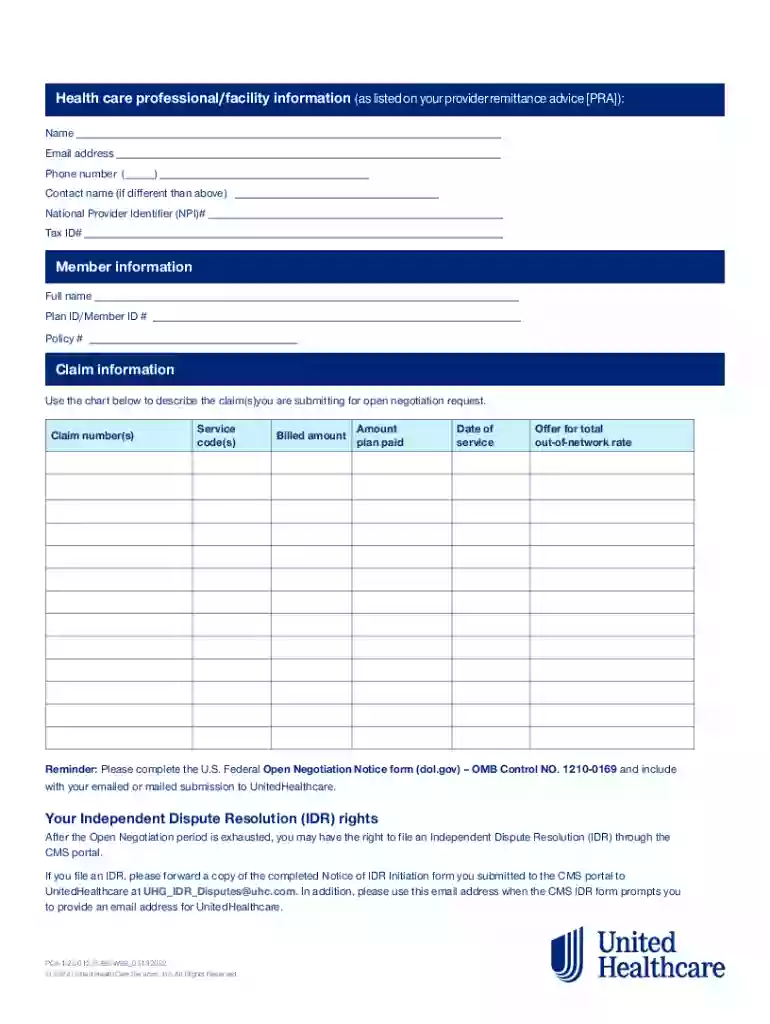
The Supplemental Open Negotiation Request Form is a crucial document designed for use by healthcare professionals and facilities dealing with UnitedHealthcare commercial plans. It serves as part of the requirements under the No Surprises Act of 2020, which addresses surprise medical billing and aims to protect patients from unexpected out-of-network charges. This form allows providers to initiate a negotiation process for disputed claims regarding the cost-sharing responsibility between insurers and out-of-network healthcare services. Understanding its purpose is essential for effective utilization and compliance with federal regulations.
Key elements of the form include sections where healthcare providers can specify the nature of the disputed claim, the reason for disagreement, and any supporting documentation that substantiates the negotiation request. The form ultimately facilitates a structured dialogue between providers and UnitedHealthcare to resolve billing disputes without needing immediate recourse to adjudication.
Healthcare providers and facilities must follow a series of steps to accurately complete and submit the Supplemental Open Negotiation Request Form. The process begins with thoroughly reviewing the claims to identify the components requiring negotiation. Providers should gather all pertinent documents, such as the initial claims, explanation of benefits, and any correspondence related to the disputed matters.
Download the Form: The form is typically available on the UnitedHealthcare Provider Portal, ensuring easy access for authorized users.
Complete Required Sections: Fill in the necessary information, focusing on detailed descriptions of the claims and supporting evidence.
Select Submission Method: Providers should choose only one submission method – either through the Provider Portal, email, or mail – adhering to the UnitedHealthcare guidelines.
Submit the Form: Ensure the form is complete and include all supplementary documentation before submission. Submit to UnitedHealthcare via the chosen method.
Track Progress: Utilize the UnitedHealthcare system or contact their support to track the status of the negotiation request.
Following these steps reduces processing time and enhances the likelihood of a successful resolution.
The Supplemental Open Negotiation Request Form plays a significant role in healthcare billing and administration by formally documenting billing disputes and providing a foundation for negotiation. For healthcare providers, the form is an indispensable tool for protecting financial interests and ensuring fair compensation for services rendered. It mitigates the risk of ongoing disputes escalating into formal Independent Dispute Resolutions (IDR), which can be more time-consuming and costly.
By using this form, healthcare facilities also demonstrate compliance with the No Surprises Act provisions, which is critical for maintaining good standing with regulators and insurers. Successfully negotiating a claim can lead to more favorable reimbursement terms and improve financial sustainability for practices, especially those operating with tight margins.
Understand the Form's Structure: Familiarize yourself with the sections of the form, including provider information, claim details, and areas for supplemental commentary.
Accurate Information Entry: Ensure that all information is current and accurate, including contact details and specifics about the disputed claim.
Document Support: Attach all necessary documentation and evidence supporting your negotiation request; this may include prior communications, billing, and medical justifications.
Review and Proofreading: Verify that the form is complete and errors are corrected to avoid delays.
Submit and Follow Up: Submit through the designated method and actively follow up with UnitedHealthcare, if necessary, to confirm receipt and progress.
The structured completion of this form ensures clarity and consistency in negotiation communications with UnitedHealthcare.
The legal framework surrounding the Supplemental Open Negotiation Request Form is rooted in the No Surprises Act, which mandates transparency and fairness in billing practices within the healthcare sector. Providers must ensure that the use of this form aligns with federal regulations and guidelines established by UnitedHealthcare.
Compliance involves maintaining accurate records of all submissions and related communications, as these may be reviewed in the event of disputes requiring legal oversight. Non-compliance or misrepresentation on the form can lead to adverse legal consequences, including the potential for claims to be rejected or penalties to be imposed under the act.
Providers are encouraged to consult legal experts or compliance officers to navigate the complex regulatory environment effectively. This ensures their negotiation submissions uphold the principles and requirements of the No Surprises Act.
The Supplemental Open Negotiation Request Form is commonly used by a variety of healthcare stakeholders, including:
These entities often require negotiation with insurers to settle billing discrepancies while avoiding the need for arbitration or legal interventions. Utilizing the form strategically supports financial stability and regulatory compliance, especially for smaller practices operating within tight budget constraints.
For businesses with a clear understanding of insurance billing standards, the Supplemental Open Negotiation Request Form can be a powerful tool for achieving equitable payment arrangements and maintaining operational efficiency.


At DocHub, your data security is our priority. We follow HIPAA, SOC2, GDPR, and other standards, so you can work on your documents with confidence.
by DSNOFS AUTHORITY The framework consists of (1) open negotiationsa required 30-business- day period to try resolving the dispute informally; (2) an IDR process.Read more
This document is about the instructions and details on the open negotiation process and Federal independent dispute resolution (IDR) process


