




01. Edit your vs113 online
Type text, add images, blackout confidential details, add comments, highlights and more.

Type text, add images, blackout confidential details, add comments, highlights and more.

Draw your signature, type it, upload its image, or use your mobile device as a signature pad.

Send ca application marriage via email, link, or fax. You can also download it, export it or print it out.
Marriage records are official government documents that serve as proof of a matrimonial union between two individuals. These records typically encompass vital details such as the names of the parties involved, the date and place of the marriage, and officiating officials. In the context of U.S. practices, marriage records become publicly available six months after the event to ensure thorough verification and authentication processes are completed. The availability after this period aids in maintaining the integrity and accuracy of the data shared with the public.
To acquire marriage records, one needs to follow specific procedures dictated by state regulations, as these protocols can differ across regions. Generally, the steps involve:
Determine Eligibility: Verify if you have a direct relationship or legal interest in obtaining the marriage record.
Identify the Responsible Office: Typically, state offices, such as the Department of Health or the County Clerk's Office, maintain these records. Check which office holds the relevant records based on the event's location.
Submit a Request Form: Complete any official forms required by the governing body, ensuring all fields are correctly filled out and legible.
Provide Necessary Documentation: Include any identification or proof of relationship if required by the state office.
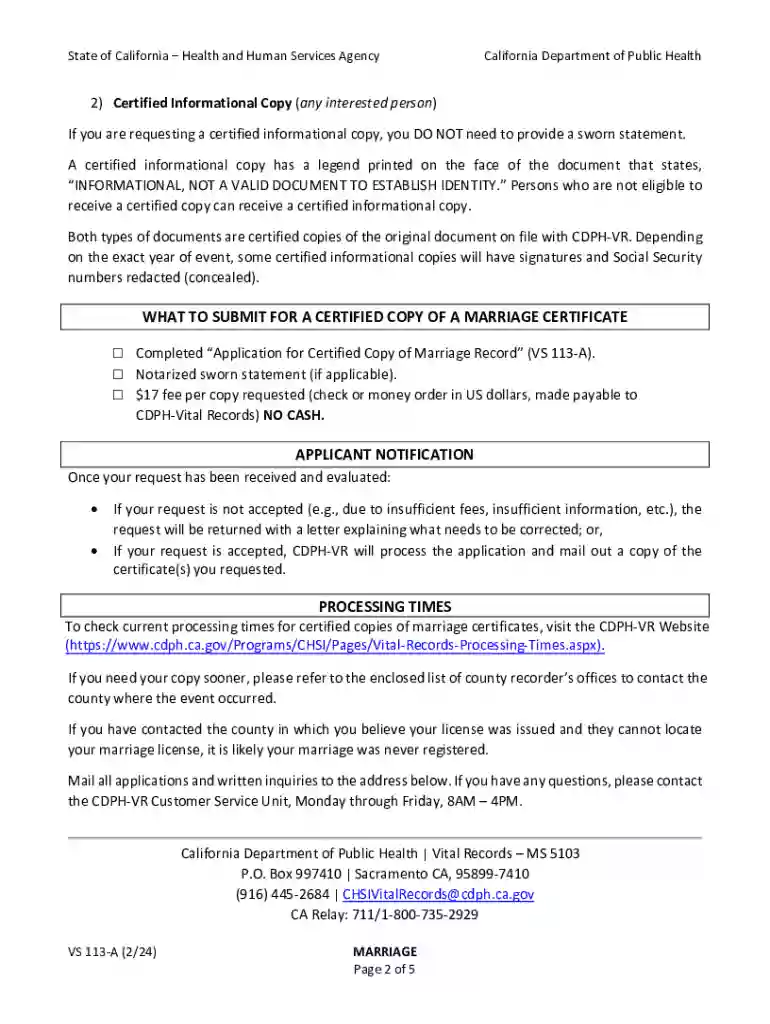
Pay Applicable Fees: Be prepared to pay a fee associated with the processing of marriage records, which varies by state and type of record requested.
Follow-Up: Keep track of processing times, typically indicated on the office’s official website or provided upon submission.
Check Processing Times: Understand that marriage records become accessible six months post-event to accommodate processing.
Complete Any Required Notarization: If necessary, certain requests demand notarized documents to verify the requester's identity and intent.
Method of Submission: Decide whether to submit the request online, by mail, or in person, in accordance with the issuing office’s preferred methods.
Track the Request Status: Once submitted, maintain communication with the office to confirm receipt and processing milestones.
Marriage records serve various legal purposes, including proving marital status for name change applications, citizenship processes, or inheritance claims. They also play an essential role in demographic surveys, genealogical research, or as evidence in legal proceedings like divorce or custody cases, where marital history may be pertinent.
Laws governing the issuance and accessibility of marriage records can vary significantly by state. For example:
California: The California Department of Public Health requires notarized sworn statements for certified copies, but confidential marriage records must be sought from the county clerks.
New York: Provides information on whether a ceremony was performed but requires a court order for more detailed information.
Understanding the specific legal stipulations in the pertinent state ensures compliance and facilitates smoother processing of requests.
Marriage records are critical in various situations. They may be used for:
Confirming Annuities or Pension Plans: Evidence of marital status may be necessary to access family benefits or settle beneficiary claims.
Historical Research: Genealogists rely on marriage records to trace lineage or document family trees.
Immigration Cases: Establishing marital relationships can support spousal visa applications and legal residency status changes.
It’s crucial to understand terminology associated with marriage records to navigate their use effectively:
A number of documents may be required depending on jurisdiction, including:
Understanding these facets ensures you are equipped with the knowledge and resources necessary to request marriage records successfully, fulfilling legal requirements and facilitating personal or business needs.
We've got more versions of the vs113 form. Select the right vs113 version from the list and start editing it straight away!
At DocHub, your data security is our priority. We follow HIPAA, SOC2, GDPR, and other standards, so you can work on your documents with confidence.
If you require a copy within the first six months after the date of event, CDPH-VR recommends that you send your request to the County Recorders Office
Vote centers are available to register new voters, update current voter records, obtain a voter registration card and to provide assistance to voters who
Apr 17, 2026 In Virginia, death, marriage and divorce data become public information 25 years after the event; birth data are public after 100 years.Read more


