







Definition and Meaning
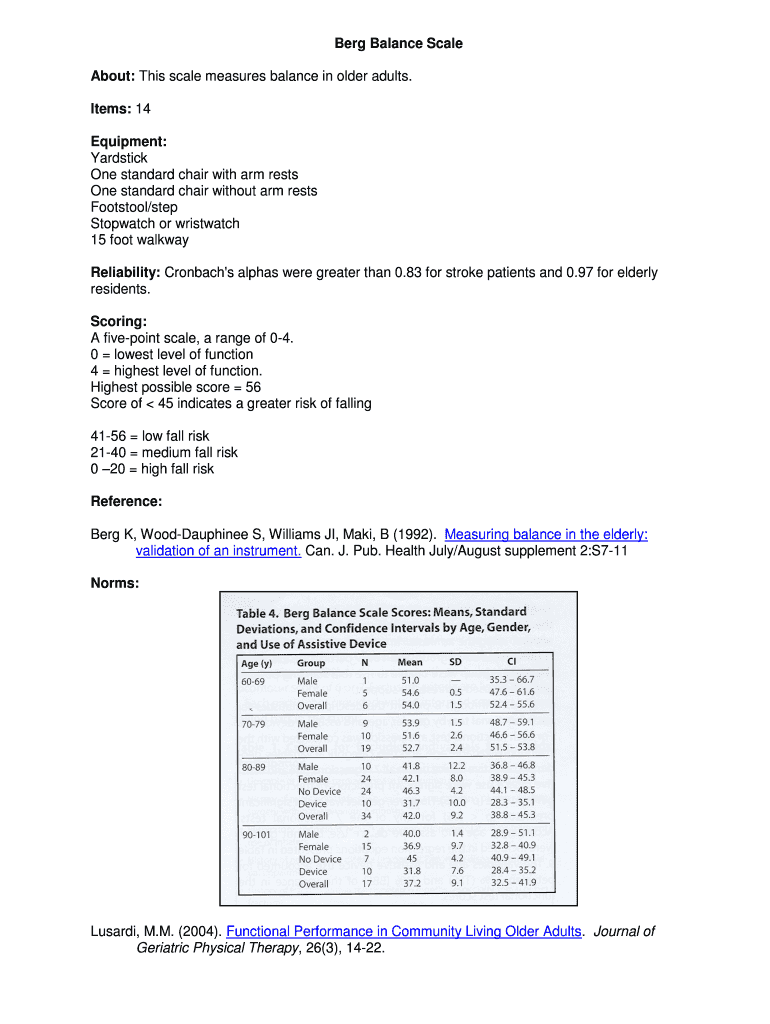
The Berg Balance Scale is a clinical tool designed to quantify balance in older adults and individuals with known balance impairments. This scale serves as an assessment tool for professionals who aim to measure the balance capabilities of their patients. It comprises a series of tasks that are each scored individually to create a comprehensive balance profile. Originating from research at Brandeis University, it has become a reliable instrument in geriatrics and neuro-rehabilitation settings.
How to Use the Berg Balance Scale
Utilizing the Berg Balance Scale involves administering a series of 14 basic balance tasks. These tasks range from simple activities like standing up from a seated position to more complex actions like retrieving an object from the floor. Each task is scored on a five-point scale, ranging from zero to four, with higher scores indicating better performance. Healthcare providers use this tool to identify balance issues and to track changes over time, making it essential for fall prevention strategies in clinical settings.
Performing Each Task
- Sitting to Standing: The patient transitions from sitting to standing without using their hands.
- Standing Unsupported: The person stands for two minutes without assistance.
- Standing with Eyes Closed: This increases the difficulty level by eliminating visual cues.
- Retrieving an Object from Floor: Testing dynamic balance, the patient picks up an item placed on the ground.
Steps to Complete the Berg Balance Scale
Accurate completion of the Berg Balance Scale requires a standard procedure:
- Set Up: Gather necessary equipment, such as a chair without armrests and a stopwatch, in a safe environment.
- Explain the Tasks: Clearly instruct the patient on each task to ensure understanding and compliance.
- Observe and Score: Carefully monitor each task, allocating scores based on performance.
- Record Results: Summarize the scores to determine the overall balance capability, interpreting the risk of falls accordingly.
Who Typically Uses the Berg Balance Scale
The primary users of the Berg Balance Scale are healthcare providers in geriatrics, neurology, and physical therapy. It is a valuable tool for:
- Physicians: To diagnose and monitor balance disorders.
- Physical Therapists: For tailoring rehabilitation programs.
- Occupational Therapists: To enhance daily living activities by improving balance.


Important Terms Related to the Berg Balance Scale
Understanding specific terminology is crucial for proper application:
- Balance: The ability to maintain the body's center of gravity within the base of support.
- Fall Risk: An increased likelihood of falling, potentially leading to injury.
- Dynamic Equilibrium: The capacity to maintain balance while in motion.
Key Elements of the Berg Balance Scale
The scale's effectiveness lies in its components, each designed to challenge different aspects of balance:
- Static and Dynamic Balance Tasks: Offer a comprehensive assessment.
- Graded Scoring System: Allows for nuanced interpretations of balance abilities.
- Equipment-Free Tasks: Ensures ease and accessibility in various settings.
Examples of Using the Berg Balance Scale
In practice, the Berg Balance Scale can be applied in various scenarios:
- Post-Stroke Rehabilitation: Monitors improvement in balance post-cerebrovascular accident.
- Elderly Fall Prevention Programs: Assists in identifying individuals at risk and tailoring interventions.
- Neurological Conditions: Helps manage balance issues in Parkinson’s disease and other disorders.
State-Specific Rules for Using the Berg Balance Scale
While the Berg Balance Scale is standardized, some states may implement additional guidelines or modifications for its use in healthcare practice. It's essential to familiarize oneself with local regulations to ensure compliance:
- California: May have specific requirements for documentation and reporting in clinical assessments.
- Florida: Could mandate supplementary training for practitioners administering the scale.
Legal Use of the Berg Balance Scale
The scale must be used ethically and within the legal scope of professional practice. Practitioners should:
- Obtain Informed Consent: Ensure patients understand the purpose and process.
- Maintain Confidentiality: Protect patient data and results.
Digital vs. Paper Version
The Berg Balance Scale can be administered using both traditional paper forms and digital platforms:
- Paper: Offers ease of use without technological requirements.
- Digital: Enhances data accuracy and storage, often integrated with electronic health records.
Software Compatibility
For those using digital health management systems, the Berg Balance Scale can often be integrated with software such as:
- Electronic Medical Records (EMR): Ensures seamless tracking of patient progress.
- Telehealth Platforms: Facilitates remote assessments when necessary.
These blocks offer a comprehensive and detailed exploration of the Berg Balance Scale, tailored to ensure relevance and utility for professionals engaged in balance assessment and intervention within the United States context.




