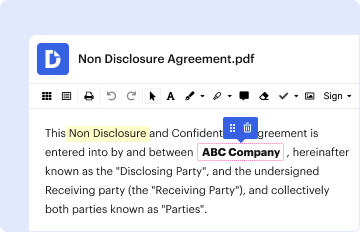
Type text, add images, blackout confidential details, add comments, highlights and more.
02. Sign it in a few clicks
Draw your signature, type it, upload its image, or use your mobile device as a signature pad.
03. Share your form with others
Send it via email, link, or fax. You can also download it, export it or print it out.
How to use or fill out In 1999, workers dying from electrocution numbered with our platform
Ease of Setup
DocHub User Ratings on G2
Ease of Use
DocHub User Ratings on G2
Click ‘Get Form’ to open it in the editor.
Begin by filling in the first section regarding the number of workers who died from electrocution in 1999. Enter your answers in the provided fields labeled a), b), c), and d).
Proceed to the next section about electrical installations and hazards. Again, input your responses into the designated fields.
Continue through each question, ensuring you select or write down your answers clearly for questions related to electrical circuits and safety measures.
Once all questions are answered, review your entries for accuracy before proceeding to sign and date the certification at the end of the form.
Finally, save your completed form and utilize our platform's features to share or print it as needed.
Start using our platform today for free to streamline your document editing and form completion!
Fill out In 1999, workers dying from electrocution numbered online It's free
In 1912, the National Safety Council estimated that 18,000 to 21,000 workers died from work-related injuries, and in 1913, the Bureau of Labor Statistics documented about 23,000 industrial deaths among a workforce of 38 million. But, things have improved dramatically since then.
How many people have died from power lines?
According to national lineman surveys and utility company data, 42 for every 100,000 lineman are killed on the job each year. This makes lineman jobs one of the most dangerous only behind loggers and manual laborers in agriculture.
Why is electricity one of the largest job site killers?
Falls from height are the leading cause of fatal injuries in construction, accounting for over half of industry fatalities. Theyre also a major cause of non-fatal injuries.
What is the #1 cause of death in the workplace?
The major causes of these deaths are (1) highway motor-vehicle incidents, including to and from work and job-related travel (34%); (2) falls (13%); (3) nonhighway industrial-vehicle incidents (11%); (4) blows (other than by vehicles or equipment) (8%); and (5) electrocutions (7%) (Table 1).
How many linemen have died on the job?
Common Electrical Hazards in the Workplace Overloaded Outlets: Overloading electrical circuits and extension cords can result in a fire. Unsafe/Non-Approved Equipment: The use of unsafe, poorly maintained or non-approved equipment can lead to electrical shorts, creating fire and/or shock hazards.
Related Searches
a common but perhaps overlooked conductor is the surface or subsurface of the ? .4. is your state covered in an osha-approved state program?
How many workers died from electrical current in 2010?
As per the Bureau of Labor Statistics, 163 workers died from injuries from contact with electric current in 2010. 76 workers died from overhead power lines in the same year. A worker was electrocuted from accidental contact with an overhead power line.
How many people died working on power lines?
Over the past decade, an average of 26 linemen lose their lives every year due to fatal work injuries. Linemen experience a non-fatal injury rate of 104.6 per 10,000 full-time workers. For every lineman fatality, there are approximately 20 non-fatal injuries.
Related links
Annual Report on Traumatic Work-Related Fatalities in Michigan
Oct 31, 2006 The number of deaths peaked in 1999 at 182 and has been on a Case 12. 32-year-old male asbestos abatement worker was electrocuted by a 120-
Cookie consent notice
This site uses cookies to enhance site navigation and personalize your experience.
By using this site you agree to our use of cookies as described in our Privacy Notice.
You can modify your selections by visiting our Cookie and Advertising Notice.