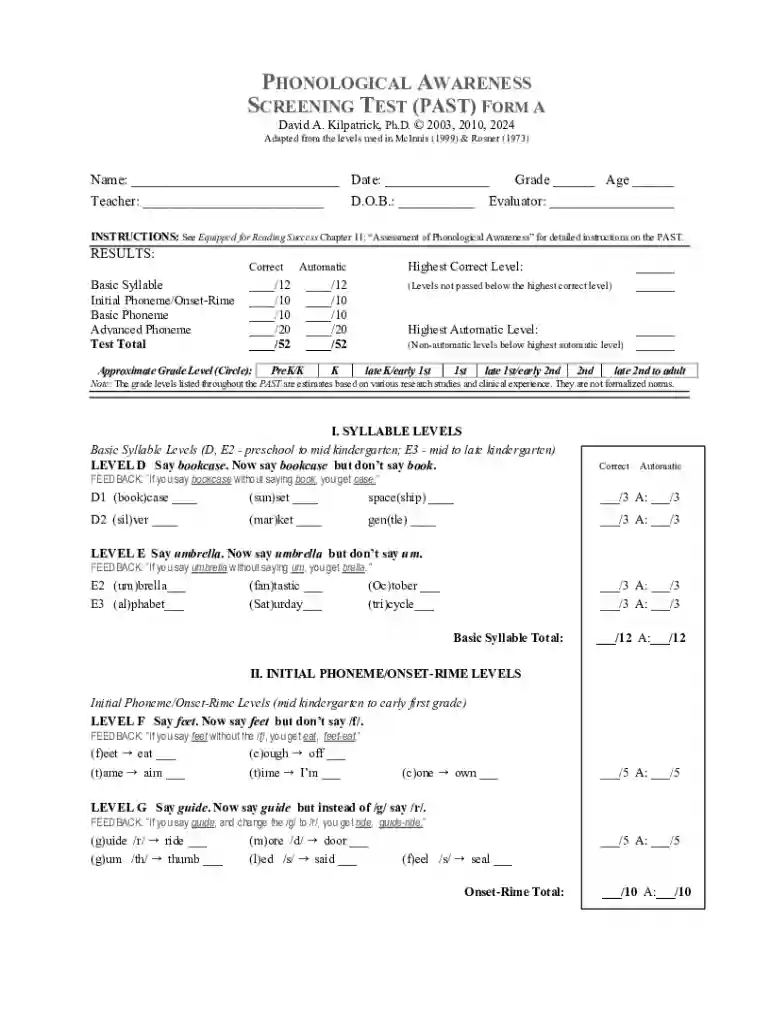
Phonological awareness screening test (past) form d 2026

Get Form
past assessment Preview on Page 1

Here's how it works

01. Edit your past assessment online
Type text, add images, blackout confidential details, add comments, highlights and more.

02. Sign it in a few clicks
Draw your signature, type it, upload its image, or use your mobile device as a signature pad.

03. Share your form with others
Send letrs past assessment via email, link, or fax. You can also download it, export it or print it out.

Overview of the Phonological Awareness Screening Test (PAST) Form D

The Phonological Awareness Screening Test (PAST) form D is a critical assessment tool developed by David A. Kilpatrick, aimed at evaluating children's phonological awareness skills. This form focuses on essential pre-reading skills necessary for literacy development, including syllable recognition, initial phoneme identification, and phoneme manipulation. By capturing students' abilities in these areas, educators can tailor instruction to meet the individual needs of each learner.

Key Components of the PAST Form D

Assessment Structure

  • Syllable Recognition: Tests the child's ability to identify and manipulate syllables.
  • Phoneme Segmentation: Evaluates skills in breaking down words into individual phonemes.
  • Onset-Rime Blending: Measures the ability to combine initial sounds with rime to form whole words.

Each section contains specific instructions for evaluators, ensuring accurate administration and scoring.

Scoring Metrics

The PAST form D incorporates several scoring metrics to help educators assess performance:

  1. Correct Responses: The number of correct answers indicates the child's level of phonological awareness.
  2. Automatic Response Rates: Measures how quickly a child can respond correctly, which is essential for identifying automaticity in phonological processing.
  3. Error Analysis: Evaluators review incorrect responses to identify specific areas of difficulty, providing insight into targeted intervention strategies.

Instructions for Administration

Required Materials

  • Testing Sheets: Ensure that the correct form is being used. Each student requires their own sheet.
  • Timer: Timing certain sections can provide insight into automaticity.
  • Scoring Guide: This guide assists in properly documenting responses and scores.

Testing Environment

  • Quiet Setting: Minimize distractions to help the child focus on the tasks.
  • Support Tools Available: Provide necessary accommodations, such as auditory support if required.

Step-by-Step Administration Process

  1. Introduce the Test: Explain the purpose of the assessment without misleading the child about its importance.
  2. Demonstrate Tasks: Use sample items to illustrate how responses should be provided.
  3. Document Responses: As the child responds, note any patterns in accuracy and timing.

Interpreting Results

Analyzing Performance

Educators should review results to derive actionable insights:

  • Normal Developmental Milestones: Compare scores against established benchmarks to identify typical or atypical development.
  • Patterns of Strengths and Weaknesses: Note specific phonological skills where the child excels or requires additional support.

Planning Instructional Strategies

Use the results to inform teaching methods and intervention plans. Strategies may include:

  • Phonemic Awareness Activities: Engage students in games and exercises that emphasize sound manipulation.
  • Targeted Interventions: Design specialized instruction focusing on areas of difficulty highlighted by the assessment.

Relevant Variants and Additional Resources

Other Forms of the PAST

  • Form A, B, C: Each variant assesses similar skills but may differ in complexity and specific tasks, making them useful for longitudinal assessments or monitoring progress over time.

Related Resources

Educators can access multiple resources for further learning and development surrounding phonological awareness, including:

  • LETRS Training Materials: Professional development options for enhancing phonological instruction.
  • PAST Assessment PDF: Available for those seeking a structured guide for administering the assessment.

By understanding the structure, administration process, and implications of the PAST form D, educators can effectively evaluate and support their students' phonological awareness development.

be ready to get more

Complete this form in 5 minutes or less

Get form

Got questions?

We have answers to the most popular questions from our customers. If you can't find an answer to your question, please contact us.
Contact us
PHONOLOGICAL AWARENESS SCREENING TEST (PAST) Kilpatrick, Ph. D. There is a history behind the title PAST. First, PAST stands for Phonological Awareness Screening Test. Second, the acronym functions to acknowledge the past work of others. This type of test originated with Rosner Simon (1971).
It suggests a students level of phonemic awareness development and potentially suggests which levels need work and which do not. Each level yields two scores, a correct score and an automatic score. For the correct score, Levels D and E are passed if all items are correct.
Formal Assessments Examples include: Phonological Awareness Screening Test (PAST): PAST is a widely used standardized test that assesses various components of phonological awareness, including rhyming, syllable segmentation, and phonemic awareness. The results can help educators develop targeted interventions.
If the combined correct score on two levels in a row is 0, 1 or 2 out of 10, discontinue the test. Consider all items in the levels beyond the discontinue level as incorrect. For example, if a student gets only two items at Level I and none at level J (thus 2/10 across the two levels), discontinue the test.
Phonological Awareness Skills Phonological awareness can be taught at each level (i.e., word, syllable, onset and rime, and phoneme) and includes skills such as counting, categorizing, rhyming, blending, segmenting, and manipulating (adding, deleting, and substituting).

Security and compliance

At DocHub, your data security is our priority. We follow HIPAA, SOC2, GDPR, and other standards, so you can work on your documents with confidence.

Learn more
ccpa2
pci-dss
gdpr-compliance
hipaa
soc-compliance

People also ask

Phonological Awareness (PPA Scale) Phonological and Print Awareness Scale. (CTOPP-2) Comprehensive Test of Phonological Processing, Second Edition. (HAPP-3) Hodson Assessment of Phonological Patterns, Third Edition. (CAAP-2) Clinical Assessment of Articulation and Phonology, Second Edition.

p a s t assessment